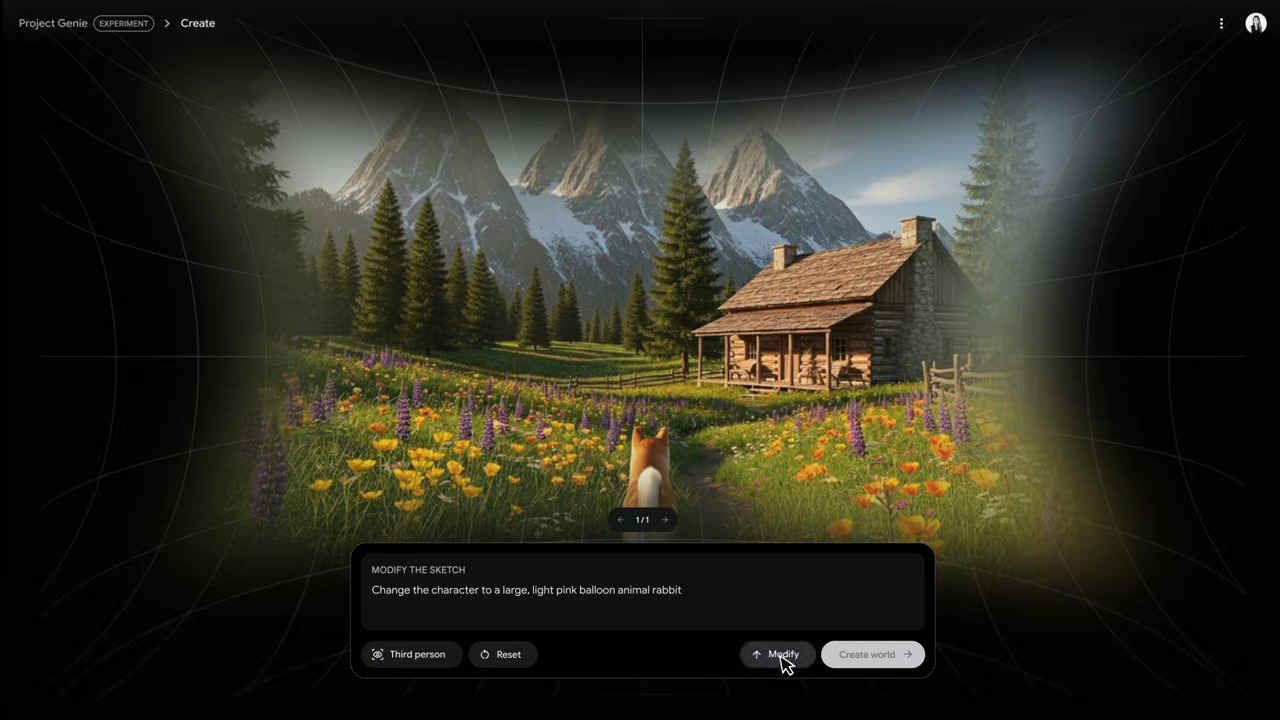
Google Project Genie
Google has spent years showing flashes of what “world models” could look like, the kind of AI that does more than generate a picture or a clip, and instead simulates an environment you can interact with. Project Genie is the latest, and most user-facing, version of that idea, a web-based prototype in Google Labs that lets people create, explore and remix interactive worlds generated by Google DeepMind’s Genie 3 model.
Using the service is just like most AI tools of the day, it’s easy to get started with but surprisingly tricky to build: type a prompt (or bring an image), hit generate, then move through a world that keeps forming in front of you. It is less “here’s a finished 3D scene”, and more “here’s a world that continues to exist as you navigate it”. Google is initially rolling out access to Google AI Ultra subscribers in the US who are 18+, with other territories due later.
In DeepMind’s framing, a world model is an AI system that predicts how an environment evolves, including how it responds to actions inside it. That matters for more than flashy demos, because the same core capability could, in theory, help AI agents learn to plan, reason, and act in complex settings, not just solve narrow games like Go or Chess. Genie 3 is positioned as part of that broader push towards systems that can handle diverse, open-ended environments.
What distinguishes Genie 3, at least on paper, is real-time generation “ahead” of the user as they move, rather than presenting a static snapshot. Google also stresses consistency, meaning the world should not collapse into incoherence the moment you turn around, even though it is being generated on the fly.
Project Genie is not being pitched as a full consumer launch, and Google is fairly explicit about its “experimental research prototype” label. Still, it is a meaningful step, because it packages a very research-y idea into something you can try, rather than just watch in a highlight reel. Google describes three key pillars to showcase how the tool works..
First is world sketching. You can prompt with text and either a generated or uploaded image to set the starting point, then decide the vibe, the character, and how you want to traverse the scene, from walking to flying to driving. Google is also tying this to Nano Banana Pro, an image generation and editing model, so you can iterate on a preview image before entering the world. Perspective controls, like first-person or third-person, are part of the setup too.
Second is world exploration. Once you are in, your movement steers generation, with the path ahead created in real time. Camera adjustments are supported as you roam.
Third is world remixing. You can take an existing world and build on top of its prompt, or browse curated worlds for inspiration. Google also says you can download videos of your worlds and your explorations, which is a subtle hint at who else this is for, not just researchers but also creators who want quick, synthetic footage.
Google is upfront about what is missing and what breaks. Generated worlds may not be true-to-life, may not always follow prompts or images closely, and physics can be unreliable. Character control can be finicky, and latency can spike. On top of that, there is a hard limit of 60 seconds per generation in the current prototype.
Those limitations indicate that Project Genie is in its early stages. A 60-second cap means it is closer to an interactive vignette than a world you can genuinely inhabit. Unreliable physics and control mean it is better for exploration and mood than for challenges that require tight interaction. Even Google notes that some Genie 3 capabilities previously discussed are not yet present in the prototype, such as “promptable events” that change the world as you explore.
Practically, Project Genie is a preview of how generative media could evolve from passive output to interactive output. Today’s text-to-video tools create something you watch. A world model creates something you can navigate, even if only briefly. If Google can extend duration, improve stability, and give creators more control, this starts to look like a new kind of content pipeline, one that sits somewhere between game engines and generative video.
Strategically, Google is also clearly positioning world models as part of its longer-term AGI ambitions, a way to train agents that can cope with messy, varied environments rather than brittle, narrow tasks. That is the subtext behind tying Genie 3 to robotics, simulation, and broader “real-world scenario” modelling, even if Project Genie itself feels like a creative playground right now.
For the moment, Project Genie is gated: Google AI Ultra subscribers in the US, 18+, with expansion promised “in due course”. If this develops the way Google hopes, the next questions will be less about whether it can generate a whimsical landscape, and more about control, safety, and workflow. To get onto the Google AI Ultra plan, you will have to fork out $249.99 per month. For now, Project Genie feels like an honest experiment: exciting in concept, clearly constrained in practice, and most revealing as a glimpse of what happens when generative AI stops producing “outputs” and starts producing places.