For decades, the path to a competitive SAT score has been gated by a simple, brutal reality: access costs money. Between private tutors charging hundreds of dollars an hour and weekend boot camps that cost as much as a used car, the college admissions race has effectively favored families with the deepest pockets.
This week, Google took a sledgehammer to that barrier. By integrating full-length, verified SAT practice exams directly into Gemini in partnership with The Princeton Review, the tech giant is attempting to democratize high-end test preparation. It is a move that transforms Gemini from a general-purpose chatbot into a specialized, free educational tool that could disrupt the billion-dollar test prep industry.
Also read: TeraWave by Blue Origin: 6 Tbps internet speed from space, Starlink in danger?
At its core, this feature is a hybrid engine. One of the persistent criticisms of Generative AI in education is “hallucination” – the tendency of AI models to confidently invent math rules or historical facts. To solve this, Google didn’t ask Gemini to write the tests.
Instead, the system relies on a licensed “ground truth.” The questions, the scoring rubrics, and the logic explanations come directly from The Princeton Review’s vetted database. Gemini acts as the delivery mechanism and the personalized tutor, but the curriculum itself is human-verified. This ensures that when a student tackles a “Heart of Algebra” problem, the difficulty curve and question phrasing perfectly mimic what they will see on the official College Board exam.
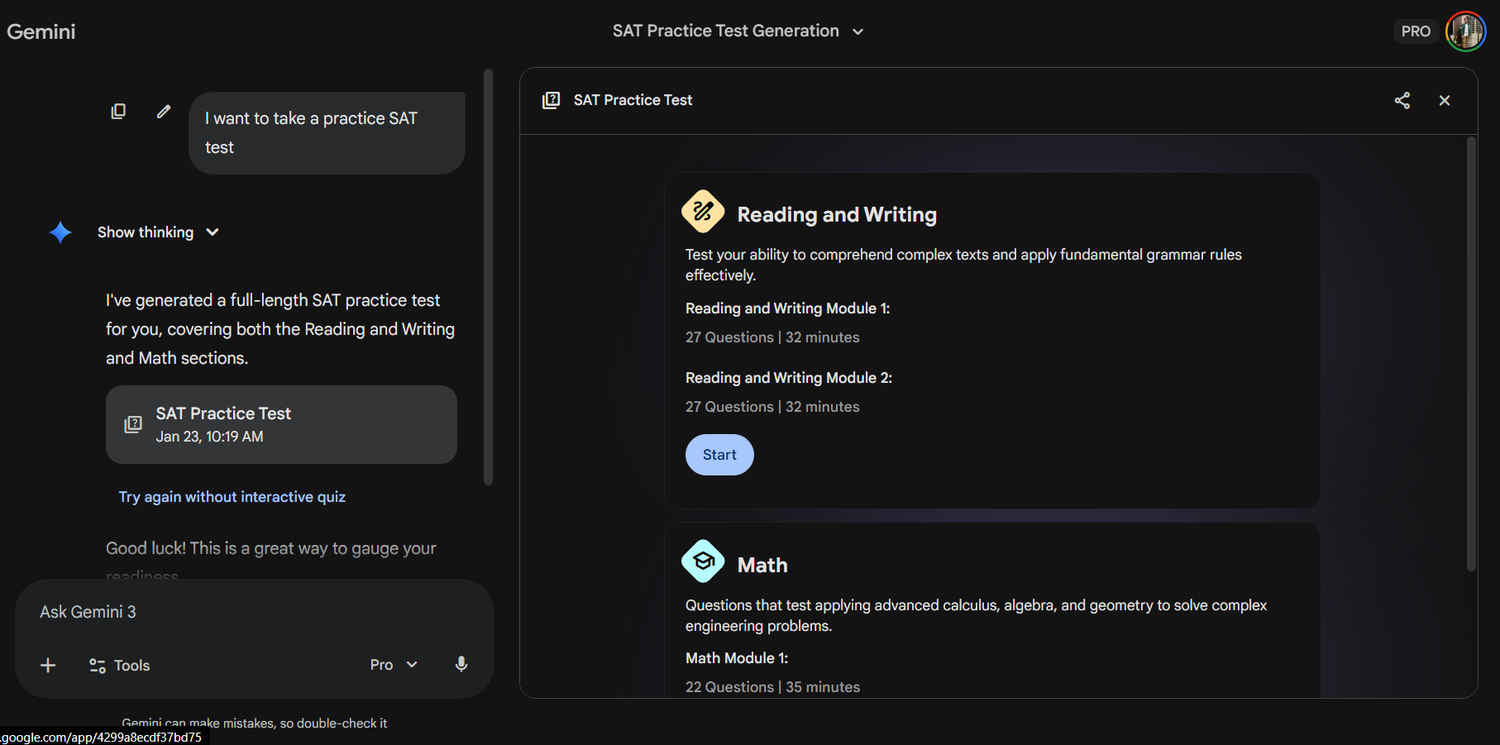
Accessing the tool is designed to be frictionless. There are no separate logins or app downloads. A student simply opens Gemini and types a natural prompt like, “I want to take a full-length SAT practice test” or “Give me a 15-minute drill on reading comprehension.”
Also read: Jensen Huang: AI will create wealth for plumbers, builders, factory workers, here’s how
The interface then shifts from a standard chat window into a focused “Exam Mode.” Distractions disappear, and a timer appears, simulating the pacing pressures of the real digital SAT. The true innovation, however, happens after the submit button is pressed. In traditional prep, a wrong answer directs a student to a static paragraph at the back of a book. If that explanation is confusing, the learning stops.
Gemini changes this dynamic by treating the answer key as a conversation. If a student misses a geometry question, Gemini provides the official Princeton Review explanation. But if the student is still confused, they can push back: “I don’t understand why we used the Pythagorean theorem here. Can you explain it simply?” Gemini then breaks down the concept, offers analogies, or walks through the logic step-by-step. It replicates the Socratic method of a human tutor, adapting the explanation until the concept clicks.
The strategy behind this launch is twofold. First, it addresses the “trust gap.” By anchoring Gemini’s capabilities to a trusted educational brand, Google is proving that its AI can be a reliable tool for serious work, not just creative writing or coding.
Second, it is an aggressive play for the next generation of users. By positioning Gemini as an indispensable, free utility for high schoolers during one of the most stressful periods of their lives, Google is ingraining its AI into their daily workflows.
But perhaps most importantly, it levels the playing field. High-quality test prep has long been a luxury good. By making it free and accessible on any device, Google isn’t just releasing a feature; it is arguing that personalized education should be a public utility, not a premium service.
Also read: xAI’s turbulent week: Open source code, a 120M euro fine, and global Grok bans