Google has officially unveiled a major upgrade to Gemini 3 Deep Think, its most sophisticated reasoning model designed to push the boundaries of intelligence in science, research, and engineering. This release marks a transition from general-purpose AI toward a specialized tool capable of navigating the nuances of advanced academia. While standard models often struggle with “messy” data or problems that lack a single clear-cut solution, Deep Think is built to thrive in these gray areas. By blending deep scientific knowledge with algorithmic rigor, Google is positioning this model as a critical collaborator for the global scientific community.
Also read: Seedance 2.0: This Chinese AI video tool is outpacing Veo 3 and Sora 2
The most striking achievement of this updated model is its unprecedented performance on the world’s most difficult academic benchmarks. Gemini 3 Deep Think has achieved gold-medal level performance in the 2025 International Math Olympiad, proving it can handle the abstract logic and creative problem-solving required at the highest levels of competitive mathematics. This expertise is not limited to numbers alone; the model also demonstrated gold-medal level results on the written sections of the 2025 International Physics and Chemistry Olympiads. These results suggest that the model has moved beyond mere pattern matching and is now capable of deep, first-principles reasoning.
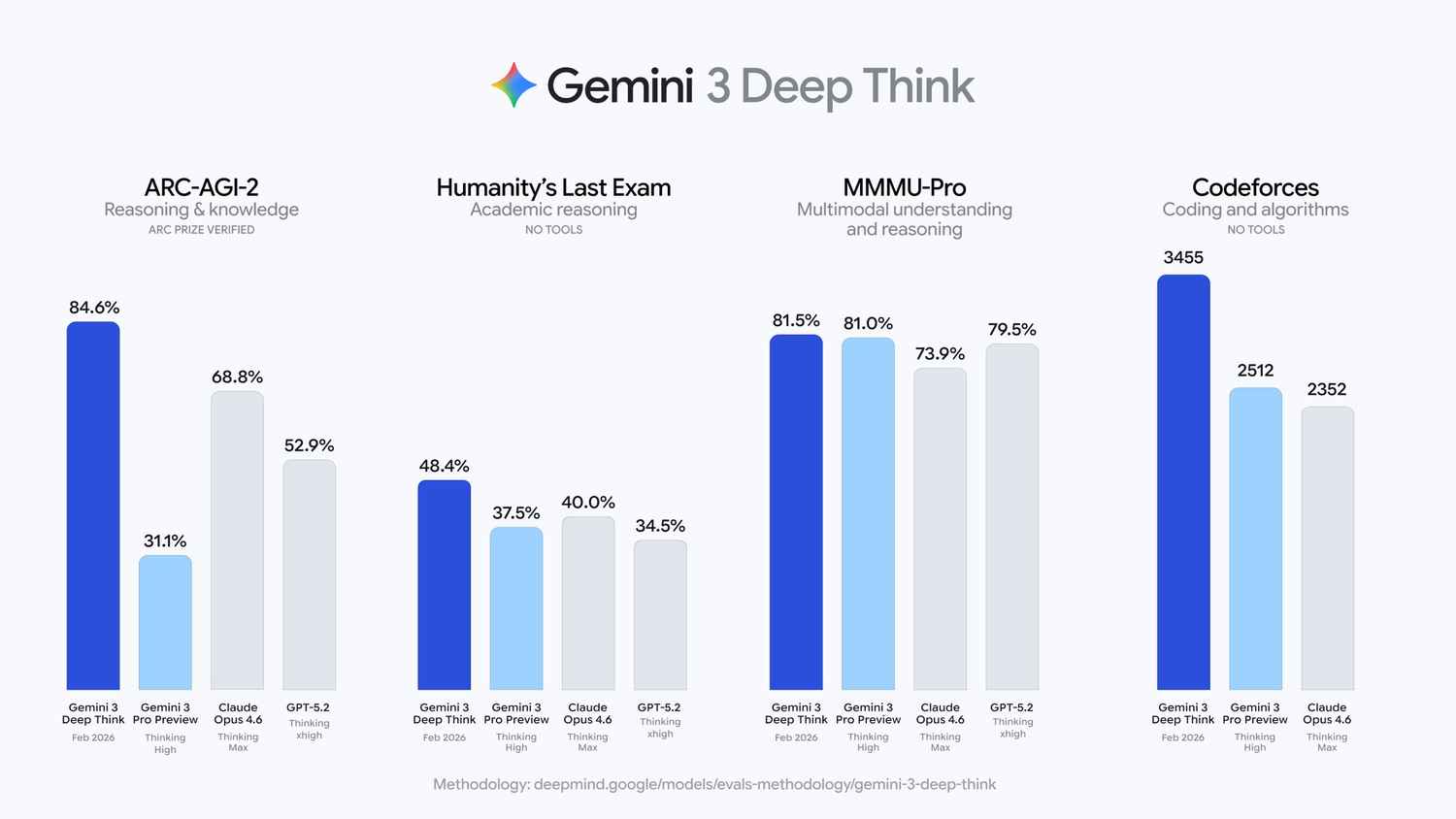
Beyond the classroom, the model is setting new industry standards for artificial general intelligence. It recorded a staggering 84.6% on the ARC-AGI-2 benchmark, a test specifically designed to measure fluid intelligence and the ability to learn new concepts on the fly. In the realm of competitive programming, it attained an Elo rating of 3455 on Codeforces, placing it among the elite tier of human coders. Perhaps most impressively, it scored 48.4% on “Humanity’s Last Exam,” a benchmark composed of questions specifically designed by experts to be nearly impossible for contemporary AI to solve without specialized tools.
Also read: Microsoft warning: AI being brainwashed to favour some brands
The true value of Gemini 3 Deep Think is already being realized in real-world research environments where human peer review often reaches its limits. At Rutgers University, a team used the model to review a highly technical mathematics paper focusing on the intersection of Einstein’s theory of gravity and quantum mechanics. In a field where training data is scarce and the logic is incredibly dense, Deep Think successfully identified a subtle logical flaw that had remained unnoticed during traditional human peer review. This ability to act as a high-level auditor for scientific literature could fundamentally change how academic research is verified and published.
Further practical success was seen at Duke University’s Wang Lab, where researchers utilized the model to optimize fabrication methods for semiconductor materials. The model successfully designed a precise recipe for growing thin films larger than 100 micrometers, a target that had previously eluded researchers using standard methodologies. By modeling physical systems through code and interpreting complex datasets, Deep Think is proving that its reasoning capabilities have tangible benefits for material science and industrial engineering.
Google is also showcasing the model’s ability to bridge the gap between abstract design and physical manufacturing. One of the most practical new features allows Deep Think to analyze a simple hand-drawn sketch and transform it into a 3D-printable object. By understanding the geometry and physical requirements of the drawing, the model generates the necessary code to create a functional file for 3D printing. This capability streamlines the prototyping process for engineers, allowing for rapid iteration from a basic concept to a physical part.
The updated Gemini 3 Deep Think is now available to Google AI Ultra subscribers within the Gemini app. To ensure this technology reaches the hands of those who can use it most effectively, Google is also launching an early access program for the Gemini API. This allows enterprises, researchers, and independent engineers to integrate these deep reasoning capabilities into their own custom applications. As AI continues to evolve, Google’s latest offering suggests that the next great frontier isn’t just about faster answers, but about more profound, verified logic that can solve the world’s most complex scientific mysteries.
Also read: Indian tech entrepreneurs more successful than returning NRIs: ORF study