Mistral is leaning into its identity as one of the strongest champions of open weight AI. With the release of Devstral 2 and the new Vibe CLI, the company is positioning itself as a serious contender in the coding assistant space, a market dominated so far by closed models and cloud locked tools. The launch marks a clear attempt to build a developer stack that is flexible, transparent, and capable of operating across entire codebases rather than isolated snippets.
Also read: Agentic AI Foundation explained: Why Linux is joining OpenAI, Anthropic for future of AI
Devstral 2 arrives in two variants. The headline model is a 123 billion parameter system built specifically for software development tasks. A smaller 24 billion parameter version offers similar behaviour with lower hardware demands, making it feasible to run locally. Both models share a major upgrade in context length, now extended to 256,000 tokens. That scale allows the model to scan long files, understand multi file structures, and maintain reasoning across large repositories.
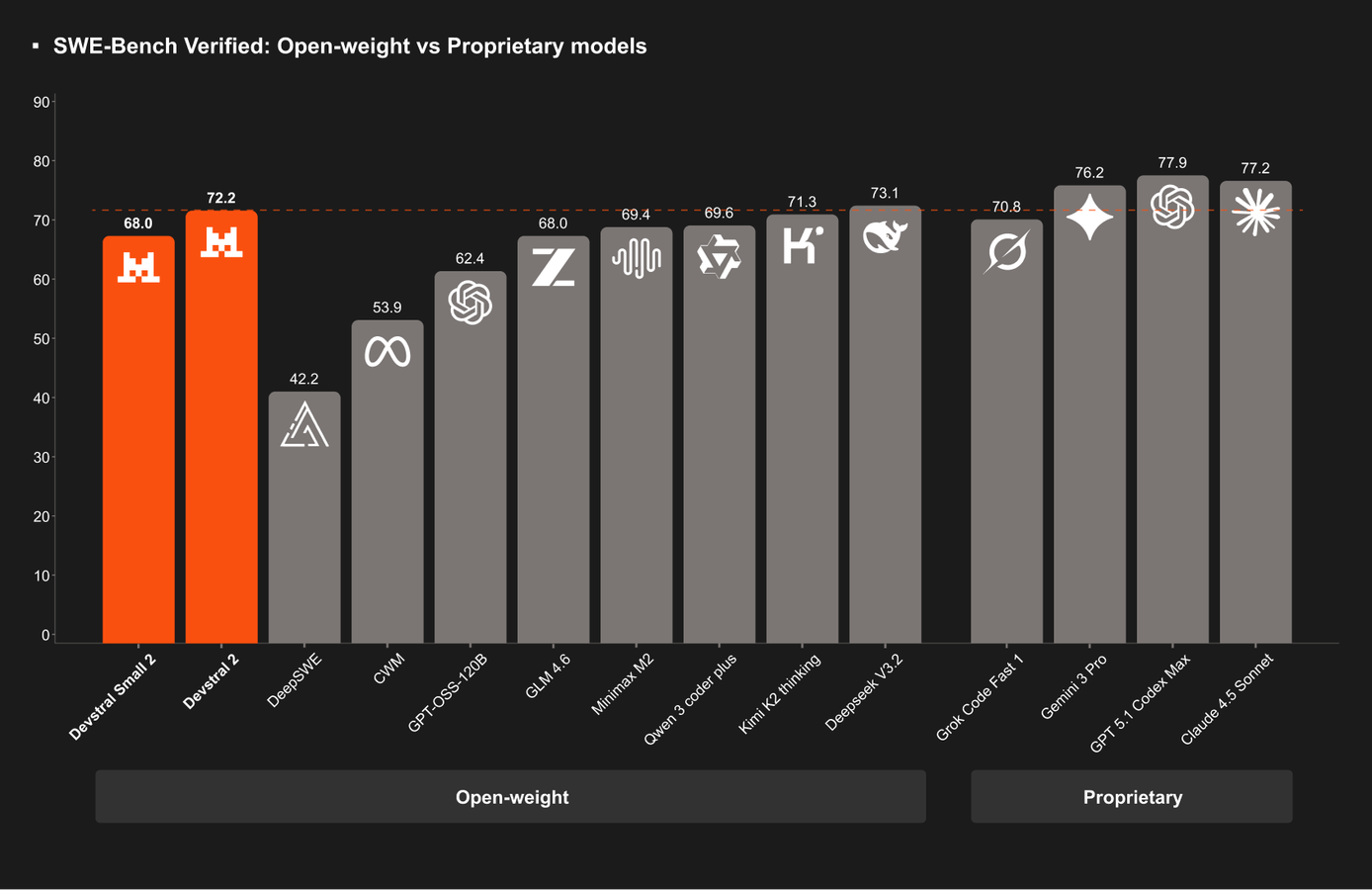
Benchmarks show significant gains. On the SWE bench Verified test, Devstral 2 reaches 72.2 percent, which places it among the most capable open weight models in coding tasks. The small model hits 68 percent, competitive enough to be practical for hobbyists and small teams who prefer offline use.
Alongside the models, Mistral introduced Vibe CLI, a command line assistant that acts on entire codebases through natural language prompts. Instead of generating standalone snippets, Vibe works by reading the folder structure, Git status, and current files, then applying changes across multiple locations when needed.
Also read: Australia bans social media for all below age 16: Tech law’s key features explained
Its tool set includes multi file refactoring, search and replace, code generation tied to existing architecture, dependency updates, and even shell commands. It is designed to run either in a terminal or inside an IDE, acting as a project aware companion that understands not just syntax but context. The approach reflects a shift from isolated code generation toward workflow automation, which aligns with how real world software projects evolve over time.
Mistral is not claiming it has surpassed every proprietary coding model, but it is making an argument built on philosophy and practicality. Devstral 2 is available under permissive licensing, with the small model allowing full commercial use. This means teams can self host, fine tune, or integrate the model without vendor restrictions. For developers who work with sensitive codebases or want reproducibility, this openness becomes a major advantage.
In user preference studies shared by the company, compact models from Mistral often matched or exceeded larger competitors on many tasks. While the top closed models still dominate in raw preference scores, Devstral aims to close the gap through efficiency, transparency, and cost friendliness.
Also read: 5 reasons why I think Canon R6 Mark III is the right upgrade for creators this year