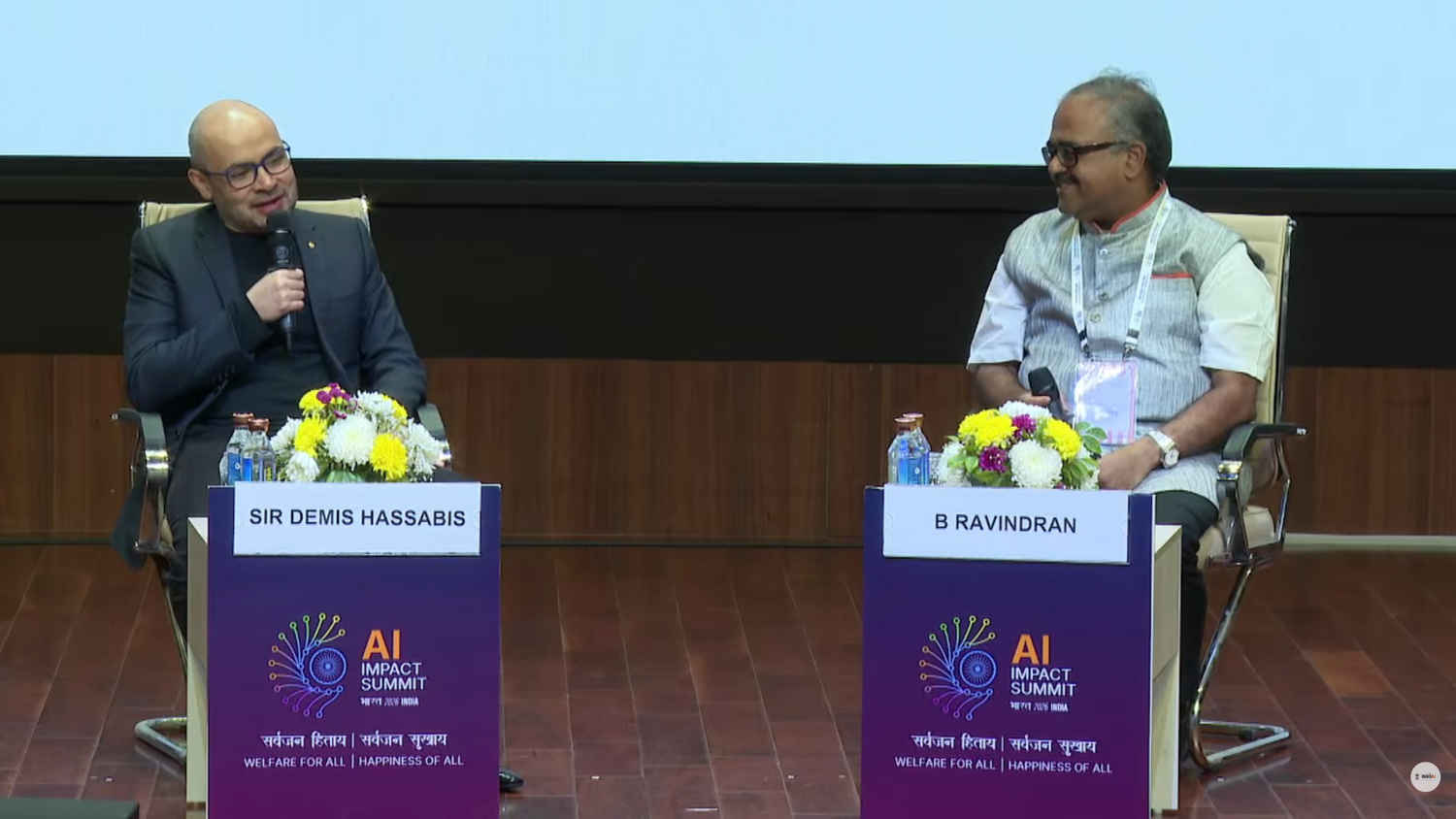
At the IndiaAI Impact Summit 2026, Demis Hassabis, the CEO and Co-founder of Google DeepMind, delivered a visionary keynote that positioned artificial intelligence not merely as a digital tool, but as the primary engine for a new epoch of human knowledge. He articulated that we are currently standing at a “threshold moment,” transitioning into what he describes as a “golden era” of scientific discovery. This era is characterized by the ability of AI to parse the immense complexity of the natural world, challenges that have historically outpaced human cognitive capacity and traditional experimental methods.
Hassabis drew a direct line from current successes to future breakthroughs, citing AlphaFold as the quintessential “proof of concept” for this movement. By solving the 50-year-old grand challenge of protein folding, AI has already fundamentally altered the landscape of biology and drug discovery. Hassabis suggested that this is just the beginning; the same principles of deep learning and reinforcement learning are now being applied to climate modeling, material science, and nuclear fusion, promising a future where AI acts as a “force multiplier” for the world’s greatest scientific minds.
Also read: Sarvam to Yotta: NVIDIA shows India AI ecosystem scale
Central to this scientific acceleration is the quest for Artificial General Intelligence (AGI). In one of the most discussed segments of his keynote, Hassabis provided a specific and ambitious timeline for this milestone. He stated that AGI – a system capable of performing any intellectual task a human can – could be achievable within the next five to eight years.
He framed AGI as the ultimate “general-purpose tool” for discovery. Unlike narrow AI, which excels at specific tasks like playing chess or folding proteins, an AGI system would possess the autonomous reasoning and cross-disciplinary synthesis required to navigate the most intricate mysteries of physics and chemistry. Hassabis emphasized that achieving AGI isn’t just a technical trophy; it is a moral and scientific necessity to address global “polycrisis” issues, such as sustainable energy and pandemic preparedness, which require a level of complexity management that current human systems struggle to maintain.
Despite the rapid progress, Hassabis was candid about the hurdles that remain. He identified continual learning as the critical “missing piece” in the current AI architecture. Most modern large language models and AI systems are “frozen” after their initial training phase; they rely on static datasets and do not naturally learn from new information or real-world experiences once deployed.
Also read: Equinix India is democratising AI through infrastructure at the India AI Impact Summit 2026
The “next frontier,” according to the DeepMind chief, involves developing systems that learn in real-time. By mastering this form of live, adaptive intelligence, AI will move beyond being a sophisticated database of the past and become a dynamic partner that evolves alongside the scientific experiments it assists. This transition toward systems that learn from “real-world experience” will be the catalyst that finally pushes AI from a predictive tool into the realm of true general intelligence.
Hassabis concluded by highlighting the unique position of India in this global shift. He noted that the success of modern AI is built upon reinforcement learning – a process where agents learn through trial, error, and feedback. With its vast data resources and a massive, technically literate youth population, India is ideally suited to lead this “reinforcement learning revolution.”
He urged the nation’s researchers and developers to focus on applying these technologies to local and global challenges, asserting that the “IndiaAI” initiative could serve as a global model for how a nation can leverage AI to bypass traditional development hurdles and leapfrog into a high-tech, science-led future.
Also read: India AI Impact Summit 2026: Trust in the age of synthetic media is turning into infrastructure