Every now and then, a product comes along that isn’t just good on paper, but it feels thoughtfully constructed with precise intent. Like someone actually spent time thinking about how it would live in your bag, on your desk, in the frantic pace of your everyday digital life. The Cuzor Pulse 70W GaN charger is one of those rare objects.
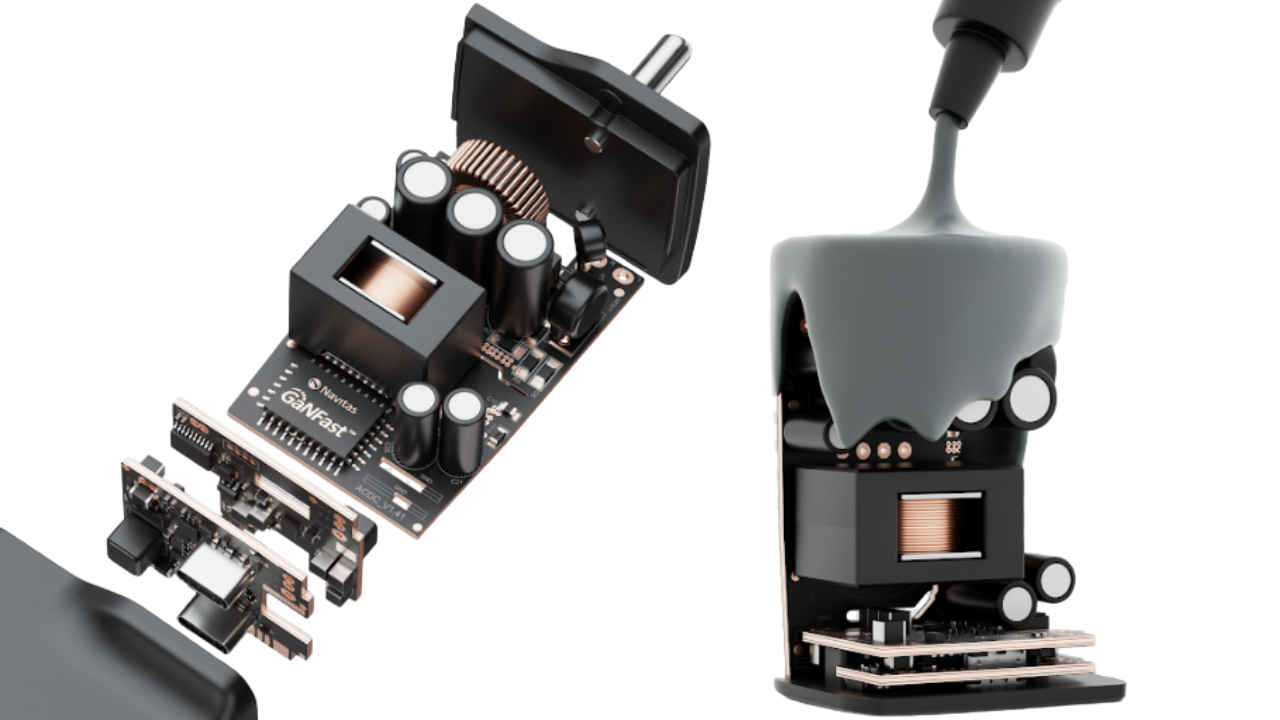
Where the product makers can’t stop talking about how thoughtful and innovative it’s built from the ground up – cutting open a unit to showcase how it’s built from the inside in forensic detail. Where a single grain in your hand is indicative of the overall quality of the rice crop, in a matter of speaking. I got that impression of the wizards at Cuzor Labs when I got a chance to interact with them while putting the Cuzor Pulse 70W GaN charger through its paces.
Small enough to vanish in a laptop sleeve, but designed with the conviction of a full-fledged power supply unit, this Made-in-India charger doesn’t just aim to compete with global names – it wants to outclass them. And in many ways, it does.
“So what we did was instead of going for the regular 65W, we’ve upped it up to 70W,” explains Ashwani Rajan, Co-founder and Head of Product and Engineering at Cuzor Labs. This is because modern laptops – especially the MacBook Air and MacBook Pro – demand a peak draw closer to 70W, even if they often settle below that. According to Ashwani, “Even if you give it a 140 watt charger, it takes 70 watts – the MacBook 13-inch as well as the 15-inch.” This is something I did verify with an M2 MacBook Air.
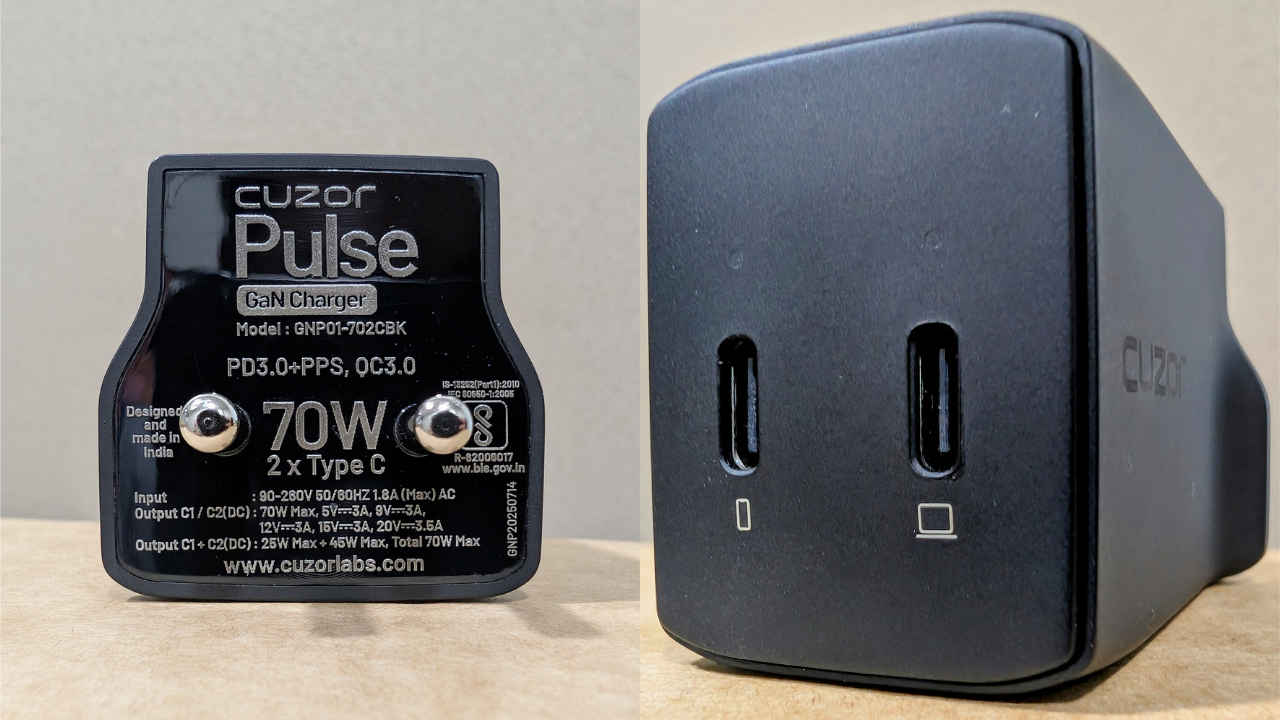
Under the hood, the Cuzor Pulse 70W GaN is every bit the spec-sheet warrior its name suggests. It supports a broad input voltage range from 90V to 265V AC, making it travel-ready across geographies, and delivers a maximum output of 70 watts through its dual USB-C ports – marked C1 and C2. When using a single port, either one can push the full 70W. Plug in two devices, and it smartly splits the load – 45W from C1 (ideal for laptops) and 25W from C2 (perfect for phones or smaller devices). It supports major fast-charging protocols including PD 3.0, PPS (3.3–20V), QC 3.0, and QC 2.0, ensuring compatibility with a wide range of devices.
With a power density of 11.97 watts per cubic inch, it outpaces most competitors in this size class, including Apple’s own 70W charger (which sits around 9.45 watts) and comparable to Nothing’s CMF unit, albeit with more wattage headroom, claims Ashwani Rajan. Efficiency of the Cuzor Pulse 70W GaN charger is rated at 91% when tested at 230V, 50Hz under full load – a mark of well-tuned internal architecture.
It helps that the Cuzor Pulse 70W GaN charger’s made with a polycarbonate body – instead of cheaper ABS plastic – making it more durable, more heat-resistant, and reassuringly sturdy. “We’ve done all these tests in reputed labs,” Ashwani told me. “10,000 socket insertions, 10,000 USB insertions, drop tests… This charger is built to last four to five years easily.” To top it off, they’re offering a two-year doorstep replacement warranty. This sort of confidence in one’s product isn’t something many companies dare to promise.
This is because the Cuzor Pulse is fortified with all the right protections, according to Ashwani: 2.5KV surge protection, overcurrent protection, short circuit protection – the works. And it’s not just talk. Cuzor has been running three units at full load in a 40dB ambient for six months straight. Zero failures so far, claims Rajan.
Also read: StuffCool Odin: 15W Qi2 wireless powerbank for iPhone
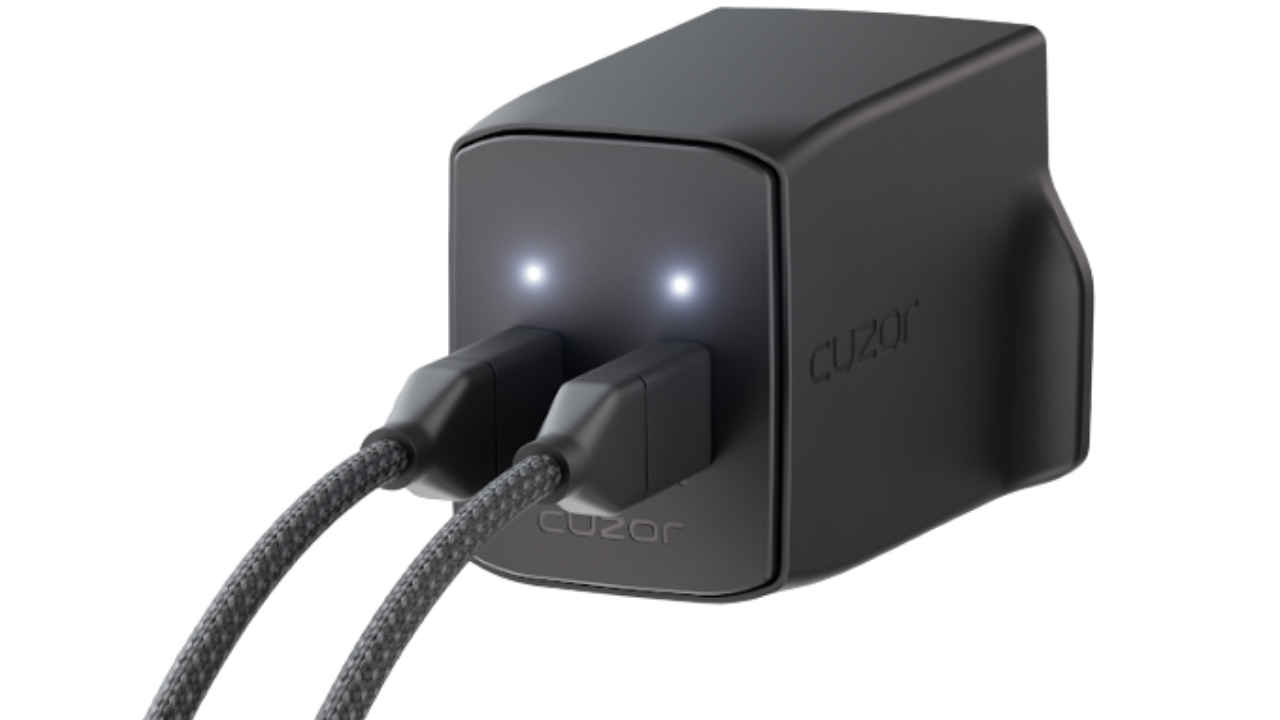
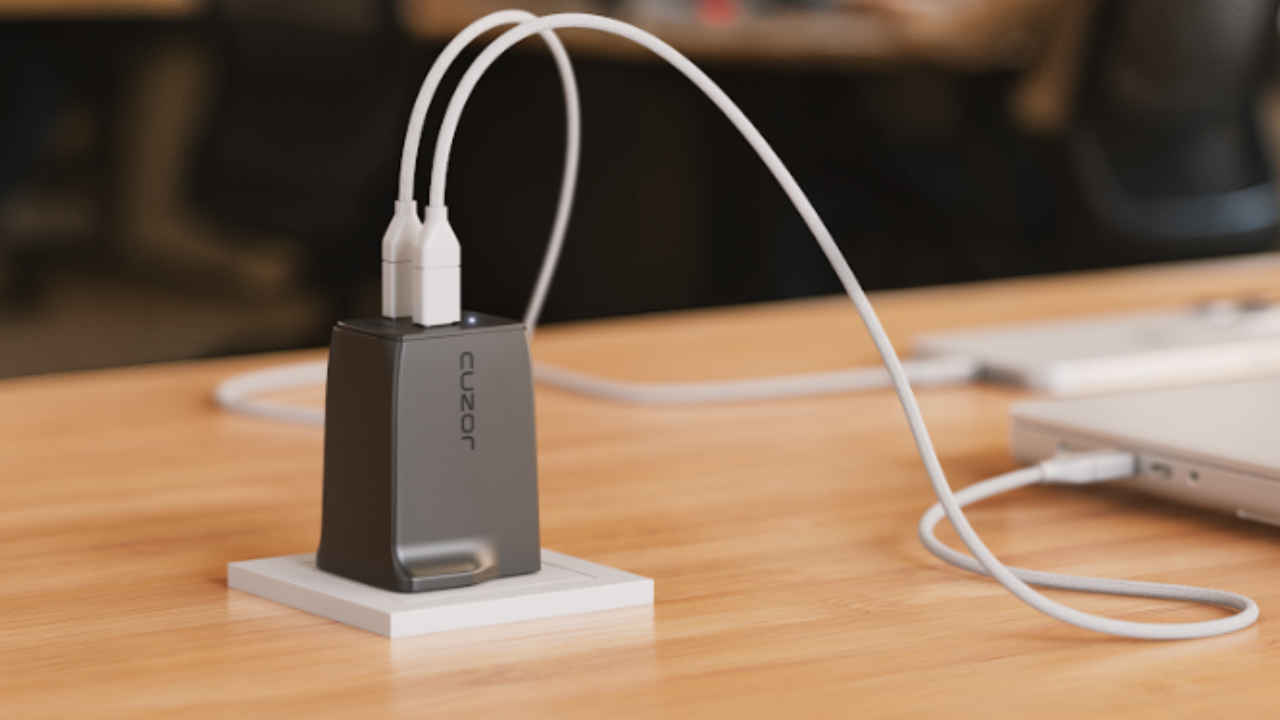
Beyond all its tech specs, it’s genuinely one of the smallest GaN chargers I’ve seen which can also charge a laptop, which doesn’t feel like a heavy brick in your backpack while on the go. It’s super sleek, thoughtfully designed with blinking LED lights that intelligently portray the charging process by the rate at which they blink. As soon as you plug in a device for charging, the Cuzor Pulse’s LED indicator lights up and throbs (fade in, fade out) to indicate how fast the device is charging. And once the device is almost 100% charged, the throb effect stabilizes to a more steady, uninterrupted glow.
“As soon as you look at the charger, you’ll be able to understand that it’s almost like 99% done and you can plug it off, and this is another feature we introduced because we had the freedom to design and didn’t want users to constantly keep swiping up their phone screen to see the charging level,” Ashwani explained. And this feature works as advertised, well enough to give people who suffer from charge anxiety to stop fidgety movements and relax.
I tested the Cuzor Pulse across a variety of devices – iPhones, power banks, laptops – and the results were encouragingly consistent.
If you’re looking for real-world proof of engineering finesse, both ports of the Cuzor Pulse adapt intelligently depending on the load, heat, and power demand – with stable voltage delivery throughout. Even when running at full 70W load, the voltage drop is negligible.
Also there’s something refreshing about a product that proudly wears its “Made in India” tag without excuses. Cuzor Labs isn’t an ODM importer or a rebrander – they’re building these units from scratch, with custom designs and tight control over every component and thermal spec.
For instance, they’re using Navitas GaNSense IC for industry-class performance. “Navitas is one of the pioneers in GaN charging tech. Just like we use Qualcomm in phones, Navitas is a similar company for GaN,” according to Ashwani Rajan. In a world of cookie-cutter chargers, the Pulse stands out for its purpose-built identity. It’s a homegrown piece of tech that’s globally competent – and in some ways, even globally ahead.
Cuzor Pulse 70W GaN isn’t trying to be the smallest or the cheapest charger on the market – I truly think it’s trying to be the most thoughtful, not just in its design but also under the hood where it matters most. And for the most part, it succeeds in that endeavour. Whether you’re a MacBook-toting nomad or a minimalist backpacker looking to cut charger clutter, this compact powerhouse (selling for ₹2,499 on Amazon.in) makes a strong case. It’s fast, smart, and built to last – with a clean design, clever LED language, and engineering that clearly had humans in mind. And really, what more do you want from a charger?
Also read: Also read: StuffCool Giga 65W: A 20000 mAh powerbank your gadgets deserve