When ChatGPT first arrived towards the end of 2022, it felt like a seismic shift in tech. Then came GPT-3, 3.5, 4o, and so many others that I’ve honestly lost count – due to sheer confusion! With each of these ChatGPT releases, OpenAI promised smarter interactions, better context handling, and improved AI-assisted coding chops – and for the most part it delivered on these promises, albeit with some hallucination baked in.
But OpenAI’s latest release, ChatGPT 4.1, isn’t just iterative improvement. It’s the kind of step-change that makes everything before it look incremental at best – which takes on Claude 3.7 Sonnet and Google’s Gemini 2.0 and above with more firepower.
Also read: Open AI Strawberry o1: 5 ways it’s better than ChatGPT 4o
Let’s unpack exactly what makes ChatGPT-4.1 such a big deal:
Remember the excitement when GPT-4o broke the 128,000-token barrier, promising richer, more cohesive interactions? GPT-4.1 just laughed that off and raised the stakes by eightfold — handling a jaw-dropping one million tokens of context. To put this in perspective, that’s enough capacity to analyze an entire epic fantasy series, a detailed legal case archive, or a complex, sprawling software project — without losing track of key details.
For professionals like developers (which is what GPT-4.1’s aimed at right now), lawyers, or financial analysts who routinely wrestle with heaps of documents, GPT-4.1’s vast context window is transformative. Imagine feeding it a full legal corpus or an intricate code repository and getting coherent, accurate insights without chopping your data into bite-sized prompts. Basically, GPT-4.1 remembers more, understands deeper, and delivers conversational responses that’s more context-aware than ever before — diminishing the gap between human nuance and machine understanding by a good deal.
Previous iterations like GPT-4o and Anthropic’s Claude 3.7 Sonnet already showed impressive coding abilities, assisting in bug fixes, patch writing, and even generating boilerplate code. But GPT-4.1 shifts from a helpful assistant to something closer to a full-stack coding partner, claims OpenAI in their official blog post.
According to the latest SWE-bench Verified scores, GPT-4.1 hits an impressive 54.6%, nearly 27 points higher than GPT-4.5 and over 20 points above GPT-4o. Practical translation of these benchmarks mean far fewer bugs, much more precise code patches, and smoother integrations. All of which’s music to any programmer’s ears. Moreover, GPT-4.1 nails frontend code — human evaluators favoured its generated interfaces over previous models about 80% of the time.
Also read: OpenAI o3 model: How good is ChatGPT’s next AI version?
For devs, this means less time debugging and more focus on strategic innovation. And its API performance? Slicker and more economical, generating minimal necessary diffs rather than rewriting whole codebases. That’s smarter, cheaper, and faster — exactly the kind of trifecta that genuinely advances software development.
Anyone who’s struggled with ambiguous or vaguely formatted outputs from earlier models (yes, even you, GPT-4o) will appreciate GPT-4.1’s newly sharpened instruction-following capabilities, according to OpenAI. Benchmarks like Scale’s MultiChallenge confirm it: a robust 10.5 percentage point boost compared to GPT-4o.
Also read: Sam Altman’s ChatGPT openly challenges DeepSeek, Llama: Open source AI war begins
Give GPT-4.1 a complex instruction — whether formatting a business report in XML or YAML, or following a precise multi-step workflow — and it executes with minimal ambiguity. This improved adherence means clearer outputs, better consistency across long conversations, and fewer “but that’s not what I asked for” moments. It also means enhanced interactions with autonomous agents, delivering smoother, more intuitive conversations across sectors from education to enterprise support.
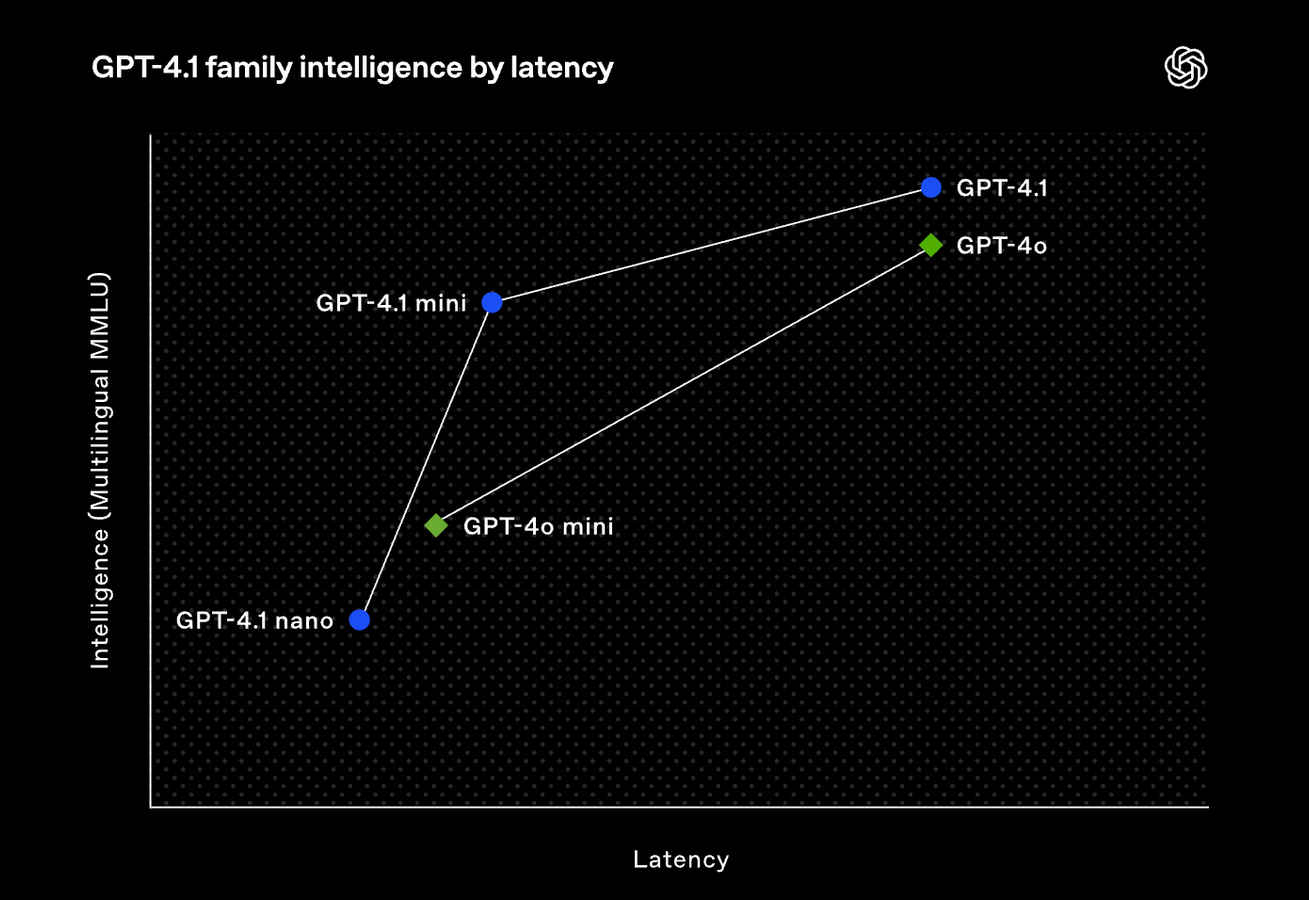
When it comes to interacting with ChatGPT, who wouldn’t want it to be speedier in its responses, right? In that regard, GPT-4.1 introduces ‘nano’ and ‘mini’ variants alongside the standard model, dramatically reducing latency and cost. Its lightweight siblings particularly excel at tasks demanding rapid-fire responses, such as real-time coding assistants or live-chat support bots.
Also read: OpenAI’s PhD-research AI agent for $20000 a month: Future of work or AI hype?
Reduced latency means interactions feel instantaneous — whether it’s seamless autocomplete in coding editors or responsive, human-like chats. And because the models use fewer tokens and lower computing resources, deploying GPT-4.1 at scale becomes economically viable, even for budget-conscious enterprises.
Basically, GPT-4.1 doesn’t just do more – it does it faster and cheaper, maintaining seamless user experiences even under demanding workloads. In the ever-accelerating AI arms race, efficiency might just be GPT-4.1’s secret weapon.
When Anthropic’s Claude 3.7 Sonnet debuted, it introduced agentic capabilities aimed at automating complex workflows. GPT-4.1 doubles down on this concept, turning the promise of autonomous agents into an everyday reality.
Also read: Claude 3.7 Sonnet: Anthropic’s new AI model explained
Its expansive context window, paired with precise instruction-following, makes GPT-4.1 uniquely suited for building truly autonomous AI agents or assistants. Legal assistants can parse multiple contracts simultaneously, flagging inconsistencies autonomously. Customer support bots manage long interactions seamlessly, offering context-rich, personalized responses without continuous human oversight.
Better yet, GPT-4.1 is easily fine-tuned, allowing developers to mold the AI for specific industries or use cases — making it more relevant, accurate, and valuable to end-users. Whether it’s detailed data extraction, sophisticated customer support, or even autonomous coding workflows, GPT-4.1 is purpose-built to drive smarter, more independent solutions.
From everything OpenAI has suggested so far, ChatGPT-4.1 seems to be more than an iterative upgrade — it feels like a platform-defining shift. From unparalleled context handling to revolutionary coding skills, precise instruction-following, blazing efficiency, and truly autonomous agent capabilities, GPT-4.1 is OpenAI’s most significant release yet.
Also read: Elon Musk vs Sam Altman: AI breakup that refuses to end