The AI that decrypts history
For centuries, the ancient world has whispered to us through cracked marble, weathered tablets, and incomplete inscriptions, fragments of messages once meant to last forever. Now, Google DeepMind’s new artificial intelligence model, Aeneas, is offering scholars a powerful new tool to listen more closely. Designed to read, contextualize, and even complete damaged Latin texts, Aeneas doesn’t just decipher ancient history, it helps restore it.
Named after the legendary Trojan hero whose story gave Rome its mythic origins, Aeneas is an AI model trained to analyze inscriptions from the Roman Empire. These inscriptions, once carved into stone, metal, and clay across the vast expanse of Roman territory, contain valuable records of everyday life, military activity, religion, and governance. Yet many arrive to us fragmented, weathered by time or damaged by human hands. Aeneas steps into this gap, applying modern AI techniques to ancient mysteries.
Also read: Beyond Azure, OpenAI embraces Google Cloud: AI frenemies forever?
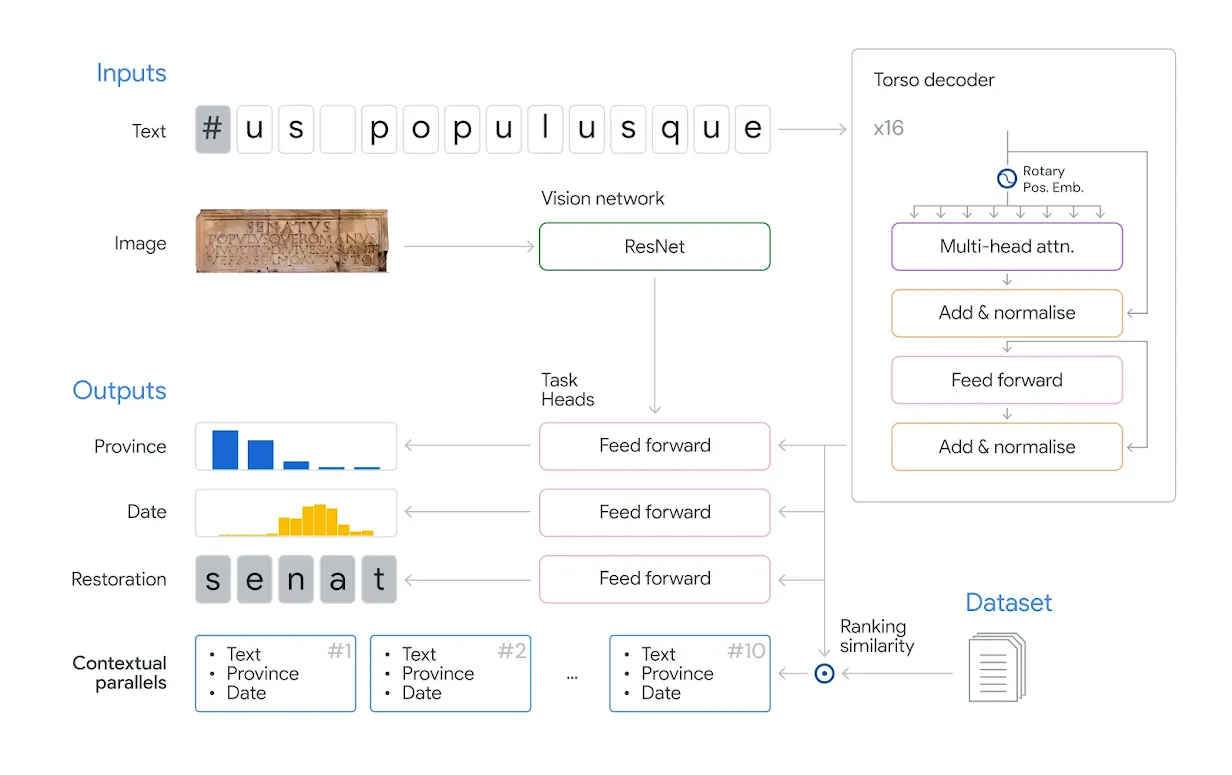
Aeneas is a multimodal transformer model developed by Google DeepMind in collaboration with classical historians and epigraphers from leading institutions, including the Universities of Oxford, Warwick, Nottingham, and Athens University of Economics and Business. What sets it apart is its ability to process both the textual and visual characteristics of inscriptions, interpreting content from partial text and accompanying images like scans or rubbings.
Trained on over 200,000 Latin inscriptions from the open-access EDCS (Epigraphik-Datenbank Clauss-Slaby) database, the model has three primary capabilities: gap-filling, dating, and geographic attribution.
When fed an incomplete or damaged inscription, Aeneas can suggest plausible completions by drawing on linguistic patterns and historical context. It can date inscriptions to within roughly 13 years and predict their place of origin from among 62 Roman provinces – a feat that previously required weeks or months of expert analysis.
Also read: OpenAI, Google, Anthropic researchers warn about AI ‘thoughts’: Urgent need explained
Perhaps most impressively, Aeneas performs at a level competitive with human experts. In controlled evaluations, the model achieved benchmark-setting accuracy across all three tasks, especially when provided with both text and image inputs. These abilities open the door to revisiting countless inscriptions that had been considered too fragmented to interpret.
Rather than replacing scholars, Aeneas is designed to enhance historical interpretation. Google DeepMind tested the model with a group of 23 professional epigraphers, each asked to analyze real inscriptions, some familiar while others not, using both their expertise and Aeneas’s predictions.
The result? In over 90% of cases, the historians said Aeneas either improved their understanding, increased their confidence, or offered new context they hadn’t considered. From high-profile imperial texts to obscure regional graffiti, the model helped reveal subtleties that could have otherwise gone unnoticed, like previously unseen linguistic trends, cross-regional links, and evolving naming conventions.
One powerful example involved an inscription so damaged that its origin had remained unclear. Aeneas was able to triangulate its likely location in Roman Britain and suggest a date range that matched recent archaeological findings. Another time, it spotted stylistic features that tied a religious dedication in North Africa to a political decree from Gaul, helping reestablish a long-forgotten administrative link.
For students and scholars alike, Aeneas lowers the barrier to entry. Google has made the model, training data, and an interactive online tool called “Predicting the Past” openly available. This democratizes access to advanced inscription analysis, whether you’re a professional academic or a curious learner tracing your roots in ancient Rome.
As the model’s creators note, Aeneas isn’t meant to provide final answers – it offers plausible, interpretable suggestions, much like a colleague might. The hope is that AI can accelerate the pace of discovery, allowing historians to focus their efforts on deeper contextual analysis and broader historical questions.
With Aeneas, the ancient world grows a little less silent. Lost voices, chipped away over centuries, begin to speak again, not perfectly, but clearly enough to be heard. And for historians trying to piece together our shared past, that’s a monumental step forward.
Also read: The Era of Effortless Vision: Google Veo and the Death of Boundaries