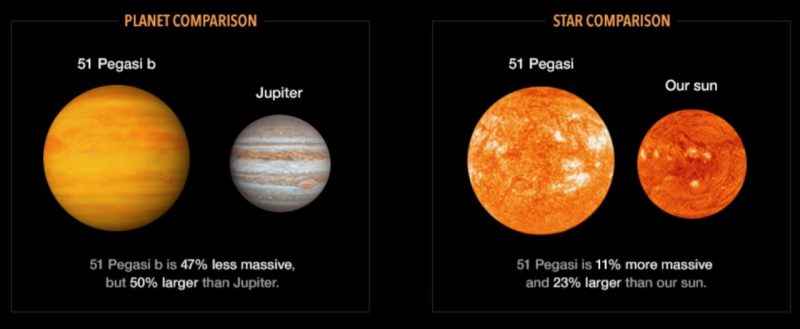
Thirty years ago, on a crisp October day in 1995, two Swiss astronomers changed the course of cosmic history. Michel Mayor and Didier Queloz, working at the University of Geneva, announced the discovery of 51 Pegasi b – the first planet found orbiting a Sun-like star beyond our solar system. It was a startling revelation: not only did it confirm that other worlds existed, but it also shattered long-held assumptions about how planets formed.
51 Pegasi b was no Earth-like paradise. It was a “hot Jupiter” – a massive gas giant orbiting so close to its star that a year lasted just 4.2 days. To astronomers of the 1990s, this made no sense. According to classical models, gas giants should form far from their stars, like Jupiter and Saturn in our own solar system. Yet here was a planet that defied the rules, forcing scientists to rethink everything they thought they knew about planetary systems.
That single discovery sparked what became known as the exoplanet revolution. In the three decades since, astronomers have detected more than 5,600 confirmed exoplanets, with thousands more awaiting verification. The search has evolved from identifying odd giants to finding Earth-like worlds, small, rocky planets orbiting within the “habitable zone,” where liquid water could exist. The dream that began in Geneva’s observatory has grown into one of humanity’s greatest scientific quests: to discover if life exists elsewhere in the universe.
Also read: Potential biosignature on Mars: What the NASA Perseverance Rover’s latest discovery really means
The first detection relied on a subtle “stellar wobble.” As a planet orbits its star, its gravity tugs the star ever so slightly, shifting the star’s light spectrum back and forth. Mayor and Queloz used the ELODIE spectrograph to measure these minuscule variations in starlight, just a few meters per second, revealing the invisible presence of a planet.
Since then, the technology has advanced at an astonishing pace. Instruments like HARPS and ESPRESSO, built by European teams including NCCR PlanetS in Switzerland, can now measure stellar motions with a precision of just 10 centimeters per second. At the same time, space telescopes like Kepler and TESS have revolutionized planet hunting through the transit method, detecting the tiny dip in brightness that occurs when a planet crosses in front of its star.
Also read: From balloons to satellites: Why Esrange is the world’s most flexible space center
Together, these methods have unveiled an extraordinary cosmic diversity. There are lava worlds and ice giants, super-Earths and mini-Neptunes, rogue planets drifting through interstellar space, and even systems with multiple suns. Each new discovery chips away at the illusion that our solar system is unique.
The search for another Earth has become both a scientific and philosophical journey. Astronomers now estimate that there may be billions of Earth-sized planets in our galaxy alone. Some, like Kepler-452 b and Proxima Centauri b, orbit within their stars’ habitable zones and could, in theory, support liquid water. Yet the challenge lies in confirming whether these worlds truly resemble our own or if they’re merely rocky husks scorched or frozen by their stars.
Future missions such as PLATO, LUVOIR, and Ariel aim to peer deeper into exoplanet atmospheres, searching for signs of life: oxygen, methane, water vapor. With instruments capable of detecting these faint chemical fingerprints, humanity may soon answer the most profound question of all – are we alone?
But even if that answer remains elusive, the journey itself has transformed our understanding of existence. Every new planet discovered reminds us that Earth is not the center of anything; it’s just one of countless worlds orbiting countless suns.
In 2025, as the University of Geneva celebrates the 30th anniversary of 51 Pegasi b’s discovery, Switzerland remains at the heart of the exoplanet enterprise. The NCCR PlanetS consortium continues to build instruments and train scientists who are pushing detection limits even further. Meanwhile, AI and machine learning are helping astronomers sift through the flood of telescope data, spotting subtle patterns that human eyes might miss.
From a single “wobble” on a graph to thousands of confirmed worlds, the exoplanet revolution has redefined what it means to be human. It has replaced cosmic loneliness with possibility, turning the night sky into a map of potential homes.
Thirty years after 51 Pegasi b, the universe feels both larger and more intimate than ever before – a place filled not with emptiness, but with endless worlds waiting to be known.
Also read: 5 crazy facts about Chile’s Vera Rubin telescope: It has world’s largest digital camera