Now the Rs 1,09,999 question: is the Galaxy Z Flip 7 worth the price? It isn’t a radical reinvention, but I think it is the most refined clamshell anyone has made so far. The larger cover screen that has its own pros and cons, improved main display, sturdier yet elegant design, and seamless Galaxy AI features finally make it feel like more than just a style statement. The new Exynos chip handles daily tasks well, though it’s not made for hardcore gaming. The cameras deliver solid results in daylight and portrait shots, but fall short of flagship-grade, especially in low light and zoom. Battery life could have been better but during my usage, it didn’t feel like an ‘issue’ issue.
Samsung Galaxy Z Flip 7 Review: Foldable phones are not rare anymore, but they still manage to stand out, and Samsung knows this. With the Flip 7, Samsung has made just enough changes to keep things interesting, some smart and some questionable. There is a new chip (it has its own story), a better and brighter display, and a few AI tricks. However, at its core, it still feels like the Flip you have seen before, until you grab it and start using it. So, is this the year the Galaxy Z Flip 7 becomes more than just a vibe? Can you finally trust it as your main phone and not just a conversation starter? I’ve been using the Flip 7 for a while now, and here’s everything that worked for me… and what didn’t.
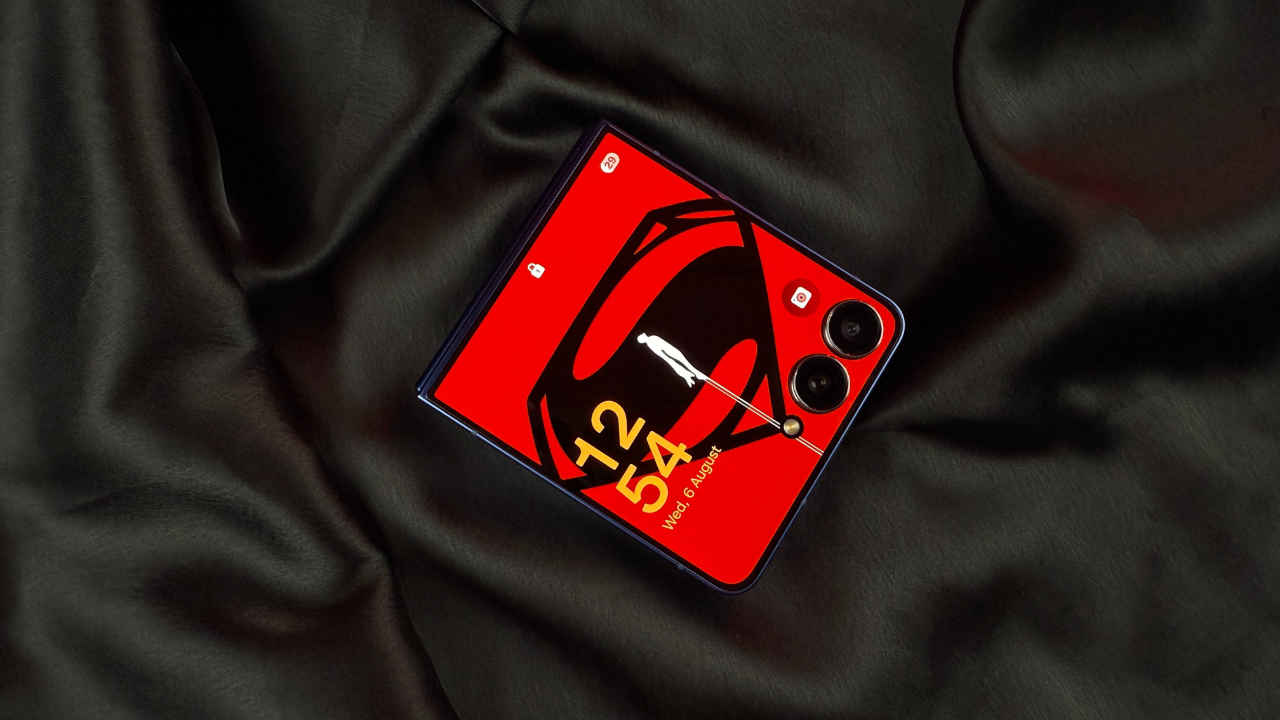
At first glance, the Samsung Galaxy Z Flip 7 might look like its predecessor, but hold on. The first change that you would notice now is that the cover display goes end-to-end. Unlike the previous Galaxy Z Flip 6, where the display stopped right around the cameras, this display incorporates the cameras too. The cover display or FlexWindow has been increased to 4.1 inches, from the previous 3.4 inches. You can honestly use that for some cool wallpaper tricks, as I saw fellow tech journalists do on Instagram.
Moving on, it retains the same sleek folding design, the same compact clamshell aesthetic, aluminium frames and yes, that nostalgic flip action that still never gets old.
But look closer, and the refinements become apparent. The phone now has a slightly slimmer hinge and thinner bezels around the main display. It weighs less, just 188g, and it effectively feels so if you have used its predecessor. When unfolded, the phone is just 6.55mm thick and folded, which makes it the thinnest clamshell foldable in India. As far as the form factor is concerned, Samsung has really made this device quite comfortable to carry around. Be it small pockets, hands, or bags, it can fit anywhere.
The phone also feels more sturdy, and the hinge is pretty solid. But how we used to open old clamshell foldable phones with one hand, it is still not possible with this one. This is something that I personally want on these foldable phones because many times you’re in a situation where you can’t use both your hands.
What was once a concern has now become normal. We have also tested the Motorola Razr 60 Ultra (review), Flip 7’s direct competitor, and one thing I really like about these clamshells is that they unfold completely and remain flat. But the new objective is to fix hinge gaps now. When folded, the Galaxy Z Flip 7 has no hinge gap; it closes completely. Whereas, the Razr 60 Ultra does leave that awkward gap when folded.
Looks are nice, form factor is the best, but what about durability? Even though Samsung has improved the IP rating this year, I think it should be better. With foldable phones, devices that are really delicate, you need the best protection. On the Samsung Galaxy Z Flip 7, you get an IP48 rating, which means it’s protected against solid objects larger than 1mm (like small tools or wires), but dust is the real concern for its hinge.
Yes, but drop and impact protection is actually decent. You get Gorilla Glass Victus 2 on both the front and back, which is one of the best in the game. That reminds me, the Galaxy Z Flip 7 does not come with an anti-reflective screen like its Galaxy S series cousins. It would be nice to have that on foldables, too.
It comes in four colours – Blue Shadow (the one I have tested), Jetblack, Coralred, and Mint. The blue colour that I am using looks really nice and slick. If you are using this phone out in public, it will surely turn some heads. Basically, the overall in-hand feel of this phone is so premium that a lot of times, randomly, I felt good just to hold this phone.
As I mentioned earlier, the cover display has been increased to 4.1 inches this year. Even the bezels are barely visible this time around. It is an AMOLED display with up to 120Hz refresh rate and a claimed peak brightness of 2600 nits. On our tests, the display reached a maximum brightness of 2380 nits, which is still pretty good. This display is sharp, smooth, and vibrant. But, how OneUI 8 makes this display charming with all those animations and interfaces, the same way it makes this display less usable also.
Even after 6 generations, you still can’t fully access all of the apps on Samsung’s clamshell foldables’ cover display. There are still only widgets you get to use on this display, and the camera. But, there is a third-party way. You can use the Good Lock app to enable certain apps, but that’s also limited. Whereas, the Razr 60 Ultra gives you so much access that you can even run benchmarks on its outer display. Now, before you think, ‘who would want to do all of that on cover displays,’ maybe I would. Remember that ‘using the phone with one hand problem?’ More accessibility on the outer display can fix that.
Now, here’s what you can do with this 4.1-inch display. With Galaxy AI built in, you can now reply to messages, use apps like YouTube, Maps, and Messages, and even customise the cover screen with widgets, live wallpapers, and AI-generated wallpapers. Is it enough to do most tasks without unfolding the phone? Almost. It’s perfect for quick replies, skipping songs, checking notifications, and even taking selfies using the rear cameras.
When unfolded, you get a 6.9-inch main display, an improvement over the 6.7-inch display from last year. Again, it’s a FHD+ LTPO AMOLED panel with 120Hz refresh rate, HDR 10+ support, and a claimed peak brightness of 2600 nits. On our tests, the phone reached a max brightness of 2610 nits, so clearly no issues on the brightness front.
The crease has also been reduced this year. It is not easily noticeable, and it really won’t hinder your phone’s use. It’s not completely gone, obviously, but it is a lot less noticeable this time.
Visually, it is a premium Samsung display on a flagship Samsung phone. I don’t think I really have to make a case here. The display is visually beautiful, fluid, the blacks and whites are on point, and with this size, you will really enjoy watching content on it.
According to our Calman tests, colour accuracy was excellent. With coverage reaching 99.4% of the DCI-P3 colour gamut, ensuring rich, true-to-life visuals for HDR content. The panel also recorded a low Delta E average of under 1.2, indicating superb calibration out of the box. In simple language, this panel is fantastic for content consumption, content creation, editing, or even scrolling through social media.
I would like to bring back the point that I had previously mentioned: When you unfold the Z Flip 7, you are not getting an awkwardly tall main display (even though it is tall), and I love that.
In a surprising move, Samsung has used its in-house Exynos 2500 chip this year, instead of a Snapdragon chip like last year. It comes in two storage variants:
Now to test its raw power, we ran some benchmarks. On AnTuTu, the Galaxy Z Flip 7 scored over 1.6 million points. If we compare it to the Razr 60 Ultra, the numbers are not really strong. But in Geekbench, Samsung does manage to give Motorola a good fight.
Now, when you’re buying a clamshell foldable phone, you don’t really buy it for gaming or hardcore performance. You buy it more for the style and flexibility that it provides, right? Maybe Samsung knows this because the Exynos 2500 is not an octa-core processor. It’s a 10-core processor, and the most powerful core is clocked at just 3.3GHz.
On the other hand, the Razr 60 Ultra’s Snapdragon 8 Gen Elite chip has its slowest core clocked at 3.53GHz.So yeah, it seems even Samsung doesn’t want you to push this phone too hard; it just wants to give you a stylish, reliable everyday experience. And in those spaces, I think the phone delivers efficiently. Be it daily tasks, calling, social media, or multitasking, the phone handles it all pretty well.
Now, even if you want to perform hardcore tasks such as intense gaming, the chipset is capable of that. But given its thin form factor, the phone does start heating up for a while. This has also reflected in our 15-minute stress test. As you can see, in just 15 minutes of heavy load, the graph has turned from green to orange. So, competitive gaming or heavy usage is not its forte.
After its elegant design, OneUI 8 is another feature that makes it shine. It runs on One UI 8 based on Android 16, with Samsung’s Galaxy AI suite deeply integrated into both the cover and inner displays. It is one of the first phones to drop with Android 16.
You get features like:
I have been a fan of One UI 8, and the experience has been positive with the Galaxy Z Flip 7, too. And if you are big on AI, this is one of those phones that has AI well integrated into them, the use is seamless, and AI gets most of your fixes right, unlike other phones.
One more feature that I genuinely loved is DeX Mode. It is a feature that transforms a Samsung phone or tablet into a desktop-like experience by connecting it to an external display like a monitor or TV, along with accessories like a keyboard and mouse. So, basically, this right here is a compact smartphone cum the smallest CPU. Really nice!
Another advantage that Samsung has over Motorola’s Razr 60 Ultra, or in fact any other phone in the segment, is that you get up to 7 years of software and security updates on this phone. And to be honest, Samsung’s rollouts are consistent and on time.
This year, the camera feels a little left out. While every parameter has seen a good upgrade on the Galaxy Z Flip 7, the camera didn’t get any. You get a dual camera set up with the Galaxy Z Flip 7, which consists of a 50-megapixel primary lens and a 12-megapixel ultrawide lens. On the main display, you get a 10-megapixel selfie shooter too.
On most days, under good lighting conditions, the Z Flip 7 delivers good pictures. The pictures are colourful, on the natural side, and not too overly saturated. They are sharp as well. But they lack that flagship finesse which you would expect while paying over a lakh for a smartphone.
Even in low light conditions, the phone tries to manage the light well; there isn’t too much brightness, and the shots look natural. However, there is a bit of noise in the pictures, and that’s when the details take a hit.
Now, since the Z Flip 7 lacks a dedicated telephoto sensor, the zoomed shots don’t quite hit the mark. In daylight, you can still manage some decent zoomed shots, but the details take a hit. And in low light conditions, the shots look pretty pixelated.
But portrait mode does the work. On portrait shots, you get a soft and nice bokeh, the skin tone is on point, the edge detection is also decent, and the details remain intact.
The Galaxy Z Flip 7 also levelled up my selfie game by not using its selfie camera. Since you can use the main camera to click selfies too, you get good quality selfies with natural skin tones. It does take a while to adjust your eyes to the camera on the cover display, but that’s more of a me problem.
The battery is now 4,300mAh, a slight bump from last year’s 4,000mAh. And the charging supports are the same:
Even though Samsung has slightly increased the battery capacity, I think it could have been better. On a single charge, this phone can last a full day, but that too, on moderate use. Heavy users, especially those who game, shoot videos, or use GPS for long durations, will still need to reach for the charger by evening.
Furthermore, the standby battery also leaves room for improvement. I have been using Motorola Razr 60 Ultra and Galaxy Z Flip 7 side to side, and most days I woke up on Samsung dead but Motorola up and running with only 2-3% consumption overnight.
So, if you compare Galaxy Z Flip’s battery consumption with last year, it is a subtle improvement, but if you compare it with other phones on the market, there is room for improvement.
The Samsung Galaxy Z Flip 7 is not a radical reinvention, but I think it is the most refined clamshell foldable phone anyone has made so far, and that matters. You get a larger, end-to-end cover display that’s genuinely useful (though still a bit restricted), a sleeker and lighter design with no hinge gap, and a stunning main display that’s a treat for both content consumption and creation.
Performance-wise, the new Exynos 2500 holds up well for everyday use, but this clearly is not a phone made for gamers or heavy-duty users. The camera gets the job done in good lighting, especially portraits, but falls short of flagship standards in low light or zoom. Battery life is slightly better than last year, but still not the best in class, especially in standby.
That said, OneUI 8 and its features like DeX mode, Galaxy AI, and Samsung’s unmatched 7-year software promise add serious value.
So, is it worth Rs 1,09,999? If you are after raw specs, better options exist. But if you are buying a foldable for the vibe, the functionality, and the finesse, this is finally a flip phone that looks cool and feels reliable enough to be your everyday driver. And I have been carrying that vibe for days now, so yeah, the Flip 7 does feel like a complete package.