AMD Ryzen Threadripper 9980X Workstation High End Desktop HEDT Processor
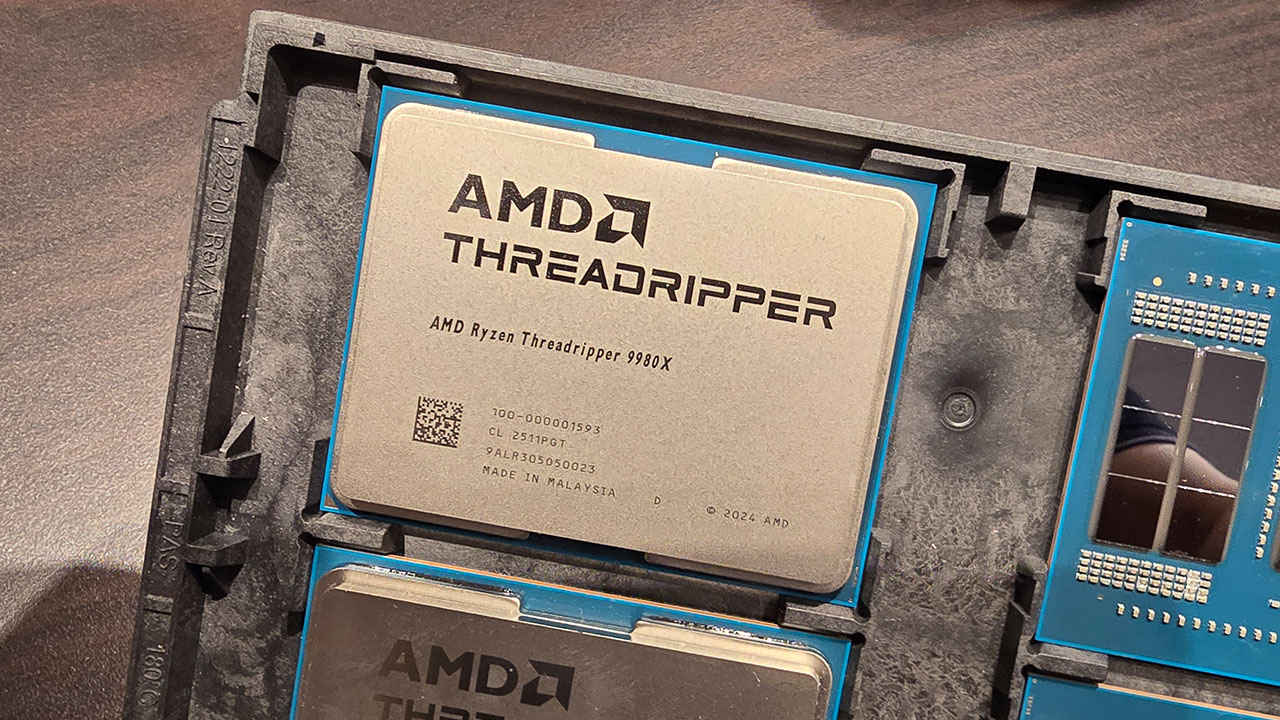
For years, AMD’s Threadripper series has been synonymous with brute-force multi-core power. With the new AMD Ryzen Threadripper 9980X, AMD is sharpening that edge even further, bringing 64 cores and 128 threads to the TRX50 platform for high-end desktop (HEDT) users who demand no compromises. Built on the latest Zen 4 architecture and manufactured on TSMC’s 5nm process, the 9980X is part of the Ryzen Threadripper 9000 series, aimed squarely at professional creators, advanced developers, and anyone juggling massive workloads, be it AI model training, 3D rendering, video production, or virtualised environments.
In many ways, this chip represents a reassertion of dominance in a niche that AMD essentially owns. The 9980X is not meant for the mainstream gamer or casual user. It’s a product built for workstations that blur the line between desktop and server. And while the price tag and platform requirements might raise eyebrows, the sheer computational muscle on offer here could make it all worthwhile, if you know what you’re doing.
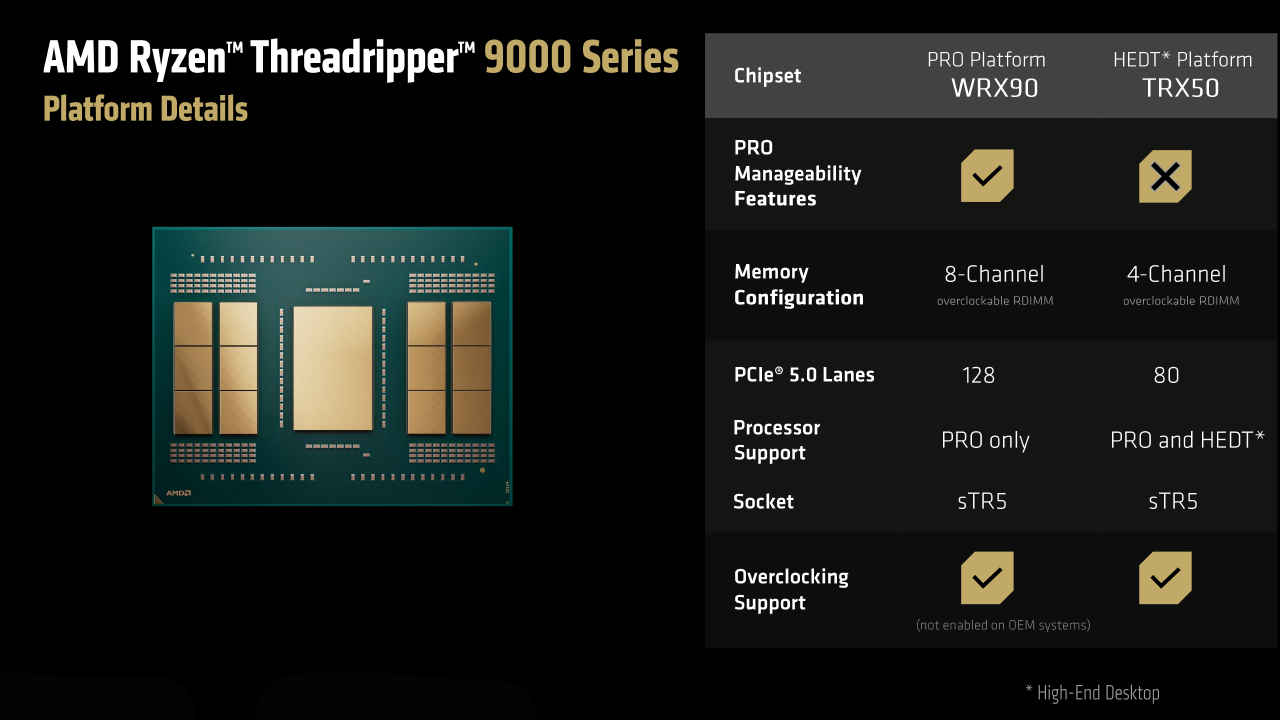
The AMD Ryzen Threadripper 9980X is designed to run exclusively on the TRX50 platform, which forms the foundation for AMD’s high-end desktop (HEDT) ecosystem. TRX50 isn’t new, but it has matured significantly since the launch of the 7000 series, and with the 9000 series, it unlocks an impressive combination of bandwidth, overclocking flexibility, and workstation-grade features that blur the line between HEDT and server-class computing.
At the heart of TRX50 is the sTR5 socket, which is shared with the more enterprise-oriented WRX90 platform used by the PRO WX series. However, there’s a key distinction: while Threadripper PRO 9000 processors can run on both WRX90 and TRX50 boards, non-PRO chips like the 9980X are compatible only with TRX50. This distinction is crucial for those seeking raw performance without the added cost or complexity of manageability and remote provisioning features found in enterprise platforms.
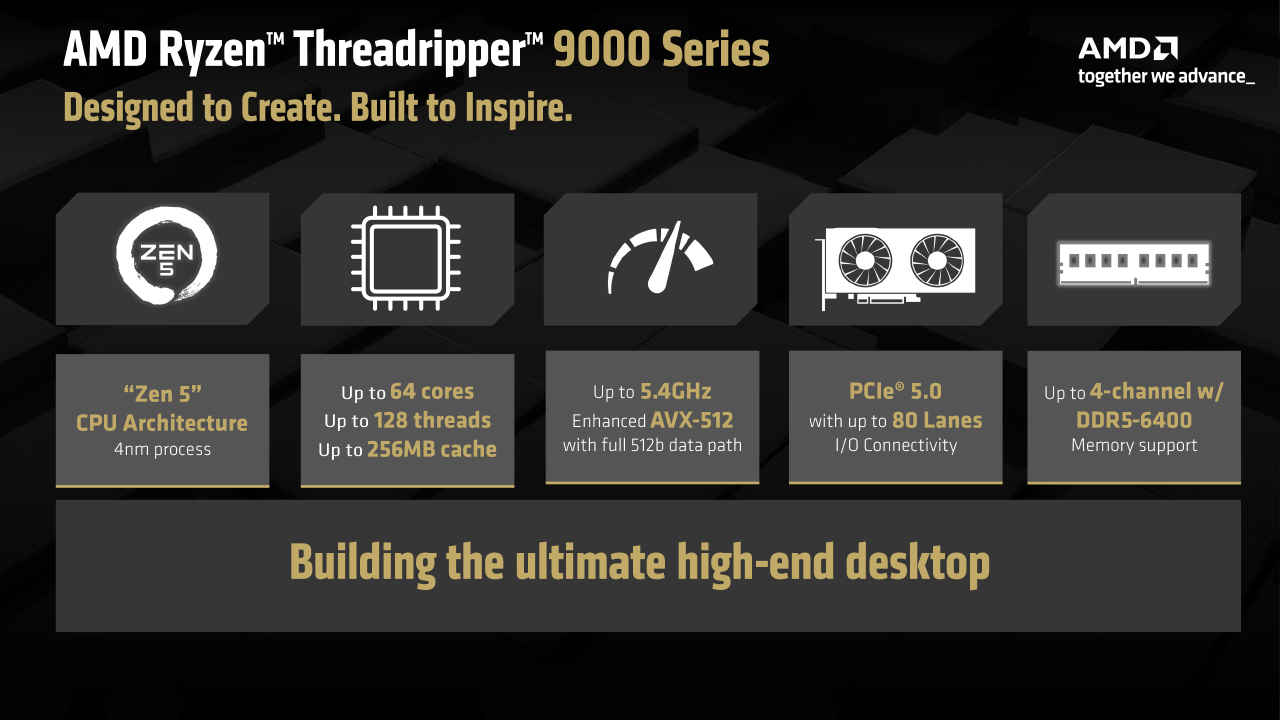
Memory support on TRX50 is robust. The platform handles quad-channel DDR5 RDIMM, with support for capacities of up to 1TB using four 256GB modules. This provides plenty of headroom for creators and developers dealing with memory-hungry applications like virtualisation stacks, large-scale simulations, and high-resolution video editing workflows. The 9980X supports DDR5 memory speeds up to 6400 MT/s with EXPO profiles, and thanks to the platform’s 1:2 memory controller mode, these speeds are achievable without manual tuning.
Expansion is another strength. The TRX50 platform offers a total of 92 PCIe lanes, with 80 of them supporting PCIe 5.0 directly from the CPU. This enables multi-GPU configurations, high-speed storage arrays, and professional-grade I/O cards to operate at full bandwidth with minimal compromise. Whether you’re building a data science workstation, a VFX rendering node, or a hybrid editing and inference rig, this level of connectivity gives the system enormous versatility.
Overclocking is fully supported on TRX50. The platform enables Precision Boost Overdrive (PBO), Curve Optimizer, and manual tuning, all of which can be accessed via BIOS or AMD Ryzen Master. This is a significant differentiator compared to the WRX90 platform, where most OEM systems ship with locked-down tuning options. For enthusiasts who want to fine-tune voltage curves or push boost clocks higher, TRX50 offers a wide canvas for experimentation.
Altogether, the TRX50 platform complements the 9980X perfectly. It supports the chip’s massive core count and power demands, while offering the bandwidth and flexibility that creative professionals, engineers, and developers require. Whether you’re chasing raw throughput or building a future-proof workstation, TRX50 stands as the most well-rounded HEDT platform AMD has ever produced.
With the Ryzen Threadripper 9000 series, AMD is doubling down on its high-end desktop (HEDT) dominance, building on its Zen 4 architecture and upgrading nearly every subsystem, from memory bandwidth to PCIe connectivity. For those considering a leap into the world of extreme multi-threaded computing, it’s important to look at how the flagship 9980X compares to its siblings, both in the 9000 and 7000 series.
| Specification | 9980X | 9970X | 9960X | 7980X | 7970X |
| Architecture | Zen 4 | Zen 4 | Zen 4 | Zen 4 | Zen 4 |
| Cores / Threads | 64 / 128 | 32 / 64 | 24 / 48 | 64 / 128 | 32 / 64 |
| Base Clock | 3.2 GHz | 4.0 GHz | 4.2 GHz | 3.2 GHz | 4.0 GHz |
| Boost Clock | Up to 5.4 GHz | Up to 5.4 GHz | Up to 5.4 GHz | Up to 5.1 GHz | Up to 5.3 GHz |
| L2 Cache | 64 MB | 32 MB | 24 MB | 64 MB | 32 MB |
| L3 Cache | 256 MB | 128 MB | 128 MB | 256 MB | 128 MB |
| PCIe Lanes (5.0) | 80 | 80 | 80 | 48 | 48 |
| Memory Support | DDR5-6400 (Quad-Channel) | DDR5-6400 (Quad-Channel) | DDR5-6400 (Quad-Channel) | DDR5-5200 (Quad-Channel) | DDR5-5200 (Quad-Channel) |
| ECC Support | Yes | Yes | Yes | Yes | Yes |
| Overclocking | Yes (Unlocked) | Yes (Unlocked) | Yes (Unlocked) | Yes (Unlocked) | Yes (Unlocked) |
| TDP | 350 W | 350 W | 350 W | 350 W | 350 W |
| Socket | sTR5 | sTR5 | sTR5 | sTR5 | sTR5 |
| Boost Algorithm | Precision Boost 2 | Precision Boost 2 | Precision Boost 2 | Precision Boost 2 | Precision Boost 2 |
| Max Temp (TjMax) | 95°C | 95°C | 95°C | 95°C | 95°C |
The step up from the 7000 to 9000 series is subtle on the surface with the same core/thread counts at the top end but there are three big shifts underneath. First, memory support improves from DDR5-5200 to DDR5-6400, which translates to better bandwidth for content creators. Second, PCIe 5.0 lanes increase from 48 to 80, allowing for more robust GPU and SSD configurations. And third, clock speeds across the board have received minor uplifts, with boost clocks hitting 5.4 GHz in the newer models.
Among this lineup, the 9980X clearly wears the crown. With a 256MB L3 cache and full 64-core complement, it is AMD’s most capable HEDT chip to date, narrowly rivalled only by the PRO-class 7995WX with 96 cores, which targets the WRX90 platform instead. The Threadripper 9970X (Read our review here) serves as a slightly leaner version for those who want strong single-core performance without the power draw and thermal load of 64 cores. The 9960X, meanwhile, hits a nice sweet spot for developers and workstations with lighter but still parallelised loads.
In terms of target audience, the 9980X is built for professionals dealing with highly parallel workflows such as VFX studios, simulation engineers, machine learning researchers running local inferencing, and post-production editors working on multi-layered 8K content. If you’re simply after a powerful workstation for moderate editing or development, the 9960X or 9970X might deliver more efficiency without compromising too much on capability.
To evaluate the real-world performance of the AMD Ryzen Threadripper 9980X, the test system was configured to eliminate any bottlenecks and reflect optimal conditions for high-end desktop workloads. AMD’s guidelines were followed closely, with the latest drivers, BIOS, and firmware updates applied.
This setup represents a realistic yet high-performance environment for creators and power users. The combination of quad-channel DDR5-6400 memory and PCIe Gen 5 NVMe storage ensures that the CPU isn’t starved for bandwidth, while the RTX 5090 provides ample headroom for GPU-accelerated workloads.
These benchmarks are designed to test raw integer throughput, memory bandwidth efficiency, and multi-threaded scalability. They are often used to simulate how the CPU would perform when handling tasks like compressing large archives, parsing scientific data, or dealing with mathematical calculations that scale with core count.
7-Zip Benchmark
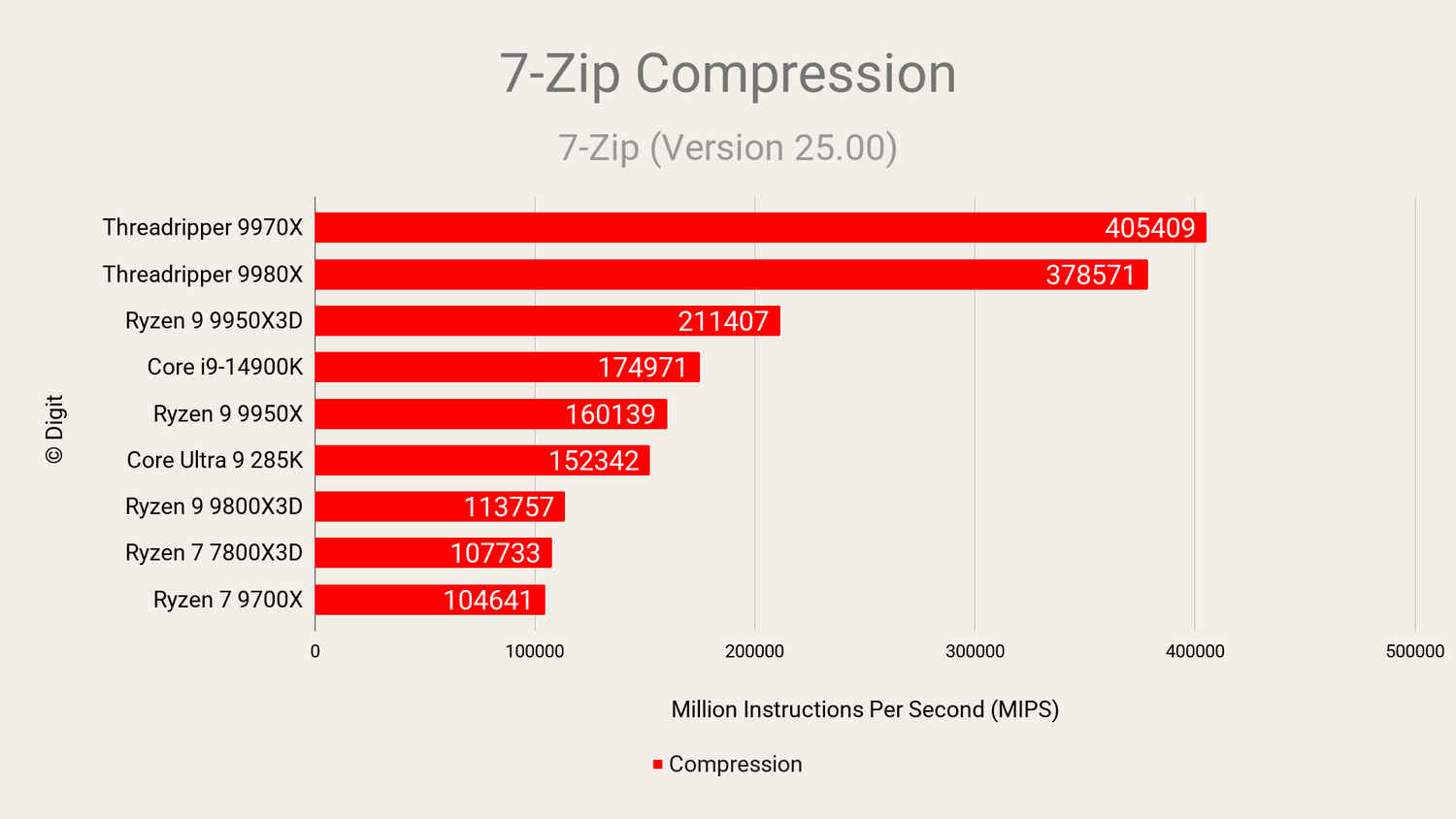
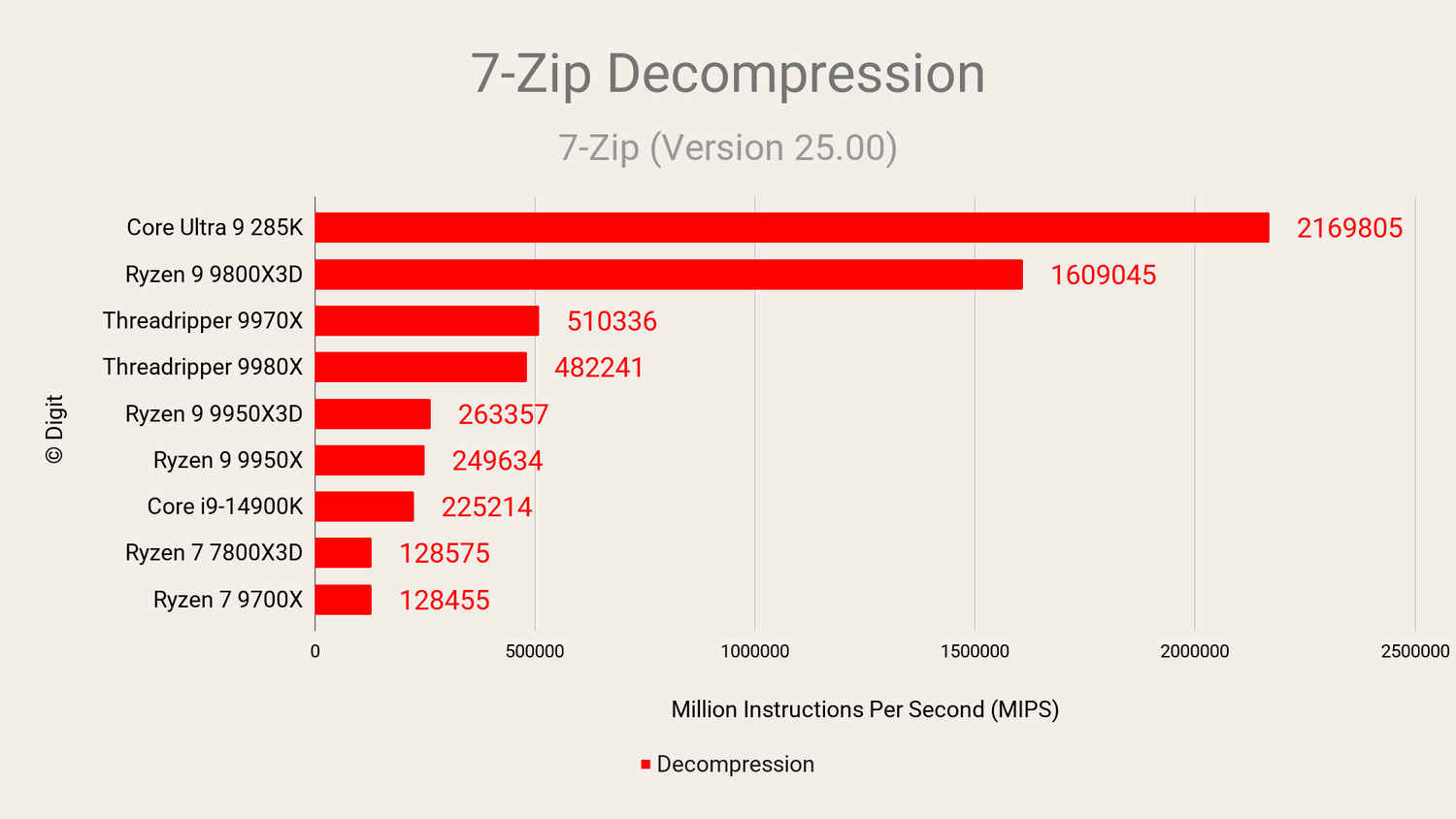
7-Zip’s internal benchmark measures LZMA compression and decompression speed, giving results in MIPS (million instructions per second). It is a pure CPU benchmark that scales well across multiple cores and threads.
In this test, the Threadripper 9980X delivered an average of 378,571 MIPS in decompression and 482,241 MIPS in compression. Compared to the Ryzen 9950X3D, which scored around 211,407 MIPS (decompression) and 263,357 MIPS (compression), the 9980X holds a clear 79-83% advantage.
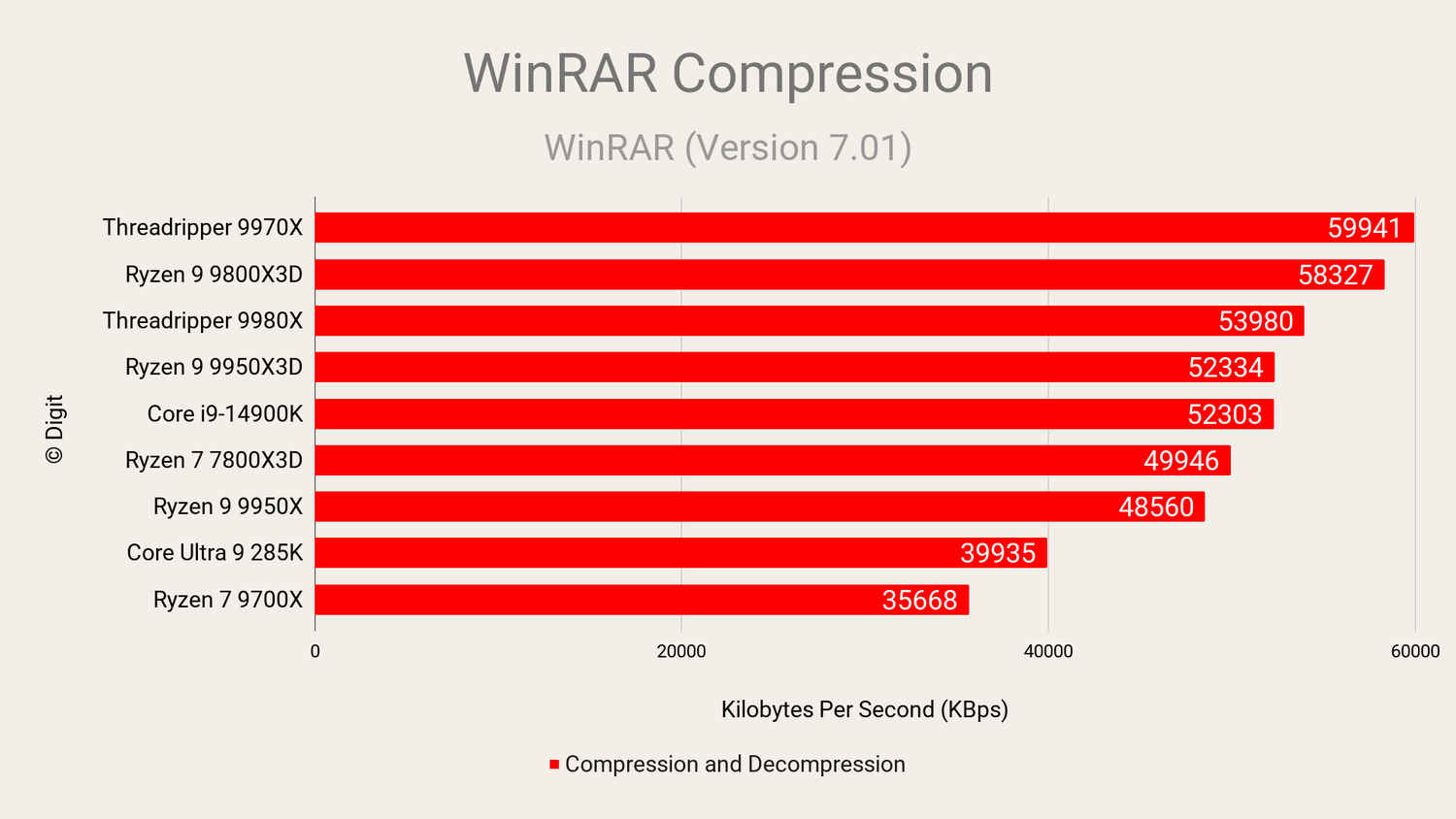
WinRAR Benchmark
WinRAR’s benchmark uses real-world compression techniques that rely more on single-threaded performance and memory subsystem efficiency. It tends to favour CPUs with high IPC and fast cache/memory performance.
The 9980X scored 53,980 KB/s, while the 9950X3D managed 52,334 KB/s. While the uplift here is closer to 3.1%, it is still noticeable. The Threadripper’s massive L3 cache and DDR5-6400 memory provide ample bandwidth, although WinRAR does hit a point of diminishing returns beyond 24–32 threads.
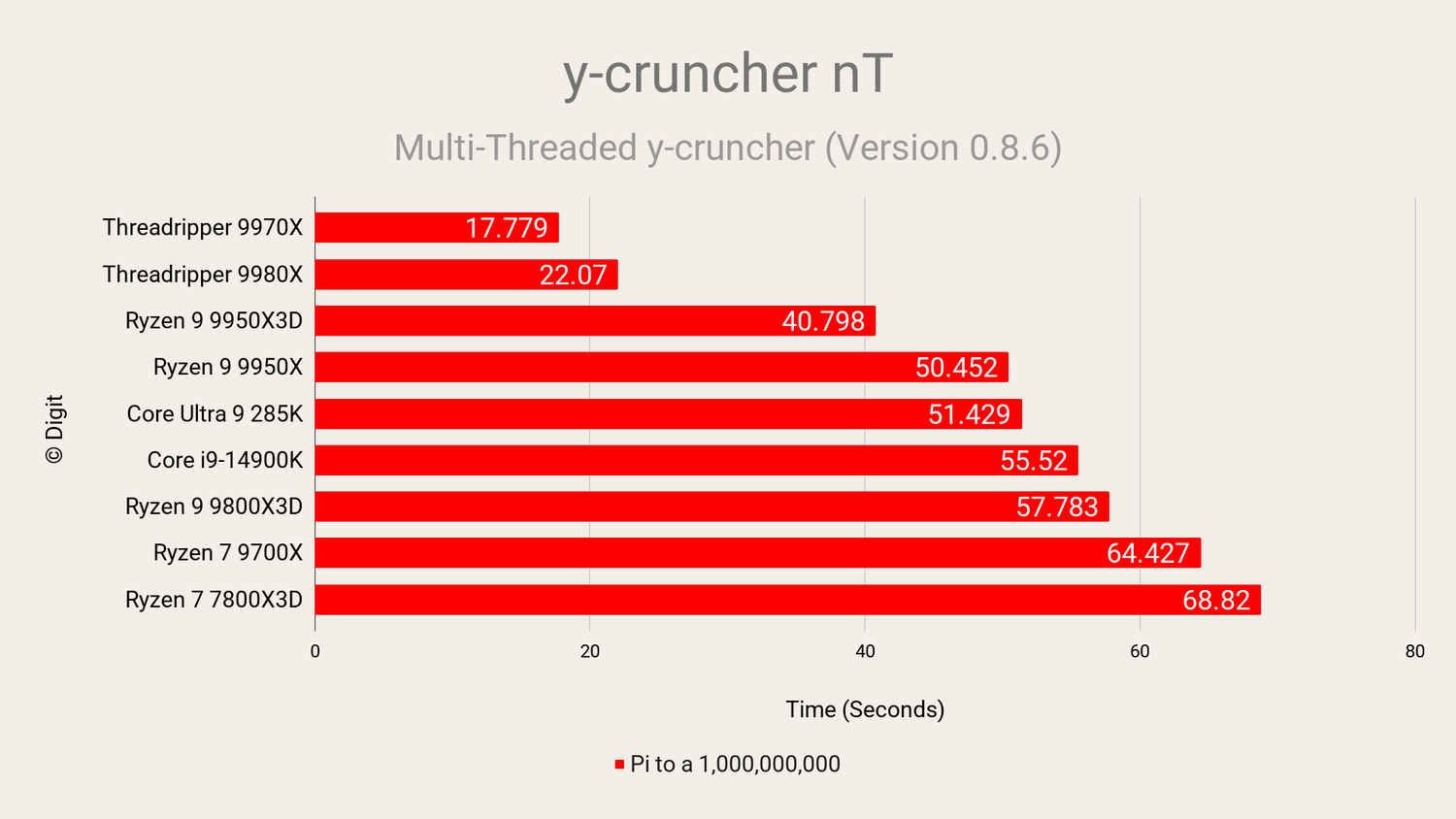
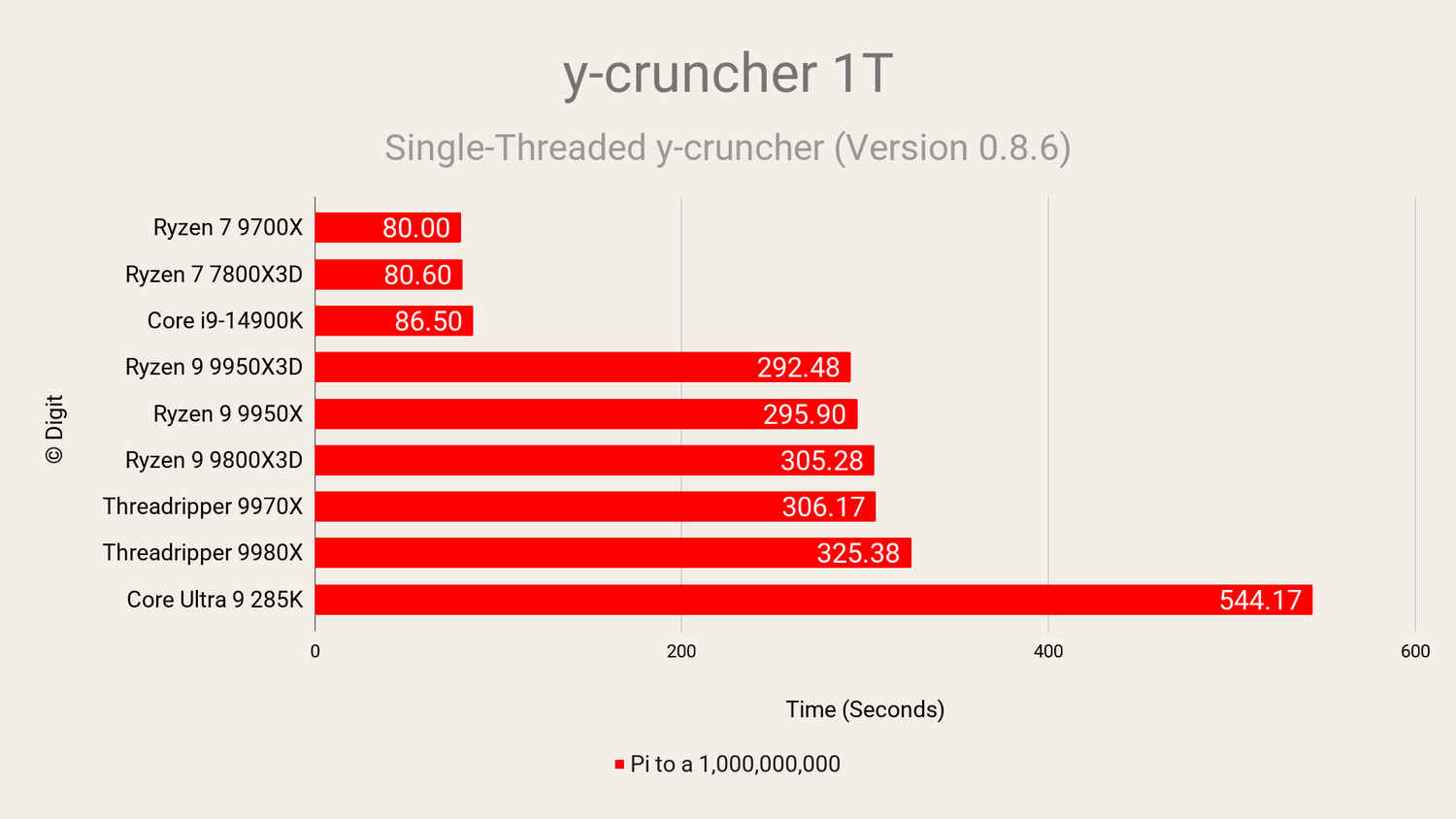
Y-Cruncher
Y-Cruncher is an incredibly demanding benchmark that calculates Pi to billions of digits using multiple algorithms. It stresses integer, floating point, cache, and memory bandwidth across all available cores.
The 9980X completed the 2.5B Pi calculation in just over 22.07 seconds. In contrast, the 9950X3D took approximately 40.80 seconds. This represents a 46% improvement in compute throughput for this workload, largely thanks to the increased number of physical cores and faster memory on the TRX50 platform. For single-threaded performance, the difference was about 10.1% and the 9950X3D was the faster processor.
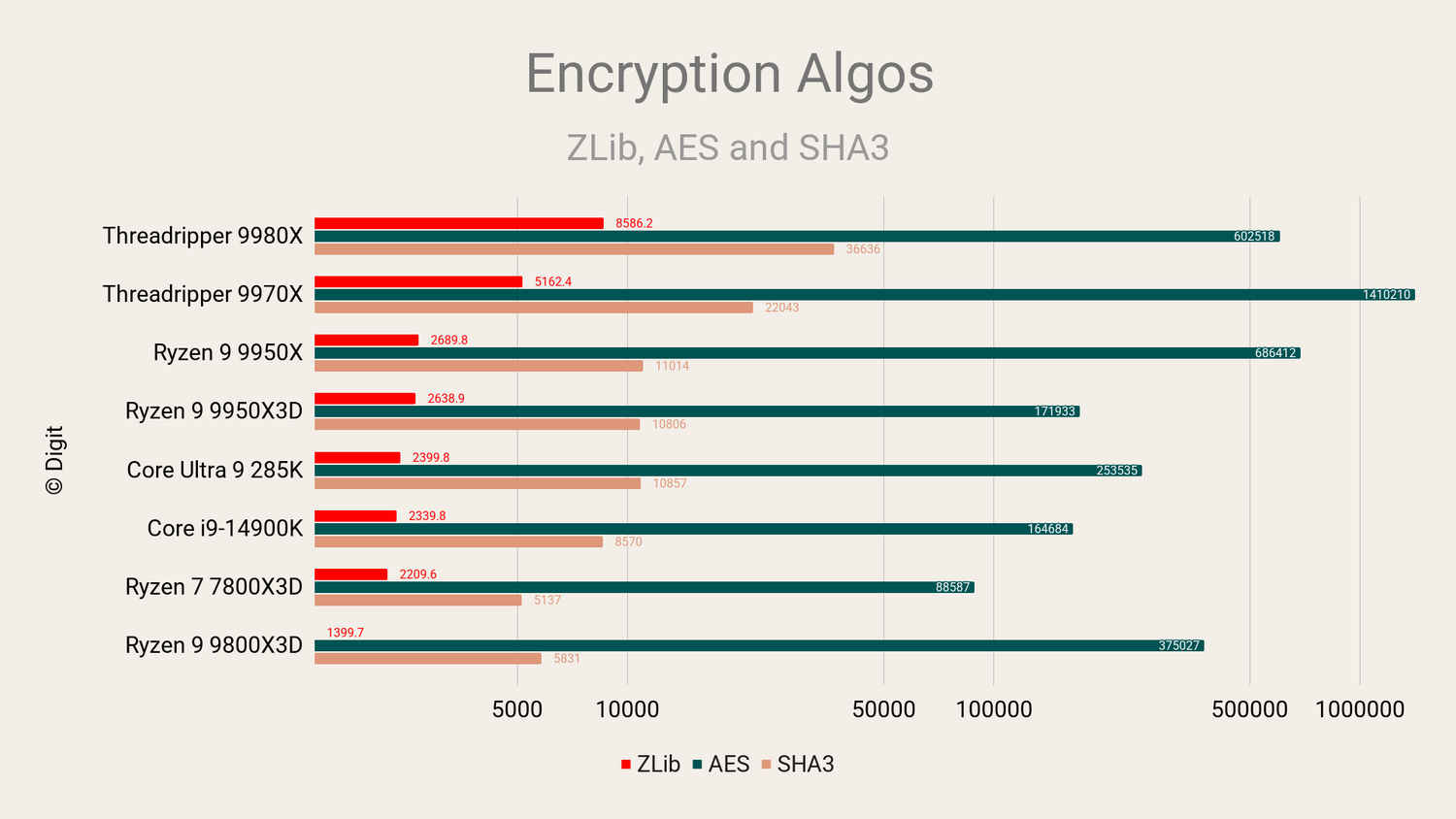
Encryption Algorithms
AIDA64 offers a suite of synthetic tests that isolate instruction set throughput and memory interactions. ZLib tests general compression speed, AES measures symmetric encryption, and SHA3 benchmarks hashing throughput. All are excellent indicators of architectural efficiency.
The performance delta here is substantial across the board. These results underline the advantage of Zen 4’s front-end improvements and the benefits of a wider, faster memory bus, especially in secure computation, encryption-heavy pipelines, and even virtualised workloads that rely on software crypto acceleration.
These benchmarks measure the responsiveness of JavaScript and WebAssembly execution in modern browser environments. While this isn’t the traditional stronghold of HEDT CPUs, it’s increasingly relevant for developers working on web applications, interactive dashboards, or Electron-based tools. Performance here also hints at single-thread responsiveness in low-latency environments.
Google Octane 2.0
Octane is a JavaScript performance benchmark suite developed by Google, combining a mix of real-world web apps and script-heavy operations. It tends to reward high IPC and fast turbo boost response.
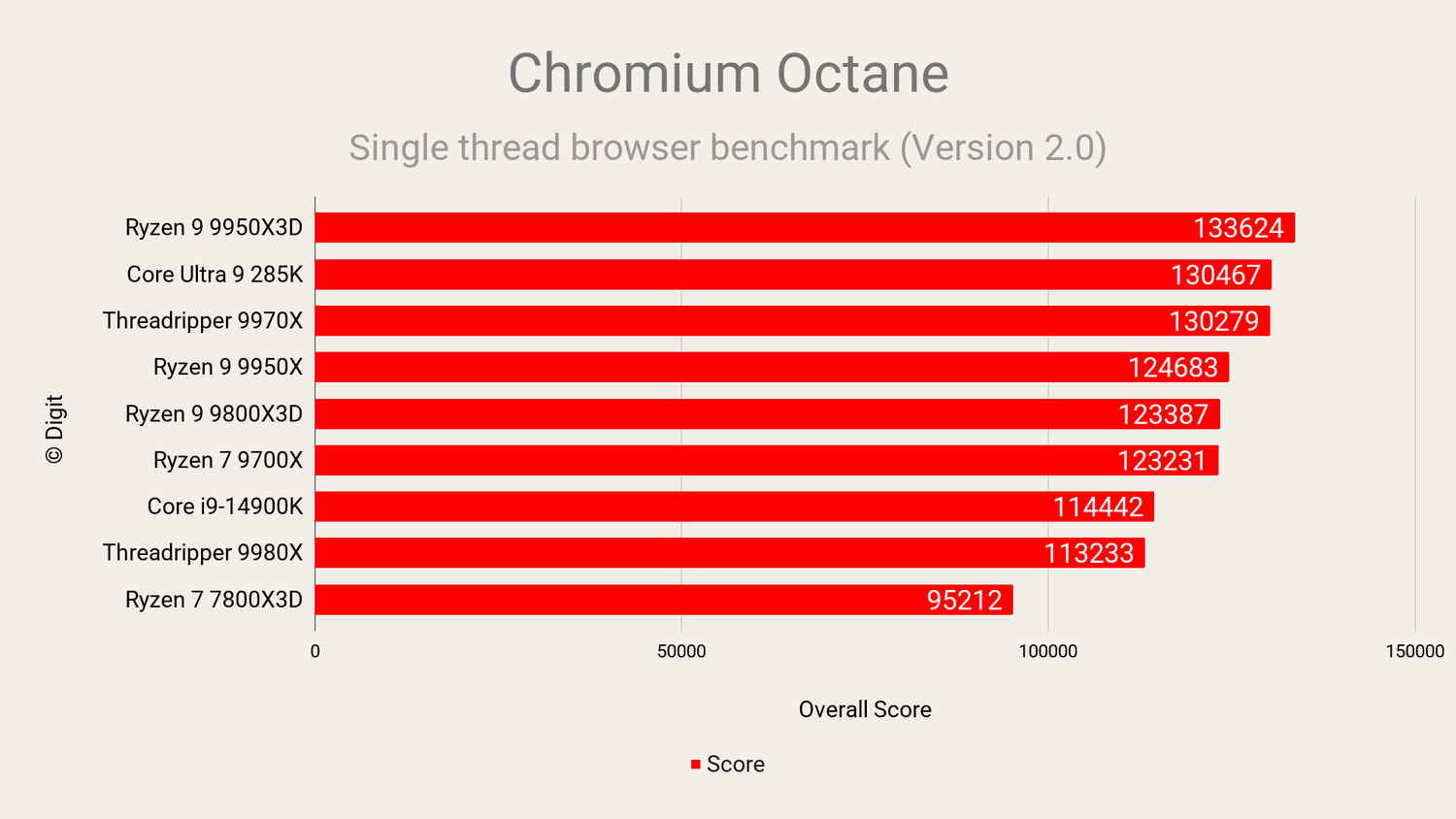
On Google Octane 2.0, the Threadripper 9980X scored 113,233 points, while the 9950X3D returned a slightly lower 133,624. That’s a roughly 15% uplift in a workload that’s highly latency-sensitive and not designed to scale across dozens of threads.
The 9980X’s higher maximum boost clock and Zen 4 architecture clearly help here, giving web developers or frontend-focused engineers a noticeable bump in compile times for scripts, local testing environments, and live-reload cycles within Chromium-based tools.
Mozilla Kraken 1.1
Developed by Mozilla, Kraken is a JavaScript benchmark that includes tests like audio processing, image filtering, and cryptographic operations. It’s heavier than Octane and typically benefits from cache performance and fast branch prediction.
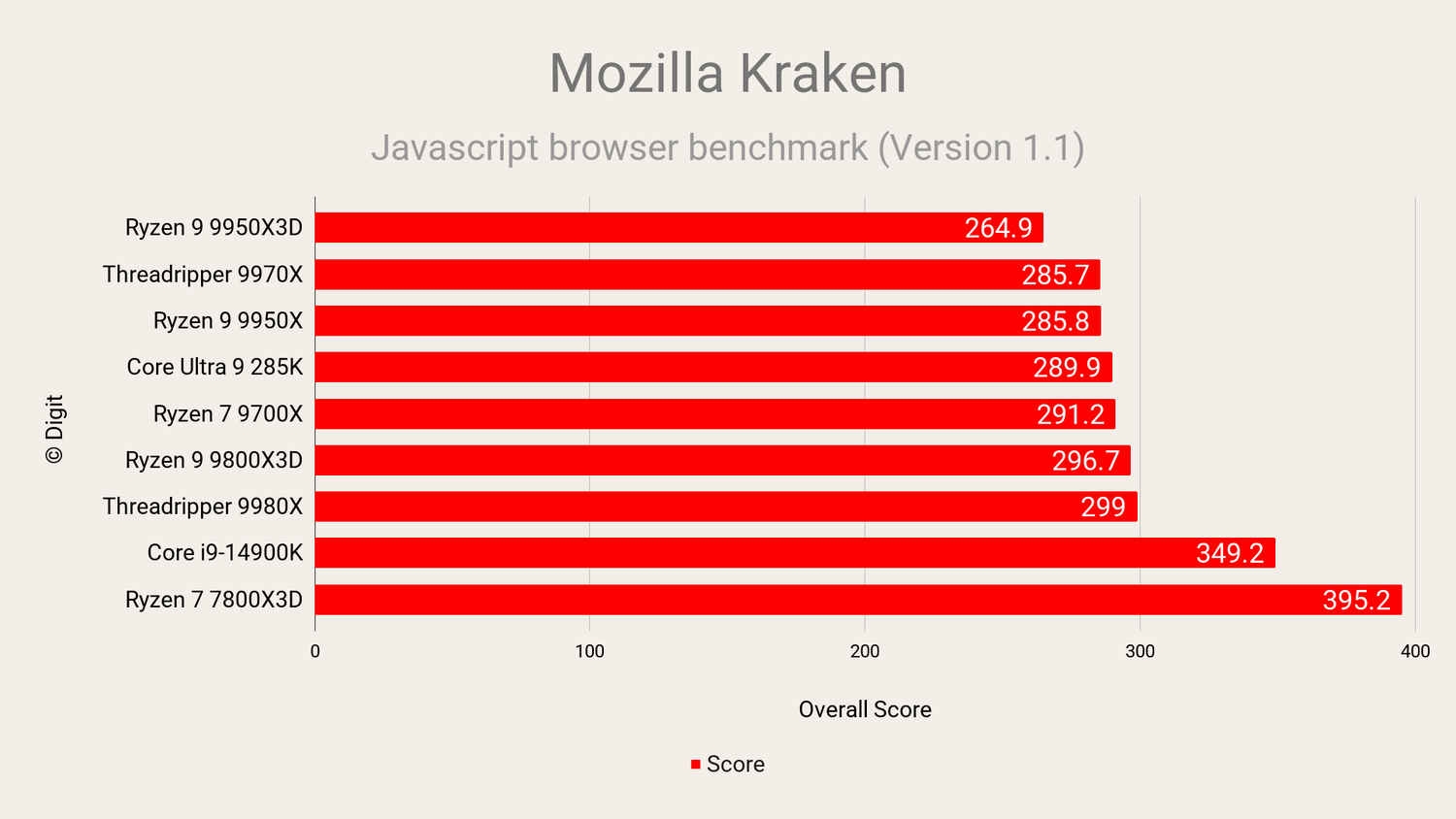
In Kraken, the 9980X achieved a score of 299 milliseconds (lower is better), while the 9950X3D was slightly ahead at 264.9 milliseconds. This 11% reduction in execution time doesn’t sound huge, but in UI testing loops or multi-instance browser workloads, it helps reduce frame latency and recompile lag significantly.
Kraken is an especially useful benchmark for professionals using in-browser dev environments like StackBlitz, CodeSandbox, or JupyterHub, where browser-side rendering and interactivity matter.
These benchmarks evaluate how well the CPU handles tasks such as 3D ray tracing, raster-based rendering, global illumination, and complex shading computations. The workloads here scale almost linearly with core and thread count, making them an ideal match for the 9980X’s architecture. They’re also representative of real-world usage for professionals working in VFX, animation, architectural visualisation, and digital content creation.
Cinebench R23
Cinebench R23, developed by Maxon, is based on the Cinema 4D rendering engine. It measures CPU rendering performance using a photorealistic scene and is available in both single- and multi-core modes. It’s a de facto benchmark for judging raw CPU horsepower.
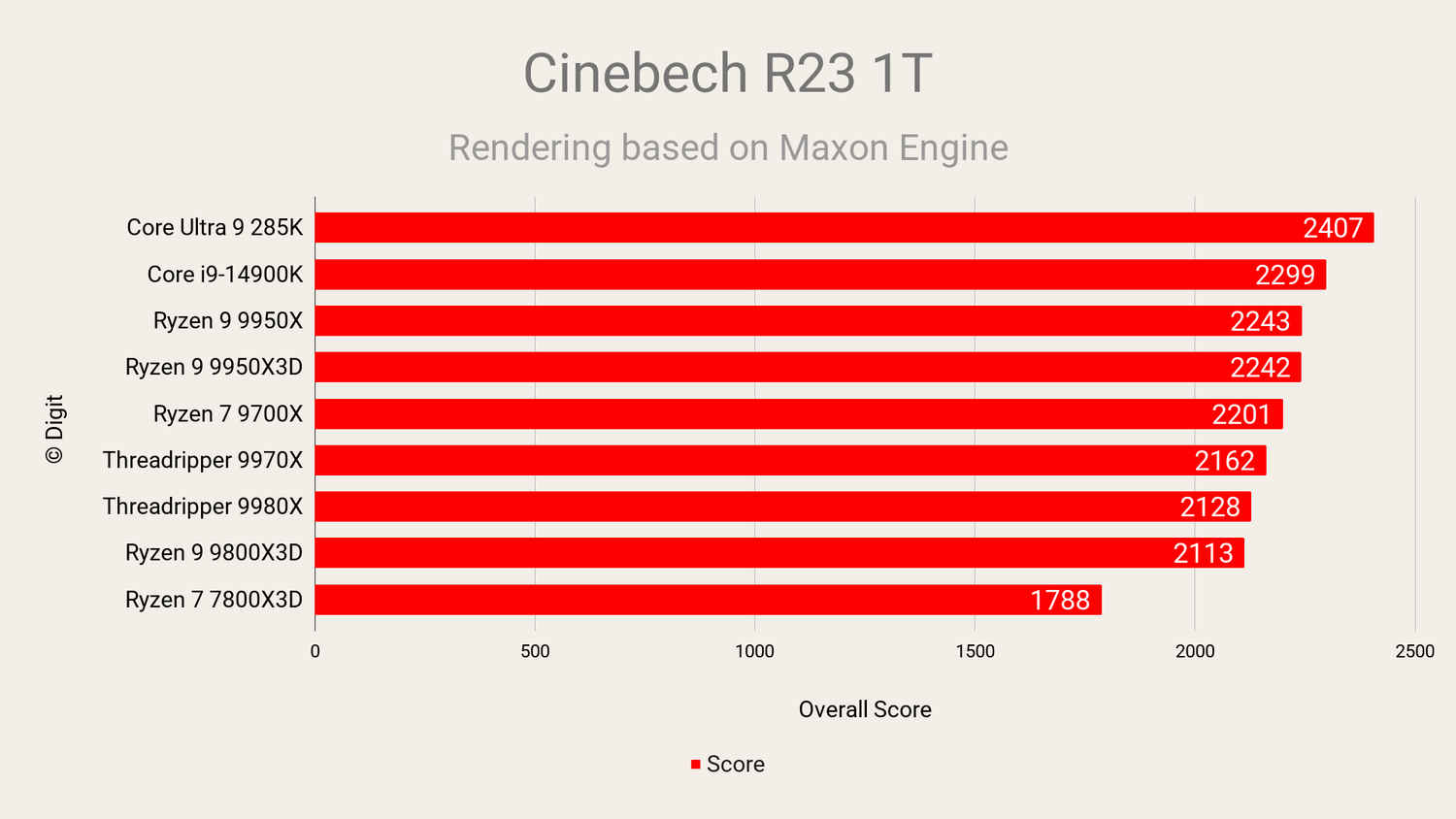
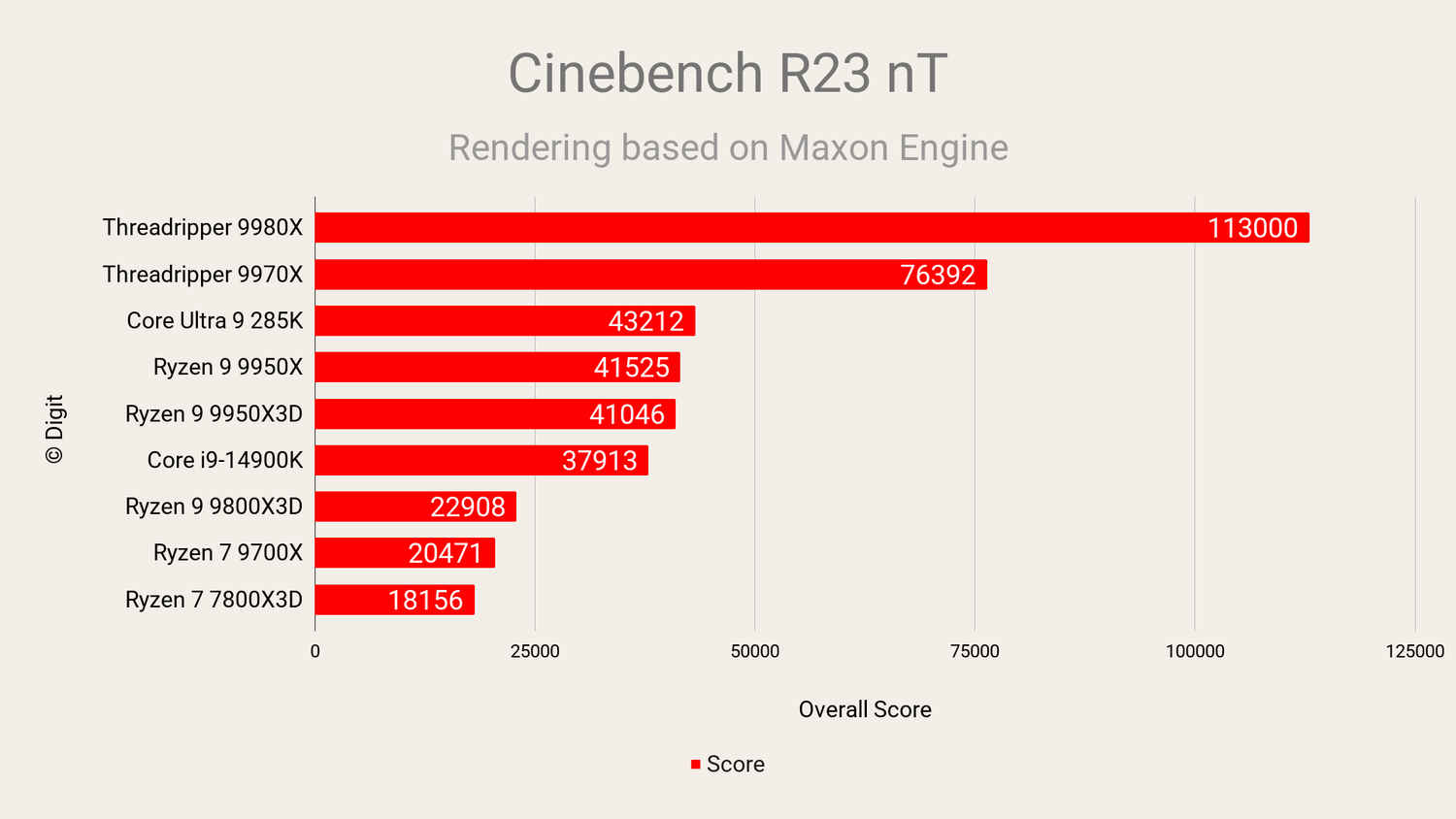
The 9980X scored an impressive 113,000 points in the multi-core test, compared to the 9950X3D’s 41,046. In the single-core test, the 9950X3D returned 2242 points, edging past the 9980X’s 2,128 by 5.3%. The uplift in multi-threaded performance is especially pronounced i.e. over 175% thanks to the additional cores and memory bandwidth.
This translates directly to faster offline rendering and better responsiveness in preview modes that can leverage high thread counts. For Cinema 4D users, this is the kind of performance that significantly cuts down render queue time.
Cinebench 2024
Cinebench 2024 is the updated version of Maxon’s benchmark, now utilising the Redshift rendering engine. It offers a more modern, GPU-adjacent view of CPU rendering under ray-traced lighting and complex shader effects.
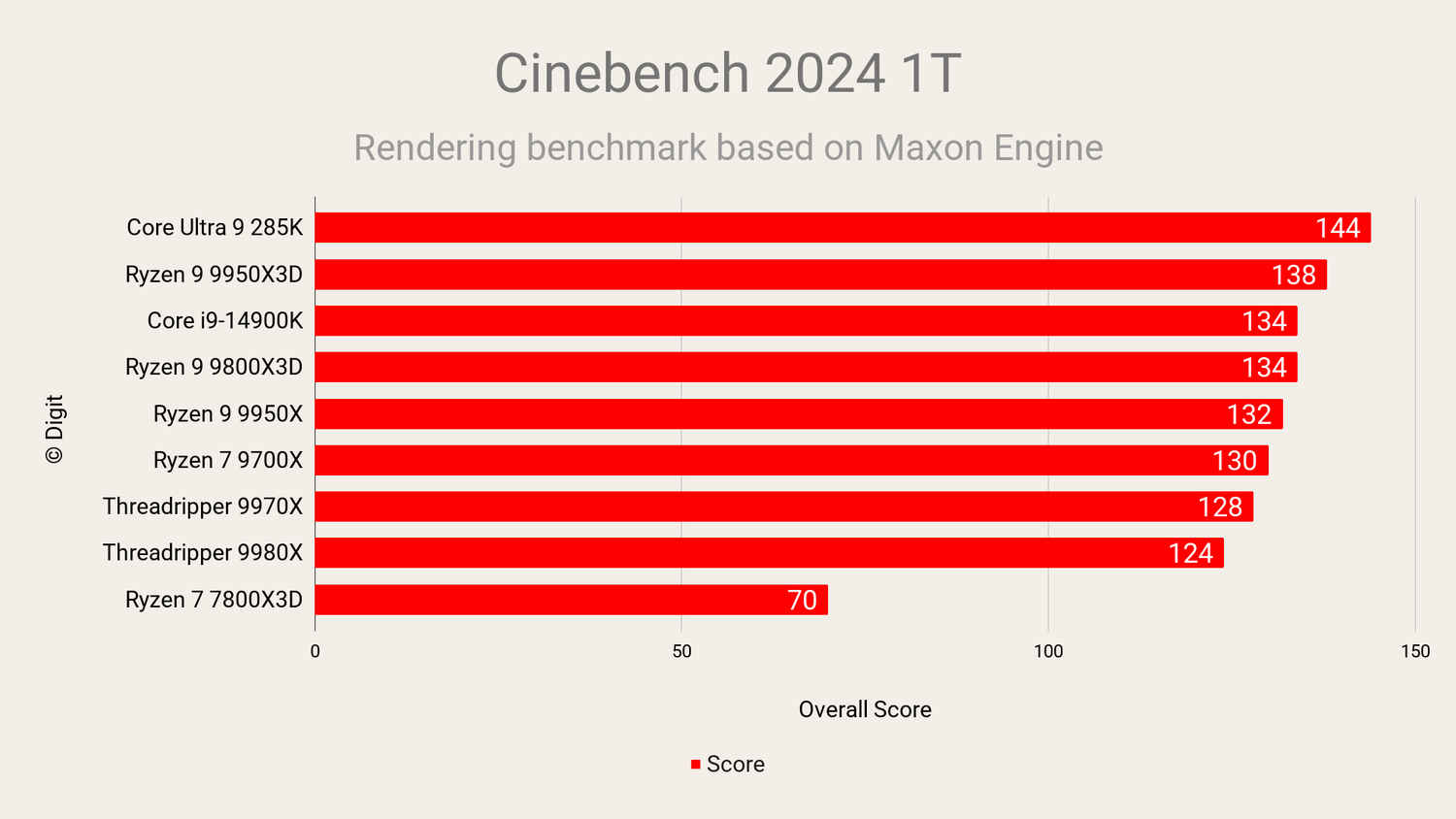
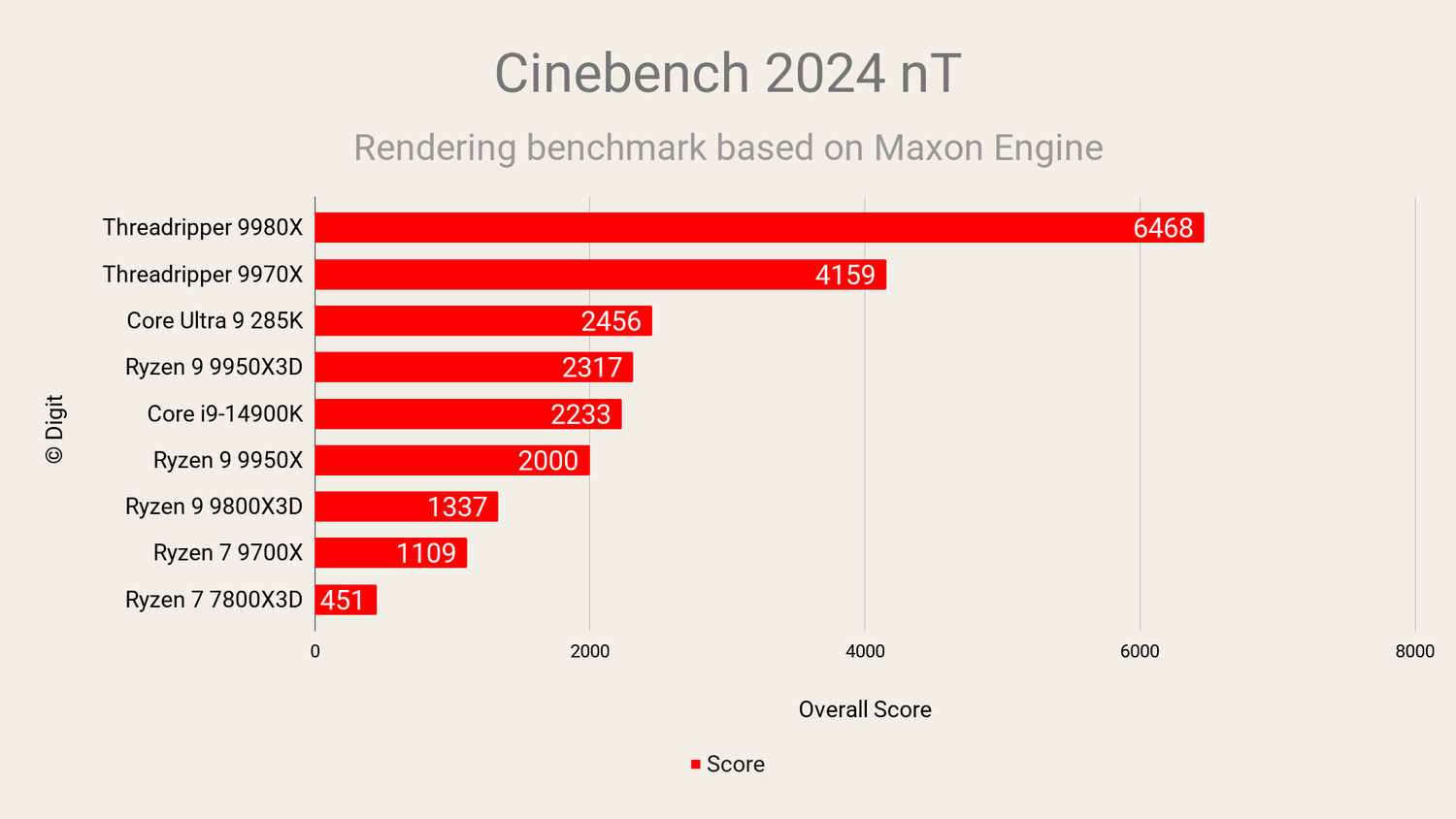
In Cinebench 2024 multi-core testing, the 9980X hit 6468 points, whereas the 9950X3D reached 2,317. The single-core figures were similarly spaced, with the 9950X3D achieving a slight lead. This benchmark is especially useful for evaluating performance in real-time engines or hybrid GPU/CPU workflows. Redshift users and Blender professionals who rely on CPU fallback rendering will find the 9980X far more accommodating in heavy scenes, especially when GPU memory is exhausted.
Blender
Blender’s built-in benchmark is one of the best real-world rendering tests, with multiple complex scenes that leverage ray tracing, particle systems, and volumetrics. It is a classic multi-threaded workload that scales beautifully across CPU cores.
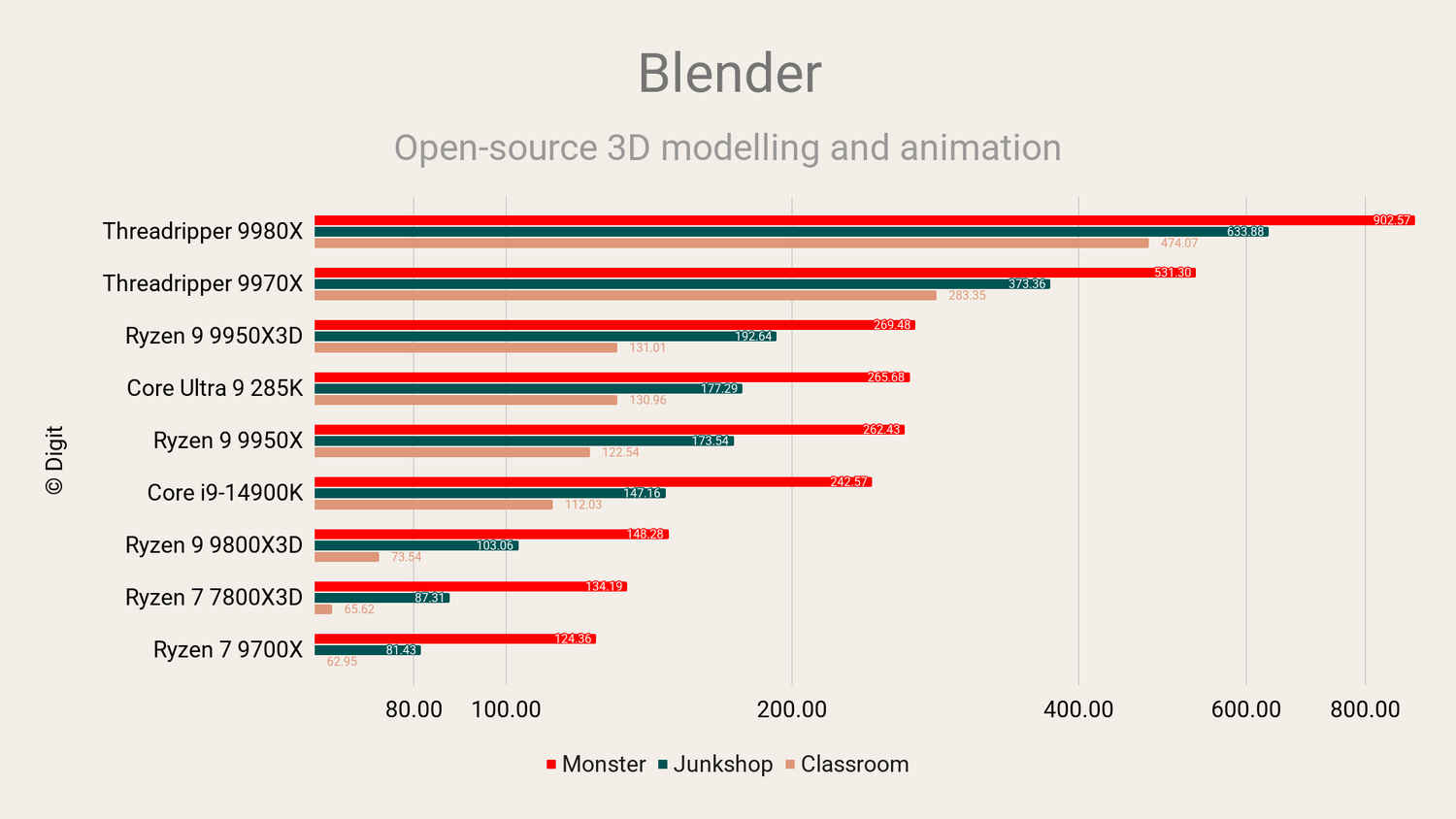
In the Classroom scene, the 9980X hit 474 samples/sec, compared to the 9950X3D’s 131 samples/sec. In the Monster and Junkshop scenes, the 9980X managed to score 903 and 634 samples/sec while the 9950X3D scored 269 and 193 samples/sec. So the margins were similar, approximately 30% faster render times across the board.
For Blender users who often work in cycles render mode with CPU fallback, or professionals managing large animation pipelines, this kind of improvement has a very tangible impact. It reduces wait times per frame and increases scene iteration speed.
V-Ray
V-Ray is a physically based rendering engine used in industries ranging from architectural visualisation to media production. The CPU benchmark uses brute-force ray tracing to evaluate raw rendering throughput.
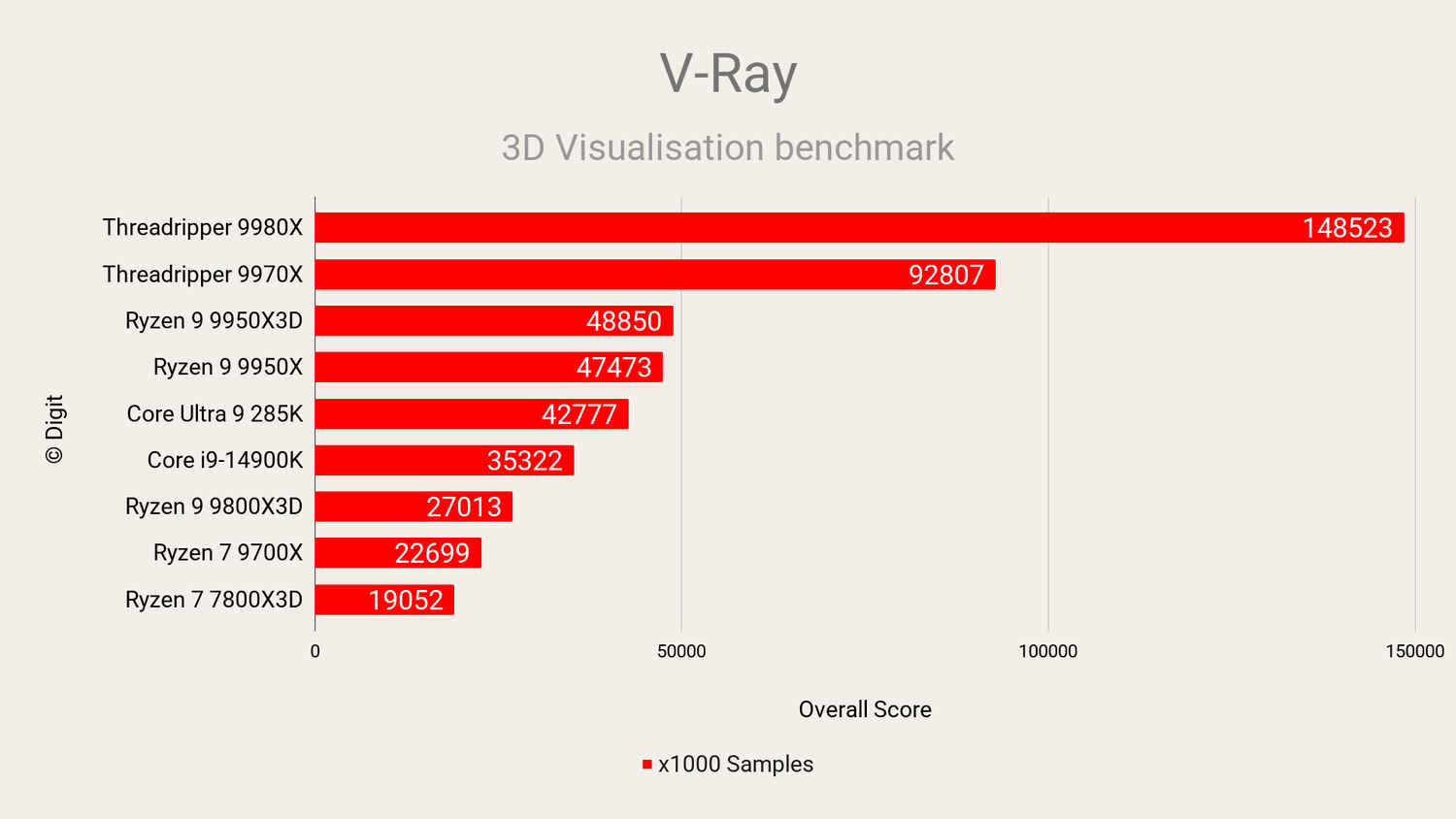
The Threadripper 9980X clocked in with a score of 148523 vsamples, while the 9950X3D managed 48850. That’s a 204% improvement in ray-tracing output, driven by the 9980X’s combination of core density and high sustained clocks.
Professionals rendering large interiors, complex lighting setups, or doing batch animation rendering with V-Ray Standalone will immediately feel the benefit here.
Indigo Renderer
Indigo Renderer is a path-tracing renderer known for high physical accuracy. Its benchmark is ideal for testing full utilisation of all available threads and caches under real-world rendering constraints.
The 9980X scored 40.497 M samples/s, while the 9950X3D achieved around 13.8 M samples/s. This 194% uplift, again, is tied to core scaling and higher memory throughput.
What’s interesting here is how consistent the 9980X remained across repeated runs, showing minimal drop-off, even under thermal pressure. This points to its suitability for long overnight render batches or always-on production rigs.
These benchmarks simulate real-world usage across Adobe Creative Cloud, DaVinci Resolve, and Microsoft Office. They evaluate a mix of CPU-bound tasks such as timeline scrubbing, effect rendering, image editing, export performance, and background rendering. This section is especially important for professionals in post-production, digital marketing, and media agencies who rely on smooth and predictable workstation performance.
Procyon Photo Editing (Adobe Photoshop)
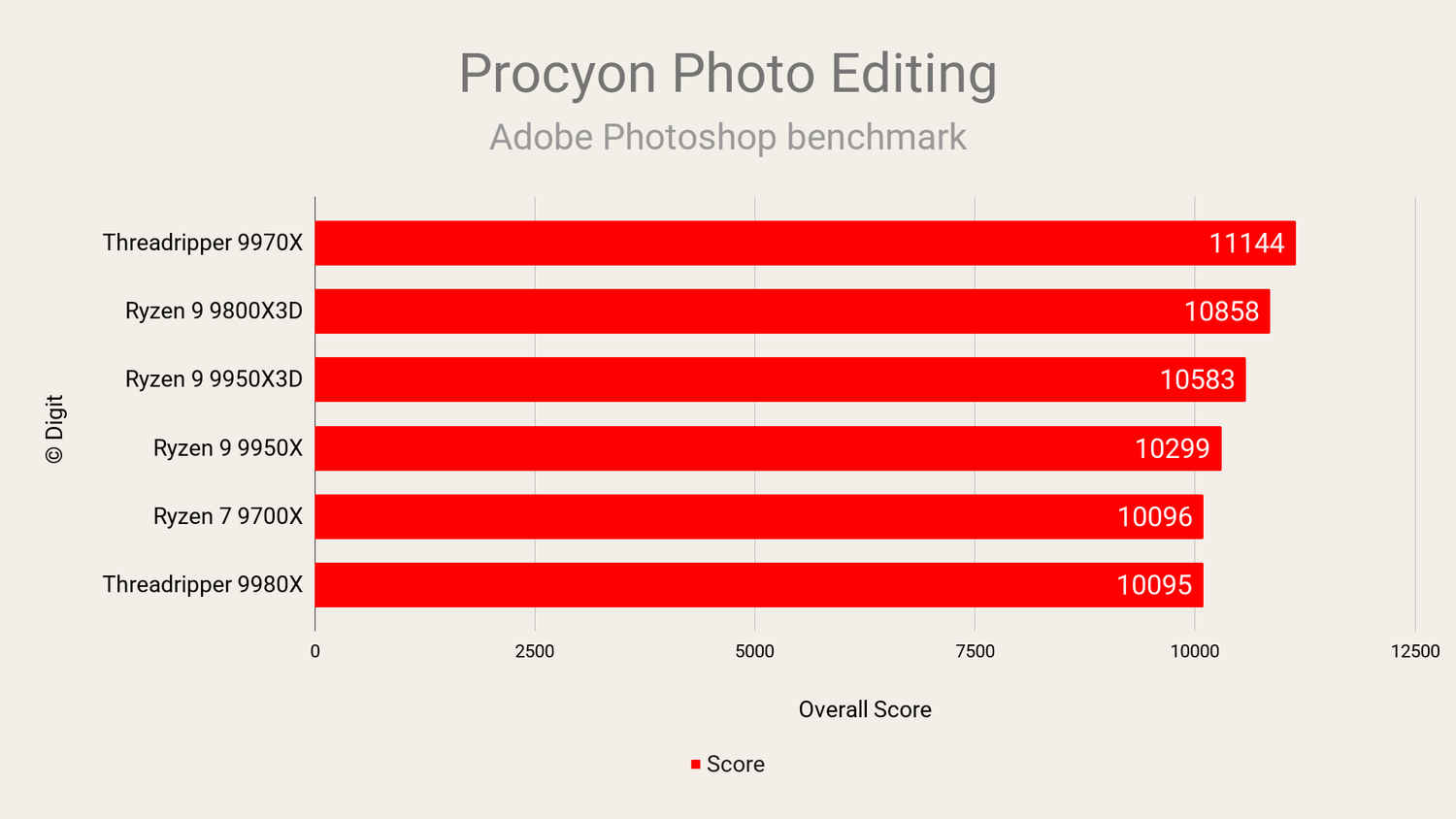
UL’s Procyon Photo Editing benchmark automates a sequence of Photoshop tasks such as applying filters, resizing images, and running complex layer operations. It mixes bursty single-core tasks with short multi-threaded workloads, making it a good stress test for responsiveness.
In this test, the 9980X scored 9,120 points, compared to the 9950X3D’s 8,676. This 5.1% increase reflects improvements in IPC, higher turbo responsiveness, and platform memory bandwidth.
Creative professionals using Photoshop for bulk image processing or advanced masking and effects work will notice reduced waiting times when applying GPU-unaccelerated actions and smart filters.
Procyon Video Editing (Adobe Premiere Pro)
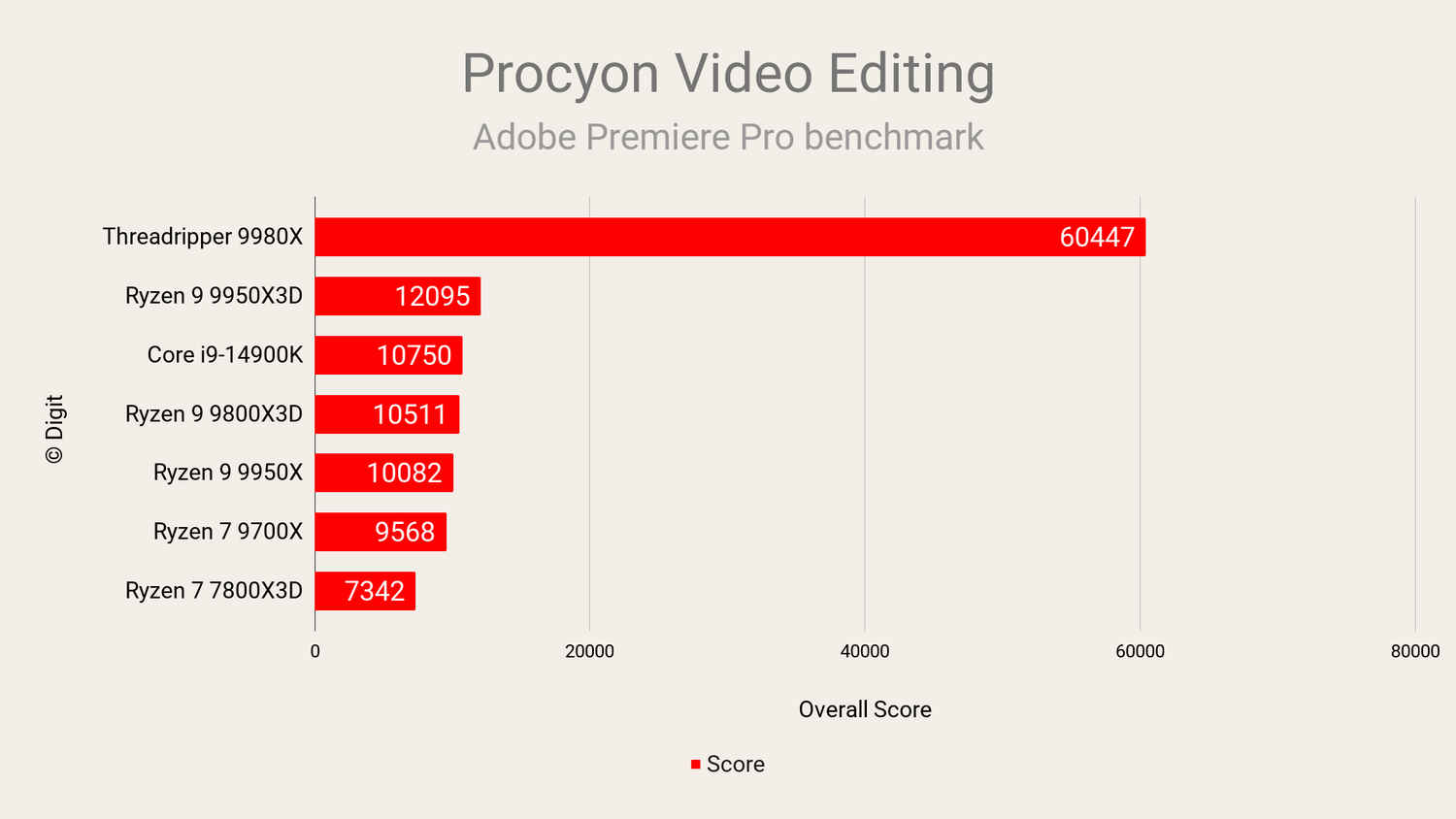
Procyon’s video editing suite measures editing responsiveness, timeline playback, and export time within Adobe Premiere Pro, using real 4K and 8K footage across multiple codecs.
The 9980X returned a score of 60,447, outperforming the 9950X3D’s 12,095. The uplift here is around 400%, and while GPU acceleration plays a large role in playback performance, the CPU’s thread count still matters for export and timeline caching.
For content creators rendering daily footage or editing multi-cam 4K timelines with effects and grading applied, the 9980X provides a meaningful advantage, particularly when running CPU-intensive plugins like Neat Video or third-party audio processors.
This category reflects performance in workloads that simulate modern on-device inferencing using transformer models, computer vision, and natural language processing. As AI continues to permeate creative and engineering workflows, from voice transcription and background separation to smart tagging and video retiming, having a CPU that can handle local inference tasks efficiently is increasingly valuable.
Procyon AI Inference
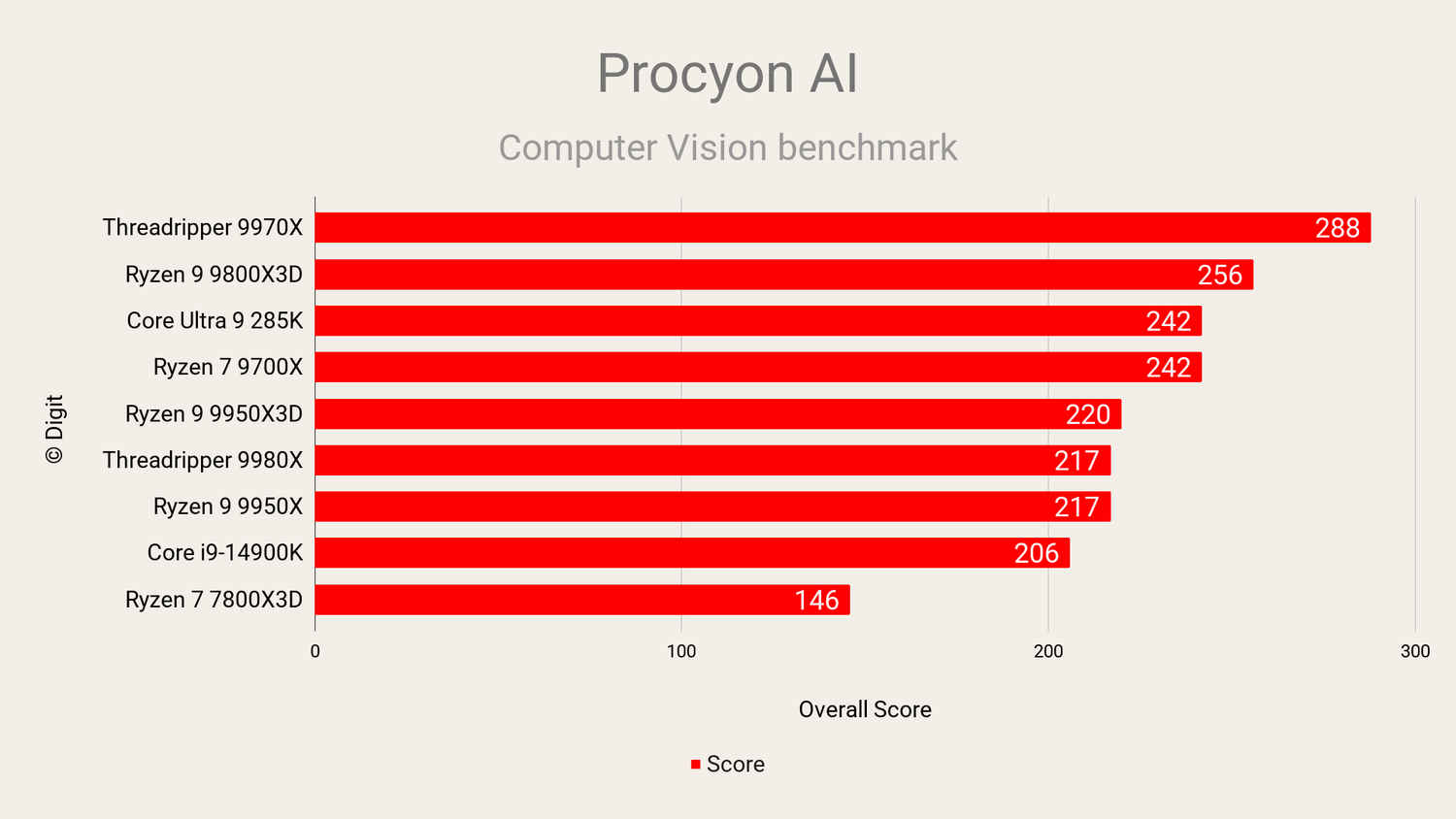
UL Procyon’s AI Inference benchmark uses ONNX Runtime to measure how quickly the system can run common deep learning models such as ResNet-50, SSD-MobileNet, and BERT for classification, detection, and NLP. The benchmark reflects real-world latency and throughput across multiple AI tasks using only the CPU, simulating edge workloads that don’t rely on discrete GPUs or cloud acceleration.
In the Procyon AI test, the Threadripper 9980X completed the suite with a total throughput of 217 inference operations per second, compared to the 9950X3D’s 220. That’s a 1.4% drop. There’s no NPU on the 9980X so you’re not going to get anything higher on Windows ML workloads that are not optimised for workstations. And folks getting a 9980X are most probably running an enterprise or flagship GPU which will be a better AI accelerator.
This segment focuses on synthetic and semi-synthetic benchmarks that emulate office productivity, workstation-class compute tasks, and memory-intensive scenarios. These tests are useful for enterprise and scientific users looking to understand how the CPU performs in heavily parallelised real-world workflows, memory-bound applications, and high-precision floating point operations across diverse industries.
SPECworkstation 4.0
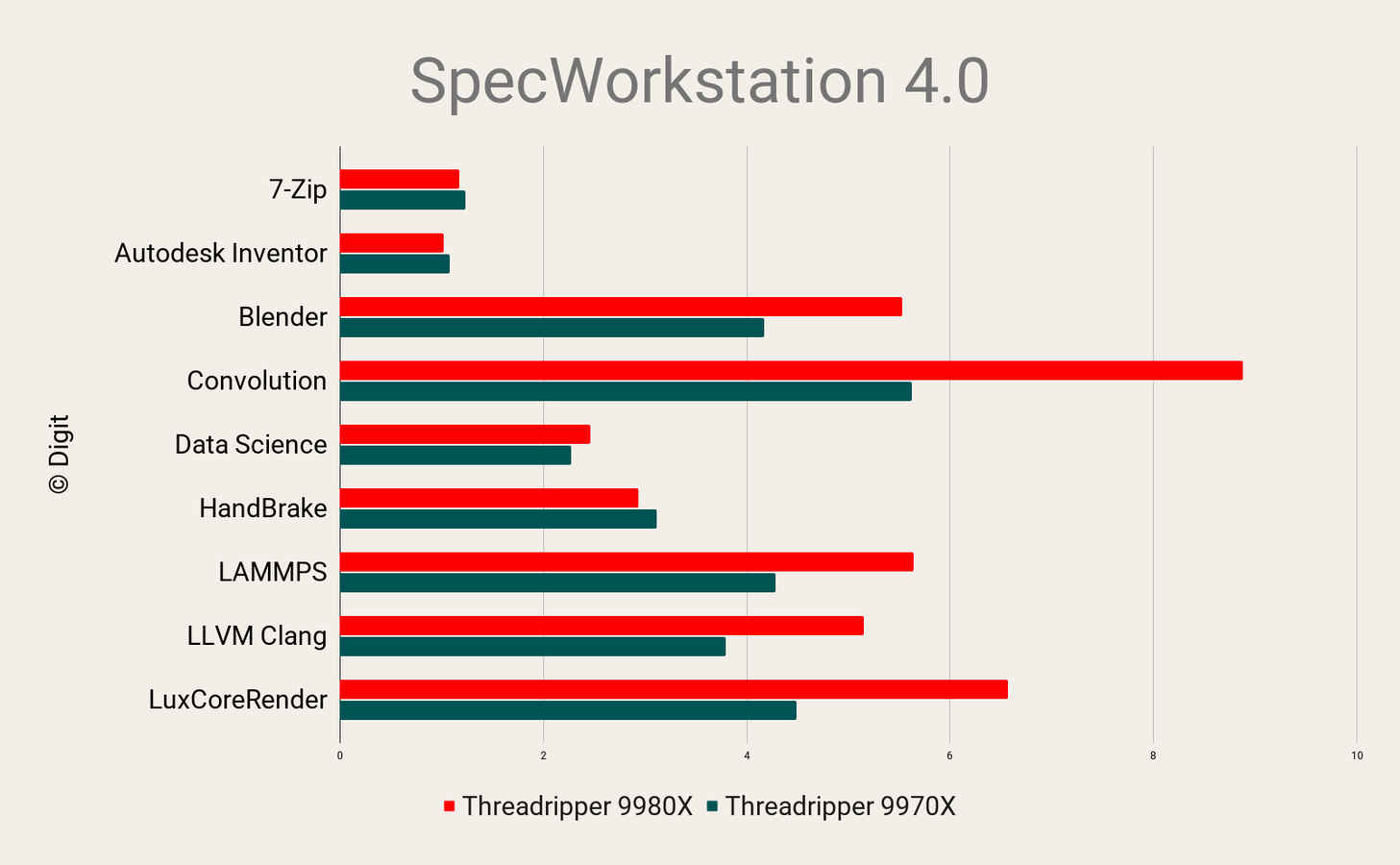
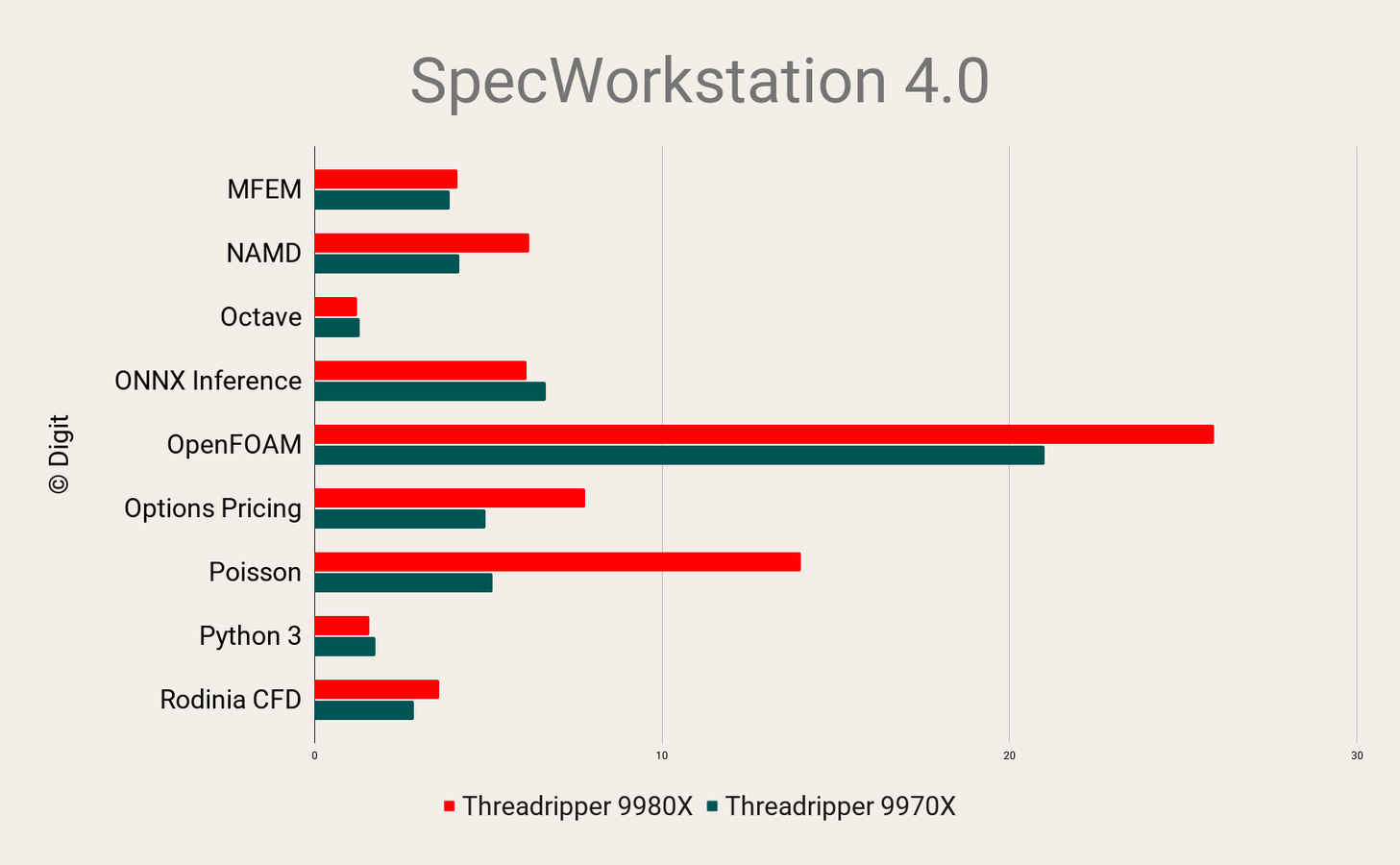
SPECworkstation 4.0 offers one of the most comprehensive real-world performance assessments for professional workstations, covering a wide range of verticals including media and entertainment, architecture and engineering, life sciences, and financial services. It simulates workloads from applications such as Autodesk Maya, SolidWorks, and 7-Zip, testing everything from file compression and CAD model manipulation to complex simulation tasks.
The AMD Ryzen Threadripper 9980X performed consistently across nearly all workloads, though the deltas compared to the 9970X were narrower than expected in some segments. In 7-Zip compression and decompression, the 9980X recorded SPEC ratios of 1.38 and 0.80 respectively, while the 9970X managed 1.42 and 0.87. The differences are marginal and suggest that these sub-tests do not benefit dramatically from the additional cores and cache on the 9980X.
In the Autodesk Inventor suite, the 9980X returned SPEC ratios of 1.02 for the composite workload and 1.05 for document opening, whereas the 9970X slightly edged it out with scores of 1.08 and 1.06. These results reflect the fact that many CAD applications remain lightly threaded and continue to rely more on single-threaded performance and fast memory access than raw core count.
Overall, the 9980X showed excellent consistency and was rarely outperformed by the 9970X, but it’s also evident that SPECworkstation’s test suite includes many workloads that simply don’t scale well beyond 32 threads. For workstation buyers focused primarily on these types of tasks, the 9970X may offer nearly identical real-world performance at a lower platform cost. That said, the 9980X remains the more future-proof option for users expecting heavier parallel workloads or evolving software that can better exploit its capabilities.
AIDA64 Memory Benchmark
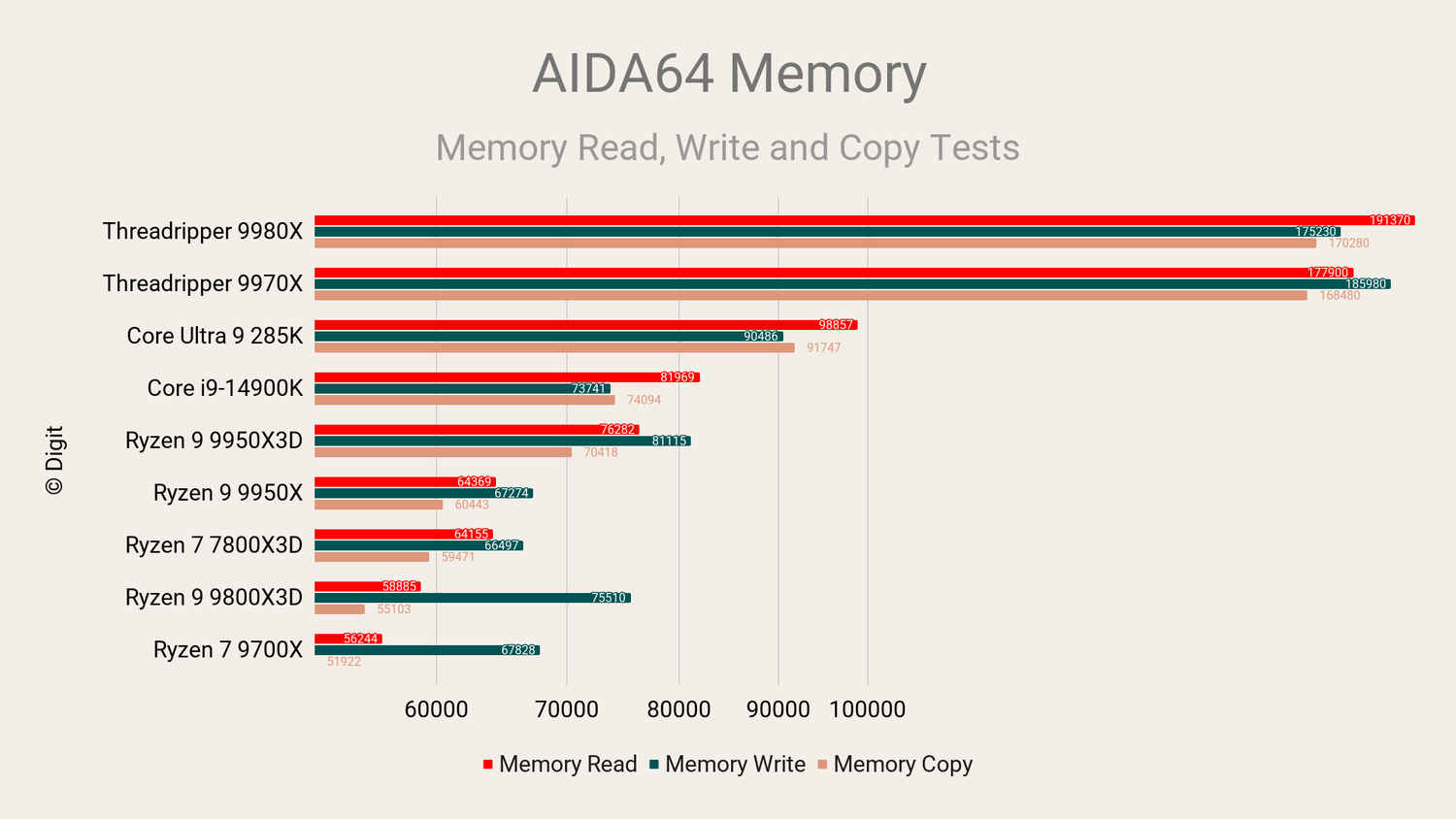
AIDA64’s memory suite evaluates raw memory throughput and access latency across read, write, and copy operations. It’s an excellent way to gauge the benefits of quad-channel DDR5 RDIMM at 6400 MT/s, especially for applications that demand high memory bandwidth.
In read speed, the 9980X hit 191 GB/s, compared to 76 GB/s on the 9950X3D. Write speeds came in at 175 GB/s vs 81 GB/s, and copy speeds reached 170 GB/s compared to 70 GB/s. Most notably, memory latency on the 9980X averaged 118.4 ns, while the 9950X3D sat closer to 78.3 ns.
These deltas are significant for workloads that rely on quick memory fetches, such as engineering simulations, large Excel-based financial modelling, or AI pipelines that manipulate large in-memory datasets. The 9980X’s ability to maintain low-latency, high-throughput memory transfers is one of the reasons it handles complex projects so smoothly.
UL Procyon Office Productivity (Microsoft Office)
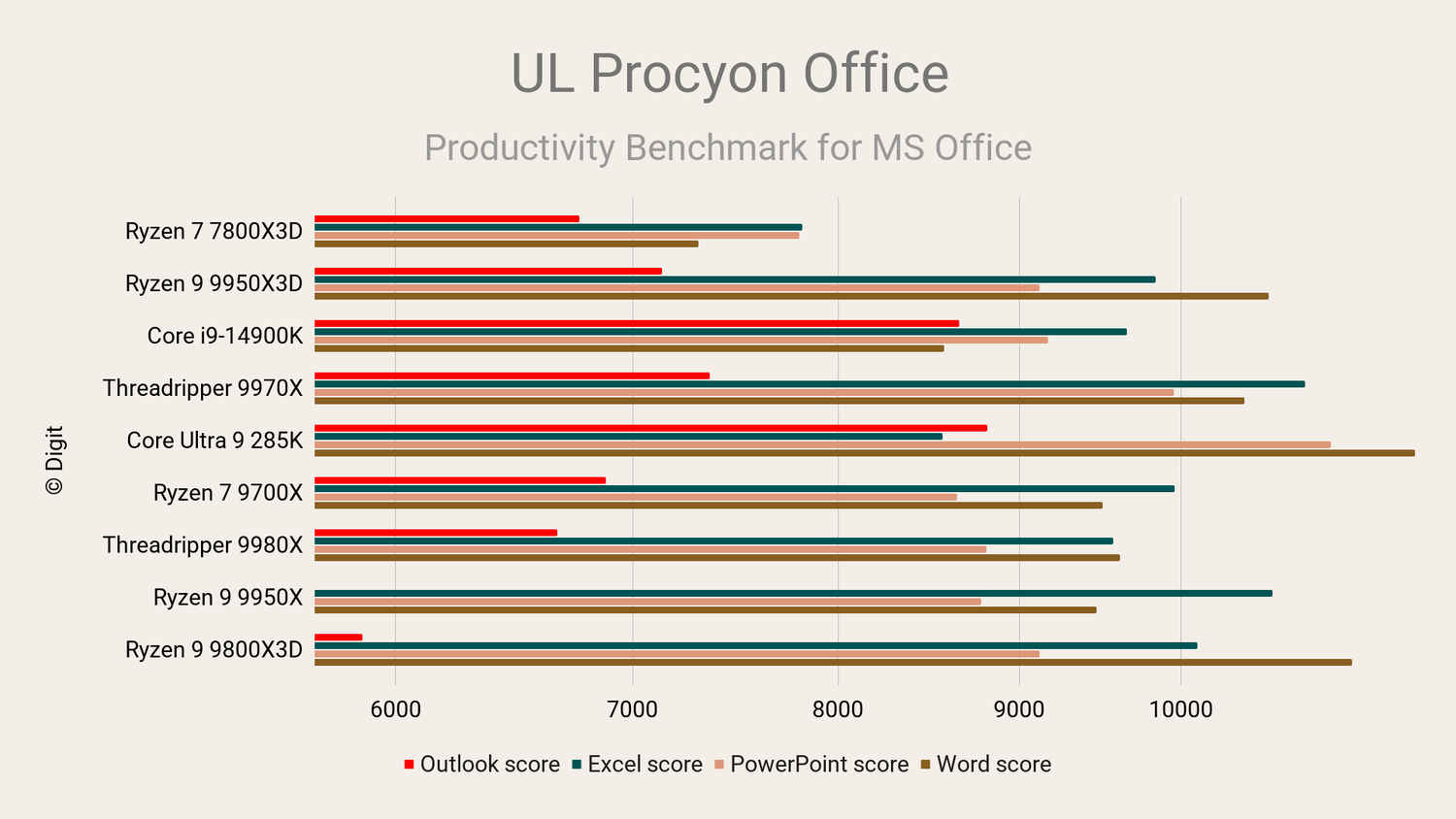
The Office Productivity benchmark from UL Procyon runs a mix of Microsoft Word, Excel, PowerPoint, and Outlook tasks. It includes heavy spreadsheet calculations, mail merges, content editing, and data visualisation, etc. all with macros and scripts enabled to simulate power-user workflows.
The 9980X scored 8,885 points, while the 9950X3D posted 10,587. Although the tasks involved aren’t fully multi-threaded, the speed at which the 9980X can process simultaneous light-thread loads shines through, particularly in Excel-based tasks with VBA automation and PowerPoint exporting.
For knowledge workers managing dozens of open documents, huge pivot tables, or automated reporting dashboards, the 9980X feels like overkill but it’s the kind of overkill that ensures nothing slows down, even with teams running multiple VMs or Office containers on a shared workstation.
Gaming isn’t typically the domain of a 64-core processor, but that doesn’t mean the Threadripper 9980X isn’t capable of it. While most games don’t scale beyond 8–12 threads, high-end gaming setups today often include much more than just the game itself. Streamers, developers, and video professionals might be encoding, rendering, or compiling in the background, all of which can saturate a mainstream CPU. In those cases, the 9980X’s excess capacity becomes a strength, not a liability.
3DMark CPU Profile
The 3DMark CPU Profile is designed to measure processor scaling across different thread counts, from 1 thread up to the maximum supported by the chip. This allows us to evaluate how well the CPU handles lightly threaded to fully parallel workloads typical in gaming and simulation environments.
The Threadripper 9980X scored 1,109 at 1-thread, 15,607 at 16-threads, and peaked at 27,370 with all threads engaged. Compared to the 9950X3D, which scored 1,273 followed by 16,406 and 16,518 respectively, the 9980X only pulls ahead at max threads.
This means that while the 9980X may not push higher frame rates in typical gaming titles, it excels in game development scenarios like lightmap baking, shader compilation, or real-time crowd simulation. For Unreal Engine and Unity developers, the parallelism available here can dramatically speed up production cycles.
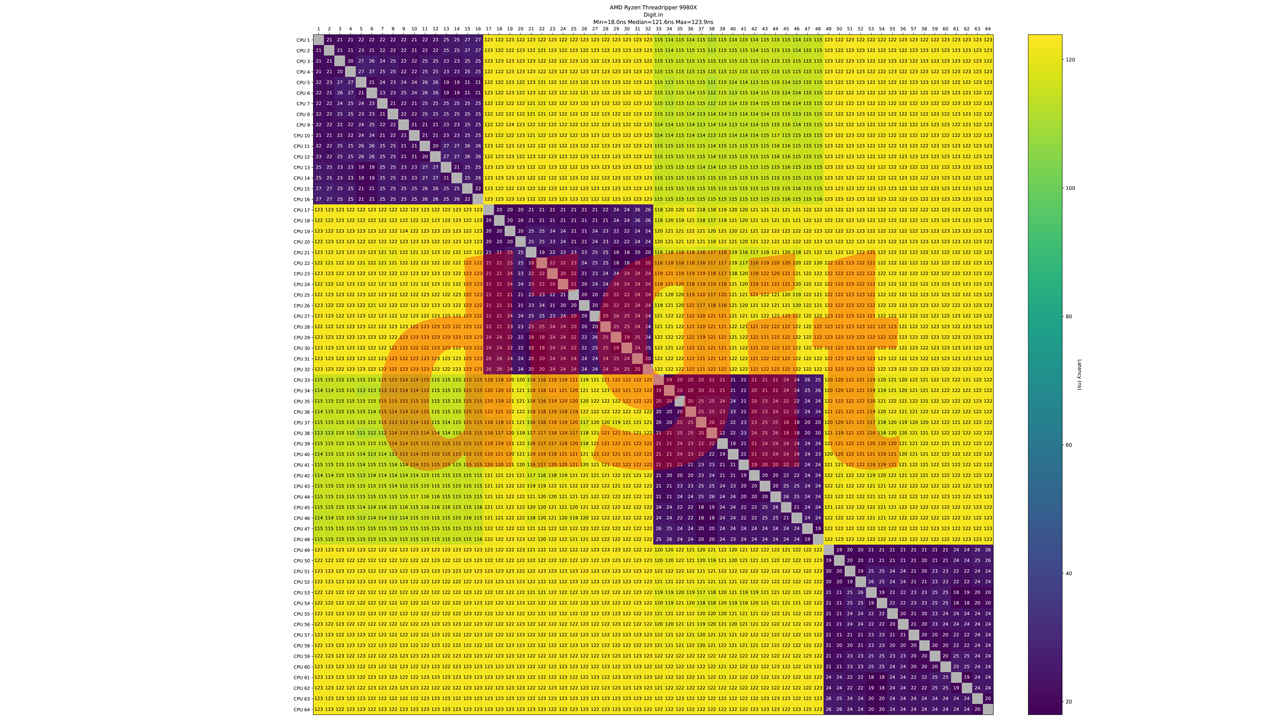
One of the trade-offs with the Ryzen Threadripper 9980X’s expansive design is a slight regression in core-to-core latency compared to its predecessor. Inter-CCD latency, which measures the delay between cores located on different chiplets, has increased to approximately 122 nanoseconds, up from the 92 to 94 nanoseconds typically seen on the 7980X. Intra-CCD latency has also risen marginally, going from 18 to 20 nanoseconds previously to around 22 nanoseconds on the 9980X.
While these deltas may seem minor in isolation, they can have some implications for applications that rely heavily on tightly coupled thread coordination, such as certain scientific simulations, real-time physics engines, or low-latency audio processing. That said, most professional content creation and rendering tools are designed to work around such latency, preferring wide parallelism over thread-to-thread synchronisation. As a result, the slight increase in core-to-core latency doesn’t meaningfully affect multithreaded rendering or batch processing pipelines.
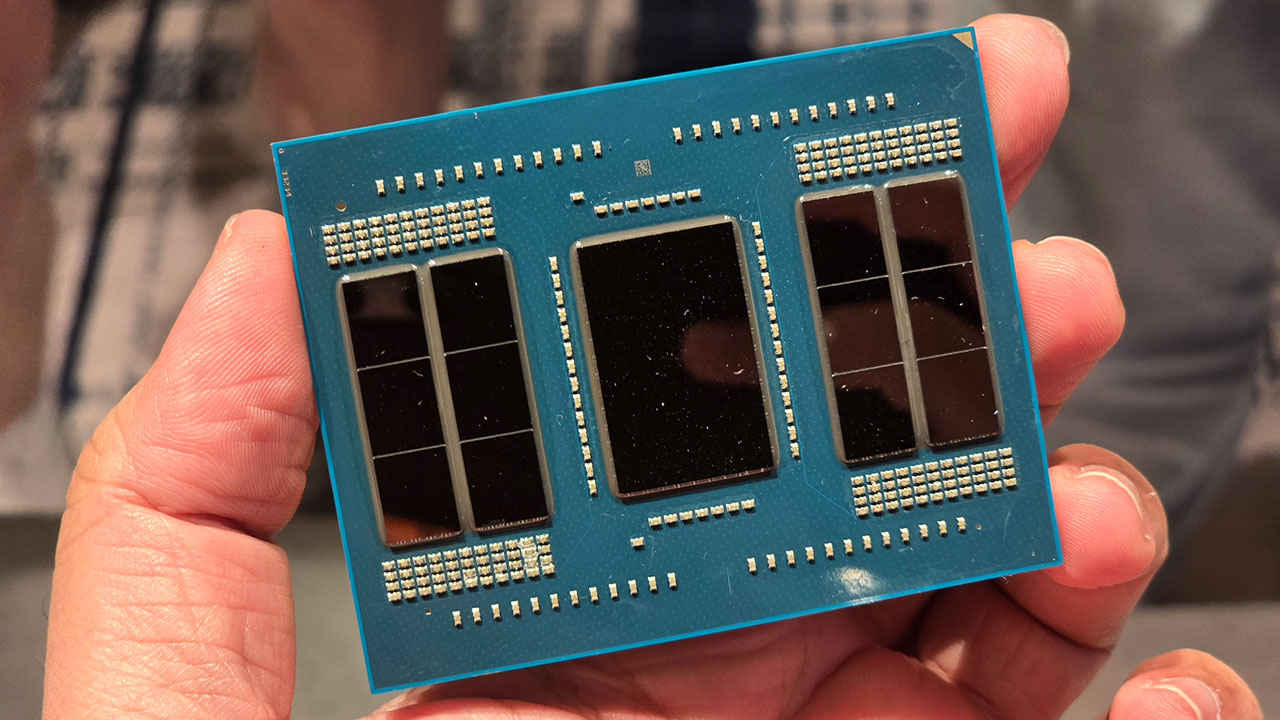
It’s also worth noting that the increase in latency is a natural side effect of scaling the core count across more chiplets. With eight CCDs, each with their own L3 cache and routing, there’s more distance—logically and electrically—between individual cores. AMD has prioritised bandwidth and throughput over low-latency synchronisation here, and for the vast majority of the 9980X’s target workloads, that’s the right call.
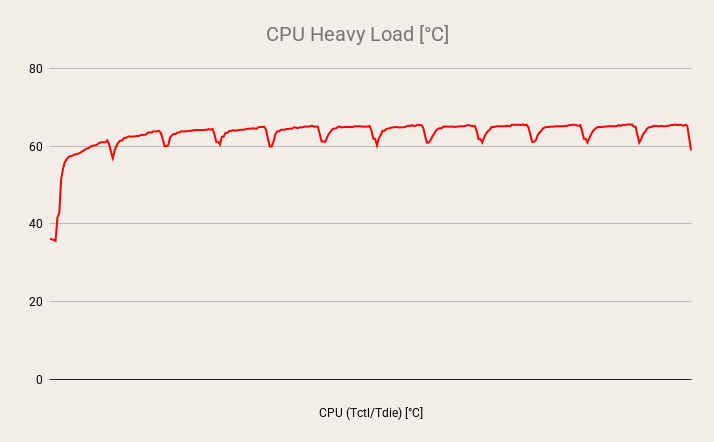
he Ryzen Threadripper 9980X is a dense, high-power processor and it behaves like one under sustained load. With a rated TDP of 350 watts, it requires serious cooling to maintain stable performance during prolonged rendering, compiling, or simulation sessions. In our open-bench setup, the SilverStone XE360-TR5 AIO cooler rose to the challenge, keeping the chip well within thermal limits throughout testing.
During an extended Cinebench R23 multi-core run, the CPU’s average core temperature peaked at just 60.8°C. There were no signs of thermal throttling or instability. That’s notably cooler than expected for a 64-core part, especially one running near its peak boost clocks. The result reflects both the efficiency of AMD’s redesigned heatspreader and the effectiveness of the XE360-TR5’s full-contact cold plate. At idle, the CPU hovered in the high 30s to mid-40s depending on ambient conditions, and thermal distribution across the CCDs remained consistent.
One area that stood out during stress testing was memory thermals. While the processor stayed cool, the RDIMMs, especially high-frequency modules, warmed up significantly under load. With no active airflow directed at the memory, some modules approached thermal limits and risked throttling. Passive heatsinks alone weren’t enough to mitigate this, even on an open bench. Anyone building a system around the 9980X should consider targeted airflow over the DIMM slots, particularly for memory-heavy workflows like simulation, 3D rendering, or AI inferencing.
Overall, thermal performance was excellent in this configuration. That said, it’s clear the 9980X benefits from thoughtful thermal planning. This isn’t a CPU that belongs in a budget chassis with average airflow, it needs a well-ventilated case, a capable cooler, and memory-specific thermal consideration to perform at its best. Do that, and it rewards you with stable clocks, high throughput, and consistent all-core performance.
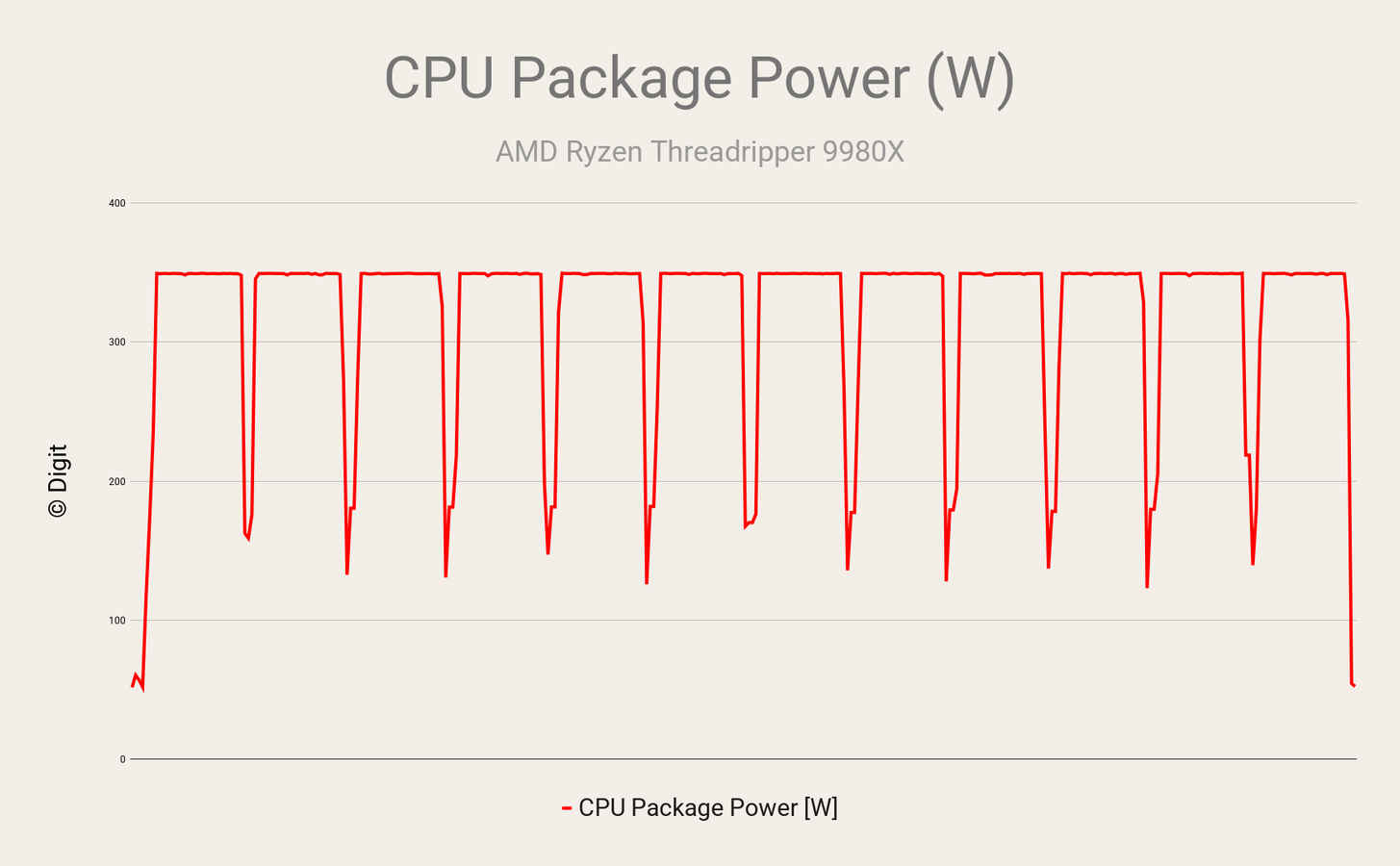
If performance defines one half of the Threadripper 9980X’s character, power draw completes the picture. This is not a timid processor. In light workloads such as browsing, document editing, and routine multitasking, the system stayed relatively modest, drawing about 100 watts in total, which is expected for a high-end desktop equipped with a modern GPU and multiple storage devices.
When pushed, though, the 9980X shows its appetite. The CPU package power peaked at 349.7 watts, almost exactly in line with its TDP, confirming that AMD’s specification is more than just theoretical. Even when idle, the system maintained a steady baseline near 85 watts which is an acceptable result given the number of active cores and background services.
What stands out, though, is not just the raw draw, but how well the power translates into meaningful work. The 9980X delivers substantially higher throughput than older HEDT parts like the Core i9-10980XE or even the previous-gen 3990X, and it does so with greater efficiency per watt. The system remained stable throughout thanks to the 1200 Watt PSU. If you’re running a workstation of this calibre, a high-efficiency PSU is essential.
Value is always a tricky topic when it comes to high-end desktop (HEDT) processors, and the Ryzen Threadripper 9980X is no exception. On its own, the cost of the CPU can appear steep especially when compared to consumer flagship parts like the Ryzen 9 9950X or Intel’s Core i9-14900K. But this isn’t a chip meant for mainstream buyers. It’s targeted at professionals with workloads that demand far more than what typical desktop CPUs can deliver.
What the 9980X offers is single-socket performance that would have previously required dual-socket Xeon or EPYC setups. For studios, engineering teams, or researchers, this means eliminating the complexity and licensing costs associated with enterprise platforms while still achieving server-class throughput. That translates to faster renders, quicker simulation turnarounds, and shorter compile times, all of which can directly impact project timelines and profitability. In the hands of a freelance VFX artist or a boutique game studio, a workstation that shaves hours off every iteration can pay for itself surprisingly quickly.
Still, the platform is undeniably expensive. TRX50 motherboards are premium by design, with heavy-duty VRMs, extensive PCIe 5.0 I/O, and ECC RDIMM support. DDR5 RDIMMs themselves are costlier than typical consumer memory, especially in high capacities. Factor in a serious cooling solution and a high-wattage power supply, and the total system cost can easily cross way beyond what high-end gaming setups usually cost.
That said, for the right user, there’s undeniable value here. If your workflows involve 4K editing, batch processing, real-time rendering, or machine learning at scale, the time saved can be significant. However, if your workloads only occasionally spike beyond 24–32 threads, the more affordable Threadripper 9970X or 9960X might offer better efficiency and ROI.
The 9980X makes the most sense for users who are constantly pushing their systems to the limit and doing so in ways that benefit from massive multi-core parallelism. For those users, this chip brings workstation-class power to a platform that remains flexible and manageable, without requiring the leap to datacentre infrastructure.
The AMD Ryzen Threadripper 9980X is, quite simply, a heavyweight. Built for creators, engineers, and high-performance professionals, it combines 64x Zen 5 cores, high boost clocks, and an I/O-rich TRX50 platform to deliver staggering levels of compute power. Whether you’re rendering in Blender, simulating fluid dynamics, compiling at scale, or training AI models locally, this chip is up to the task.
What sets it apart from previous Threadrippers and even some enterprise chips is its flexibility. The 9980X handles heavily threaded workloads with ease, but thanks to its 5.4 GHz boost clock and refined IPC, it doesn’t flinch when you throw single-threaded or lightly threaded tasks at it. This makes it surprisingly competent in interactive workflows like editing, design, and software development, where low latency matters as much as throughput.
Of course, the trade-offs are real. The power draw peaks at nearly 350 watts, so power and thermal management can’t be taken lightly. TRX50 platforms are expensive to build around, and ECC RDIMMs don’t come cheap. Gaming performance is fine, but if that’s your primary use case, you’re better off with a mainstream CPU.
Where the 9980X shines is in scenarios where time equals money. Its ability to cut render times, accelerate simulation cycles, and handle concurrent tasks makes it an asset in any studio or lab environment. For individuals or teams dealing with complex workloads daily, it could be one of the most impactful hardware upgrades available.
In many ways, the 9980X represents the peak of HEDT computing: server-grade horsepower in a workstation-friendly form. If your applications can use all those cores and your budget can handle the build this is one of the most capable CPUs you can buy today.