The Galaxy Z Fold 7 finally feels like a leap, not because it reimagines the foldable phone, but because it refines it with surgical precision. The Fold 7 landed in India at a hefty Rs 1,74,999, and is Samsung’s slimmest Fold yet, shaving millimetres off both the hinge and frame, and for the first time, the closed device actually feels like a phone, not a paperback notebook.
But like last year, Samsung’s foldable doesn’t arrive alone. Vivo’s X Fold 5, launched just days after, is cheaper by Rs 25,000. And suddenly, the conversation shifted, not about what foldables can do, but about which one should be your next everyday phone.
Because that’s where we are now. Foldables are no longer futuristic tech flexes. They’re practical, premium smartphones that have to justify their price not just with specs, but with polish. And the Galaxy Z Fold 7 is doubling down on durability, polish, and everyday usability. Seven generations in, is this finally the Fold that feels complete out of the box? Or are we still beta-testing Samsung’s foldable vision at Rs 1,74,999?
The Galaxy Z Fold 7 is Samsung’s most polished foldable to date, and it’s finally a foldable that feels like a regular phone when shut. This one is wafer-thin at 4.2mm when open and just 8.9mm when folded, which is thinner than the Fold 6 (review) and within striking distance of the Galaxy S25 Ultra’s 8.2mm profile, making it more pocket-friendly.
At 215 grams, it’s also the lightest Fold Samsung has ever built. In fact, if you’ve used older Folds, your muscle memory might actually fumble a bit, it’s that light! And with its sharper corners, flatter cover screen, a titanium-backed display support layer and a new hinge that’s smoother and feels more precise, this Fold 7 is less like a prototype refined over time and more like a design that was meant to exist. Open and close it a few times and you’ll notice it’s smoother, quieter and tighter.
Getting there wasn’t easy, though. Samsung’s been chiselling away at its foldable formula for years, but the Fold 7 is where it starts to show. Samsung eliminated the digitiser layer (RIP S Pen support), thickened the Ultra Thin Glass for better resilience and sandwiched in a titanium plate to stiffen the whole thing.
Both the inner and outer displays are flat now, which does wonders for usability, especially when swiping from edges or using the Fold like a mini laptop. The aluminium frame and Gorilla Glass Ceramic 2 protection also add a layer of durability, and you still get IP48 water and dust resistance, which is fine for instilling confidence, but short of X Fold 5’s IP59+ rating.
While slimming down the Fold 7, Samsung ensured the displays didn’t get left behind in the process. The cover screen is now 3% larger and the main display is about 5% bigger than the Fold 6. In our tests, you’re looking at a peak brightness of 2,480 nits on the cover display and 2,400 nits on the main foldable panel. And while peak numbers are often achieved in tiny HDR windows, real-world usability here is absolutely stellar. Outdoor visibility is excellent and even under direct sunlight, both screens cut through harsh outdoor light and remain readable and vivid, with colours and contrast holding up effortlessly.
But it’s the calibration that makes these displays near-flawless.
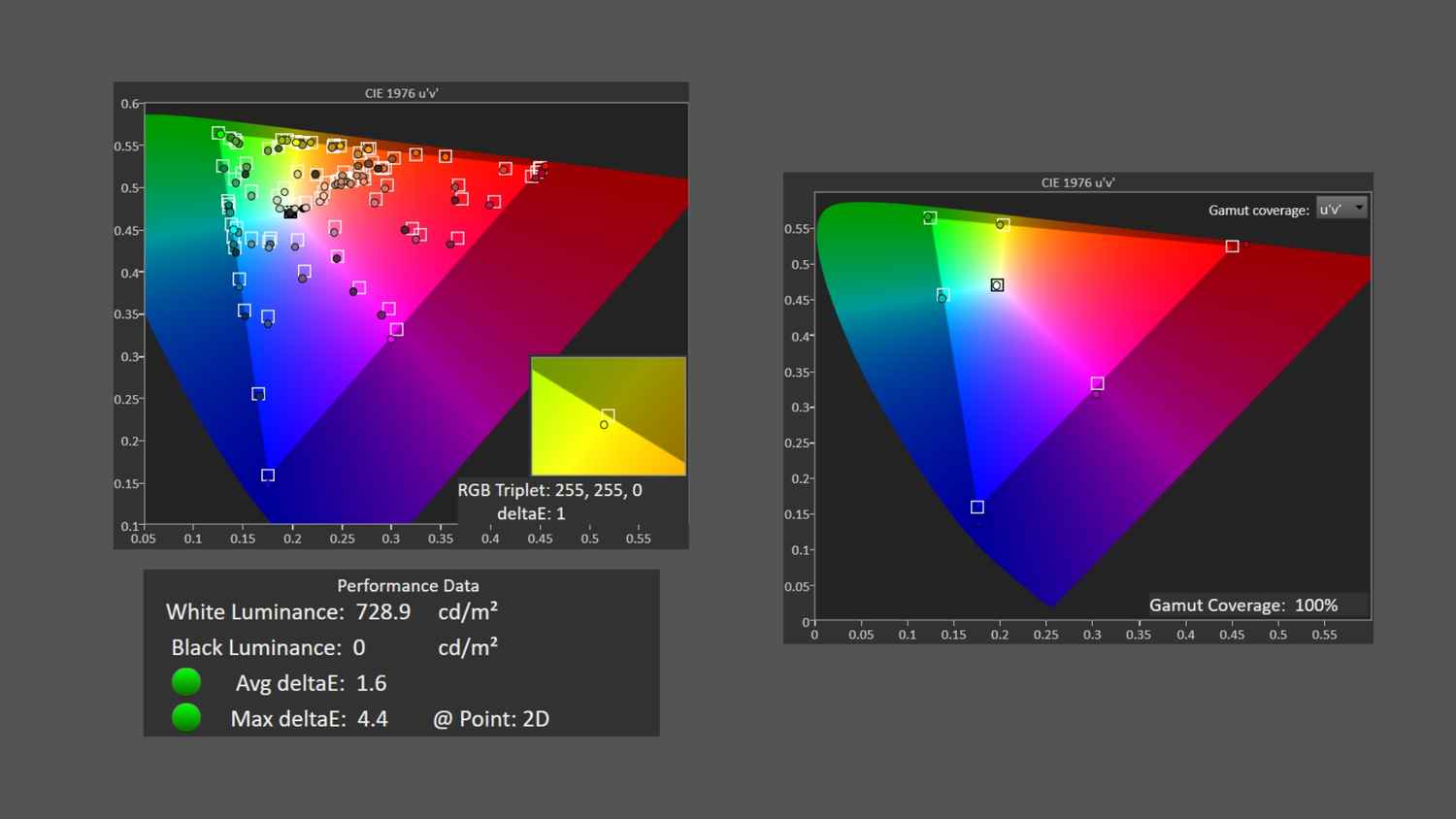
In our Calman tests, the Fold 7’s main screen delivered 100% sRGB coverage with tight adherence to target colour values. The deltaE colour accuracy stayed impressively low, averaging 1.6 and going no higher than 4.4 in worst-case scenarios. That’s well below the visible error threshold, meaning colours look natural, balanced, and professional-grade whether you’re editing photos or just bingeing K-dramas.
The black levels stayed pinned to zero thanks to OLED’s perfect contrast. Speaking of contrast, the Fold 7 delivers a near-infinite ratio, and grayscale performance is equally solid, giving you accurate shadow detail and neutral midtones.
The HDR performance is equally good with both HDR10 and HDR10+ support on YouTube and OTT apps such as Netflix and Prime Video, to name a few. This means punchier highlights, smoother gradations, and that classic OLED depth on both screens. The foldable panel itself handles 10-bit colour with ease, and Samsung’s software processing does a good job of tone-mapping without clipping or oversaturation.
And yes, both displays are now completely flat, which makes a bigger difference than you might think, especially when using the phone in Flex mode, navigating the UI with edge gestures, or just trying to type on the outer screen. Samsung’s decision to optimise the form factor finally pays off in a way that’s both aesthetic and ergonomic.
With 10-bit colour depth, Dolby Atmos-enabled speakers, and these calibrated screens, the Fold 7 might just be the best portable binge machine you can fold in half.
The Fold 7 might look more refined, but under the hood, it’s all business. It’s powered by Qualcomm’s Snapdragon 8 Elite, so it’s only natural to expect top-tier performance.
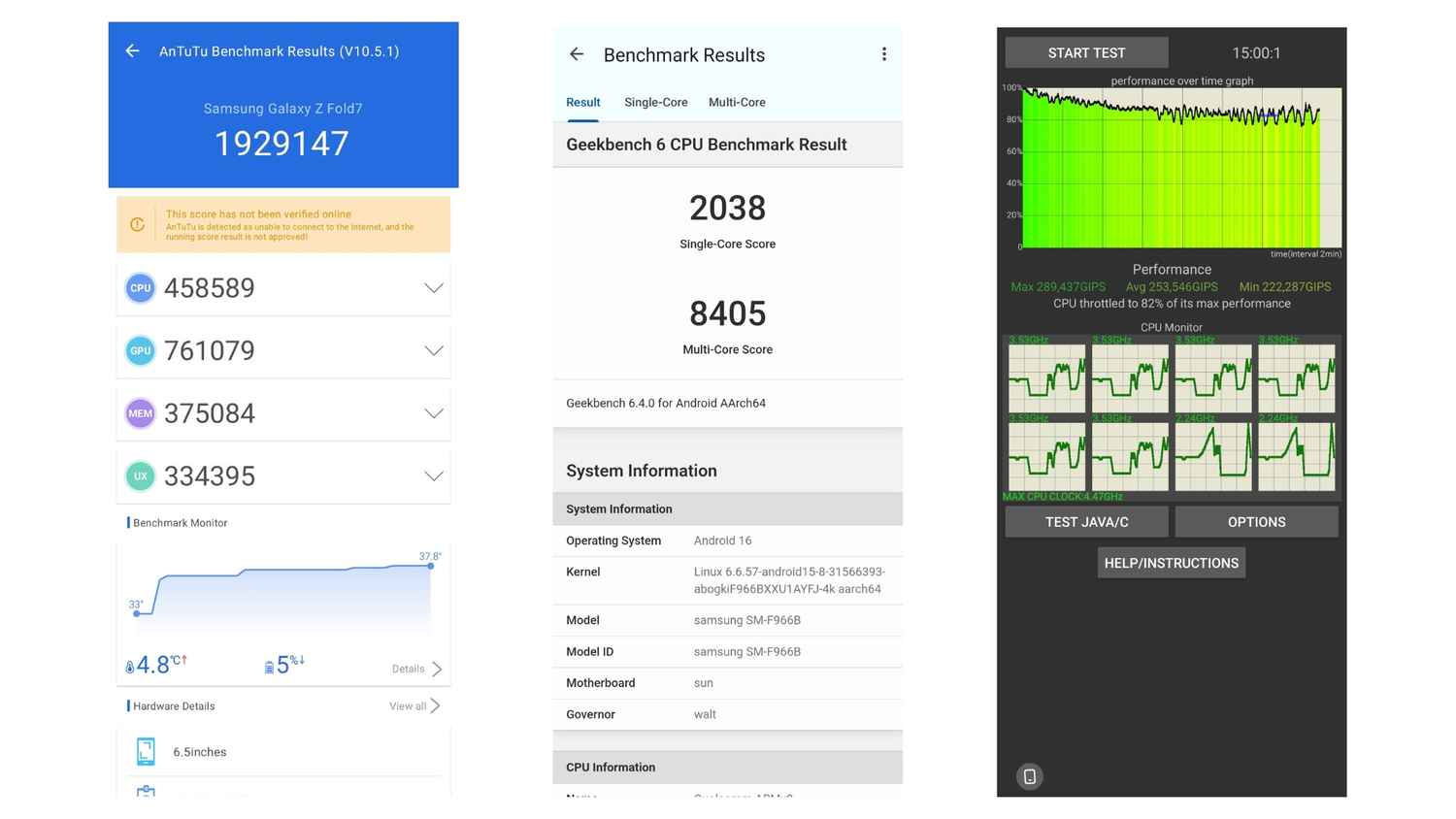
Starting with AnTuTu, the Fold 7 pulls in a staggering 1,929,147, which is nearly a 22.5% jump over the Fold 6. Even Geekbench 5 multi-core scores are up by nearly 29%, while the single-core score holds steady.
What really impresses is sustained performance. The CPU Throttling Test holds at 82%, a massive improvement over the Fold 6’s 60%. That alone translates to a phone that doesn’t get bogged down mid-session, especially during heavier multitasking or long gaming runs. The vapour chamber redesign ensures that you get a cooler, more stable experience all around.
BGMI runs at 88–90 FPS on Smooth + Extreme+ settings while Genshin Impact gets a consistent 58-60 FPS at the highest settings. Both feel glorious on the larger 8-inch screen, but it’s not just about the frame rate, it’s the immersion. Everything from recoil control to map awareness feels enhanced on the bigger canvas. There are minimal frame drops and no palm-searing heat. That alone makes it one of the best foldables for gaming and better than many slab flagships.
The 3DMark Wildlife Extreme hits 4,966 (a modest bump over Fold 6), while PCMark Work 3.0 now jumps to 18,576, up nearly 3.7% from the Fold 6. The Fold 7 flies through multitasking with fluid animations, drag-and-drop workflows in Flex Mode, and Samsung’s DeX desktop interface like it was born for productivity.
Running on top of Android 16 is the One UI 8 that brings polish to the Fold 7 and foldable-first AI features. You can now share your screen in Gemini Live, move and resize AI-generated snippets, or use natural voice commands to get context-aware results in apps like Notes, Calendar, and even the camera. Features like Circle to Search now work in games and AI tools adapt fluidly across split screen and floating windows. Samsung has also promised 7 years of OS and security updates, which means the Fold 7 is built to stay relevant long-term.
Despite no change in battery capacity, the Fold 7 maintains a battery life of 912 minutes in PCMark, slightly better than the Fold 6 despite higher performance output. That’s a win for power efficiency, and credit goes to both the 3nm node and Samsung’s thermal tuning.
In daily use, that translates to around 6 hours of screen time with mixed usage: Slack, Chrome, camera, YouTube, and a bit of BGMI thrown in. Charging is still on the slower side for 2025, where a full top-up takes just under 1 hour 40 minutes, but 25W is Samsung being… Samsung. You do get wireless charging and reverse wireless for earbuds and watches, which keeps things convenient, especially for travellers.
Like the foldable mechanism, the camera system is another part of the Fold 7 that quietly demonstrates its maturity. This year we get well-rounded cameras that deliver images that look close to what your eyes see, without leaning too far into computational makeup.
The new 200MP main sensor is a step up and brings real-world gains in detail, tone, and dynamic range. In daylight, it’s a treat: skies don’t get oversaturated, greens stay grounded, and textures, whether it’s buildings or trees, come through with impressive clarity. The colours are neutral and accurate, the dynamic range is wide without looking processed, textures hold up well and there’s no excessive contrast trickery in sight.
Low-light performance on the main sensor is equally composed. High contrast scenes and neon signs are handled with restraint, highlights don’t blow out easily and noise is well-controlled.
Close-ups are another strength. Food shots, fabric, tiny textures, all pop with accurate subject separation and a soft, natural bokeh. Portraits are sharp, edge detection is tight and skin tones avoid both oversmoothing and saturation.
The 10MP telephoto lens does its best work when the sun’s out. Zoomed shots are sharp enough at 3x with decent colour retention and you can read text on distant signboards without that mushy, smudged look. But once you shift to low light, it starts to unravel. Detail drops, noise creeps in, dynamic range tightens, and there’s focus hunting. It’s serviceable, but not flagship-grade.
Samsung’s colour science this year is more balanced and true-to-life rather than boosted. It’s a welcome change for purists or anyone who enjoys editing later, but folks looking for punchy, saturated social media-ready shots might find it a touch too flat straight out of the camera.
Overall, it’s a dependable camera system that doesn’t shout, but knows exactly what it’s doing, with a few caveats tucked behind the zoom.
After seven generations, Samsung has finally figured out how to make a foldable that feels like a natural extension of your daily phone use, not a science project. It’s slimmer, lighter, and more pocketable. It unfolds to a larger, brighter display. And when you use it, there’s finally a sense of fluidity in the hinge, the UI and the transitions that earlier Folds couldn’t fully deliver.
Performance is rock-solid, the display experience is top-tier, and the main camera finally gives you a flagship experience. Even though the telephoto lens misses the mark in low light, the overall imaging package is consistent and reliable, especially for those who favour natural-looking photos over hyper-stylised ones.
Is it perfect? No. You’re still paying Rs 1,74,999 for 25W charging, no S Pen support, and a camera setup that’s good but not best-in-class across the board. And with the Vivo X Fold 5 undercutting it on price, the Fold 7 isn’t the only premium foldable worth considering anymore.
But here’s the thing: for anyone who’s been waiting to finally take the foldable leap, this is the most refined, least compromised version of Samsung’s vision yet. It feels ready. Not experimental. Not niche. Just quietly capable.