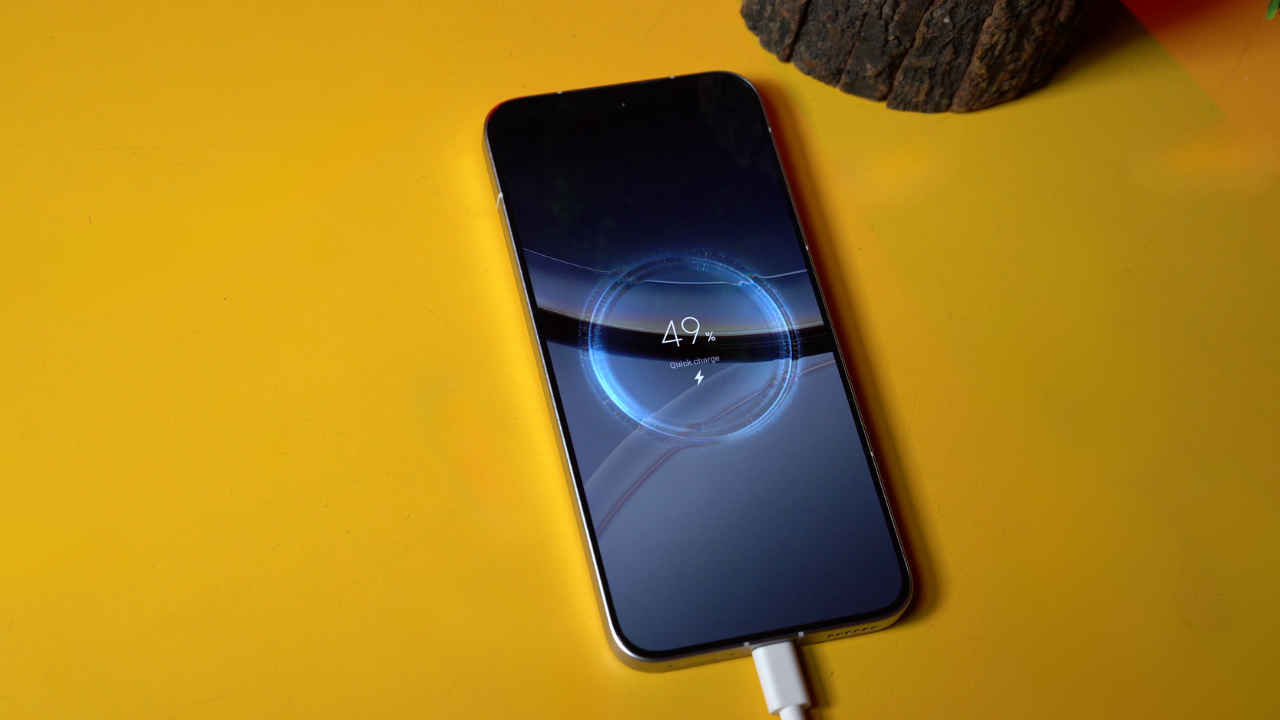
The Poco F7 is all about raw power. It is built like a tank, runs like a flagship, and lasts forever. Sure, the camera is not its strongest suit, but if gaming, performance, and battery are what matter to you, this one is a total no-brainer at Rs 31,999.
Just three years back, if I had told you there is a phone priced at Rs 31,999 that packs a 7550mAh battery, is powerful enough to rival flagships, and comes wrapped in a rugged yet eye-catching design, would you have believed me? Probably not. But wait, by now, you must be wondering why I have listed all the key specs and haven’t even mentioned the camera once? Well, that pretty much sums up the story of our new favourite performance mid-ranger, the Poco F7.
I have been using the successor to the Poco F6 for a week now, and I think it’s finally time to tell you everything about it. So here goes my review of the Poco F7.
Poco F7 Review: Smudge magnet, but damn it looks good!
As I mentioned earlier, the Poco F7 is a rugged smartphone. At Rs 31,999, I genuinely don’t think any other brand has launched a phone that offers Gorilla Glass 7i protection on both the front and back, along with an IP69 rating against dust and water. The Poco F7 packs both of these.
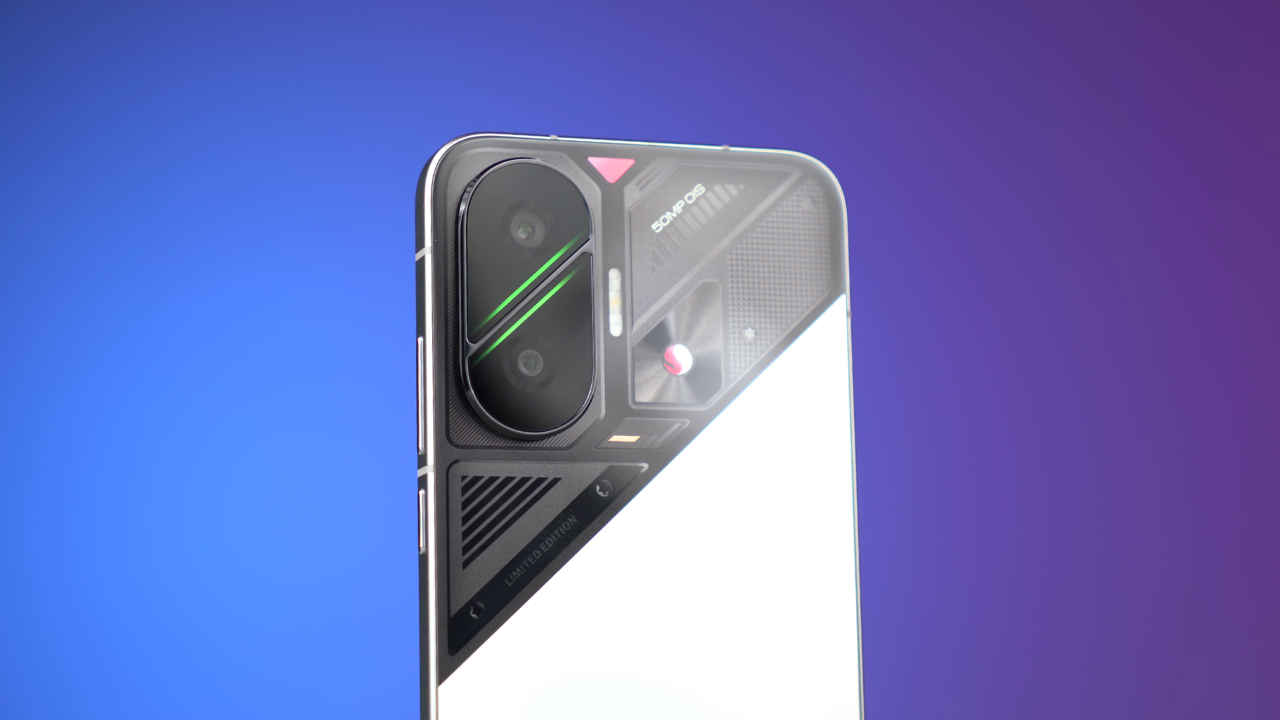
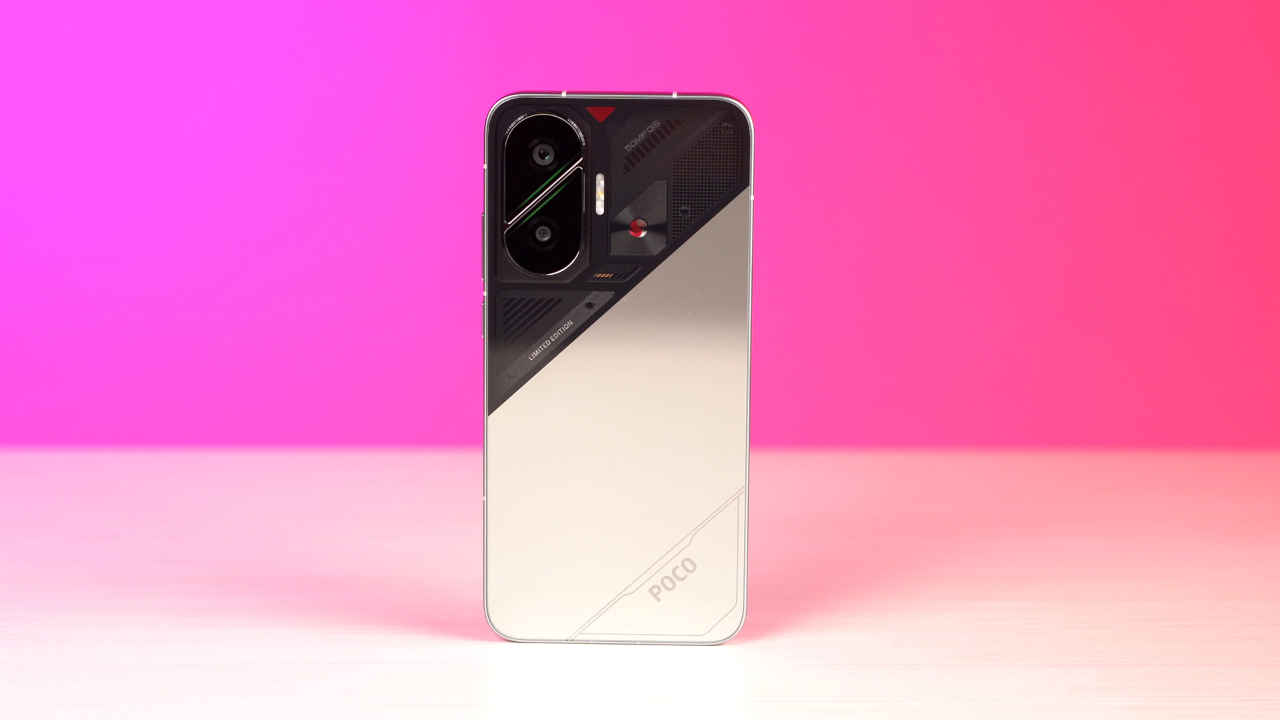
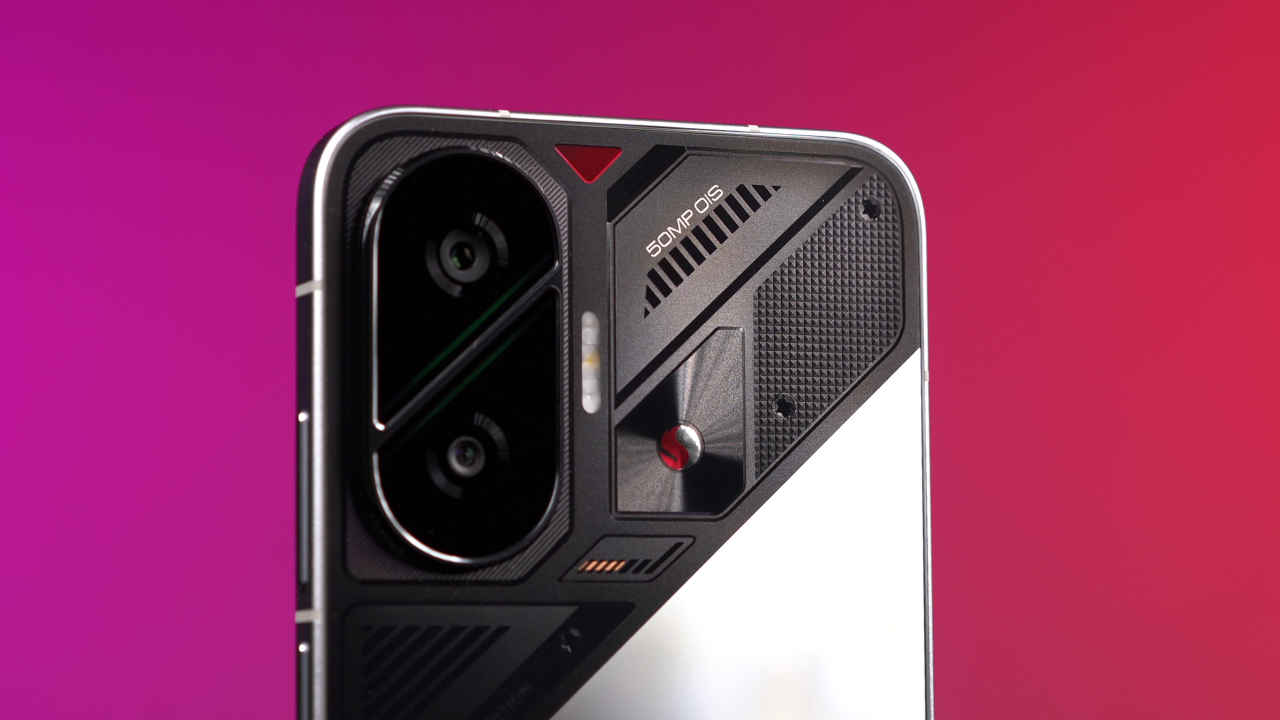
Now, coming to the looks, I have the silver variant of the Poco F7 (the one I would recommend to everyone), which sports a unique back panel. It has got some really cool elements: that tiny Snapdragon branding and those green diagonal lines running across the camera bump add a nice touch.
But with great looks comes great maintenance, and no, I am not talking about money. If you want your Poco F7 to keep looking good, you’ll need to carry a microfibre cloth at all times. This phone is a smudge magnet. The silver finish catches so many fingerprints that it kind of steals the charm. Though I would still say go for this colour, it looks fantastic.
Lastly, this phone is quite wide and bulky, weighing over 220 grams. However, honestly, I think that’s a fair trade-off when you are getting a power bank-sized battery inside a smartphone.
A well-tuned display
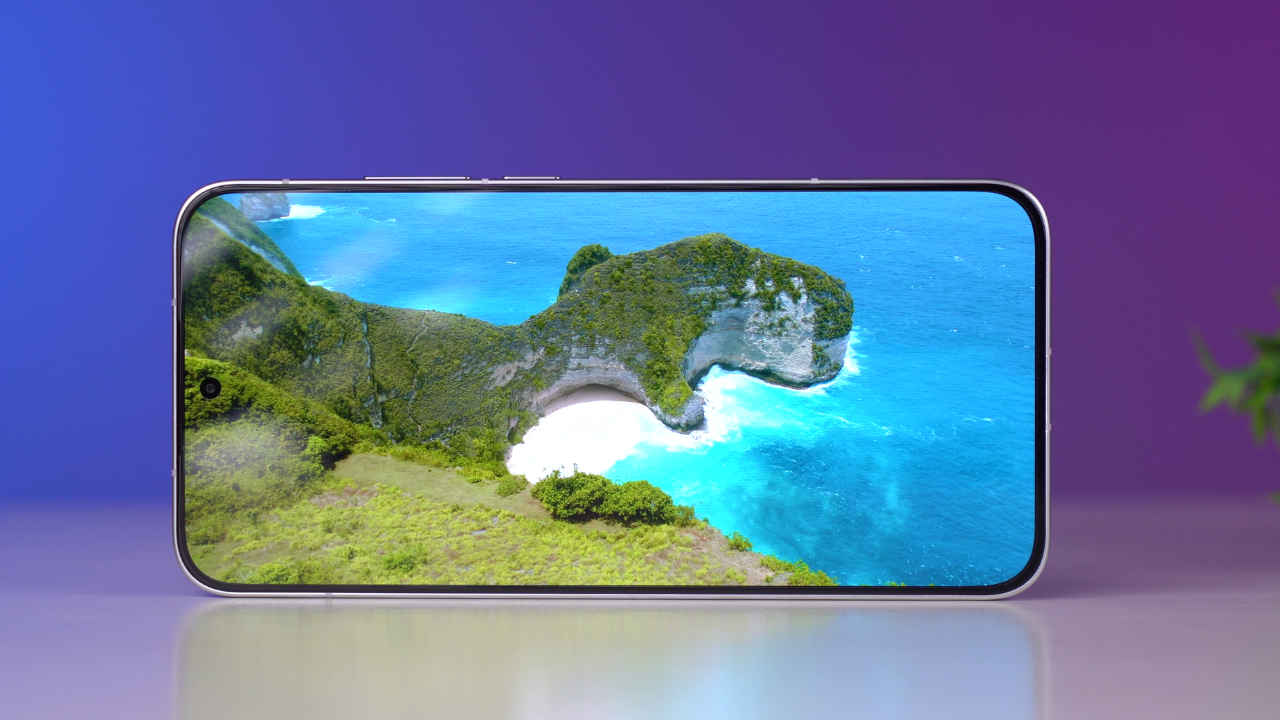
On the display front, the Poco F7 features a 6.83-inch pOLED panel with a 1.5K resolution and a 120Hz refresh rate. Now, while it is not the brightest display in the segment, it doesn’t really hinder usability, be it indoors or outdoors. We recorded a peak brightness of 1780 nits on auto mode, which is not class-leading, but it gets the job done. Despite that, the panel feels fluid and bright enough for everyday use.
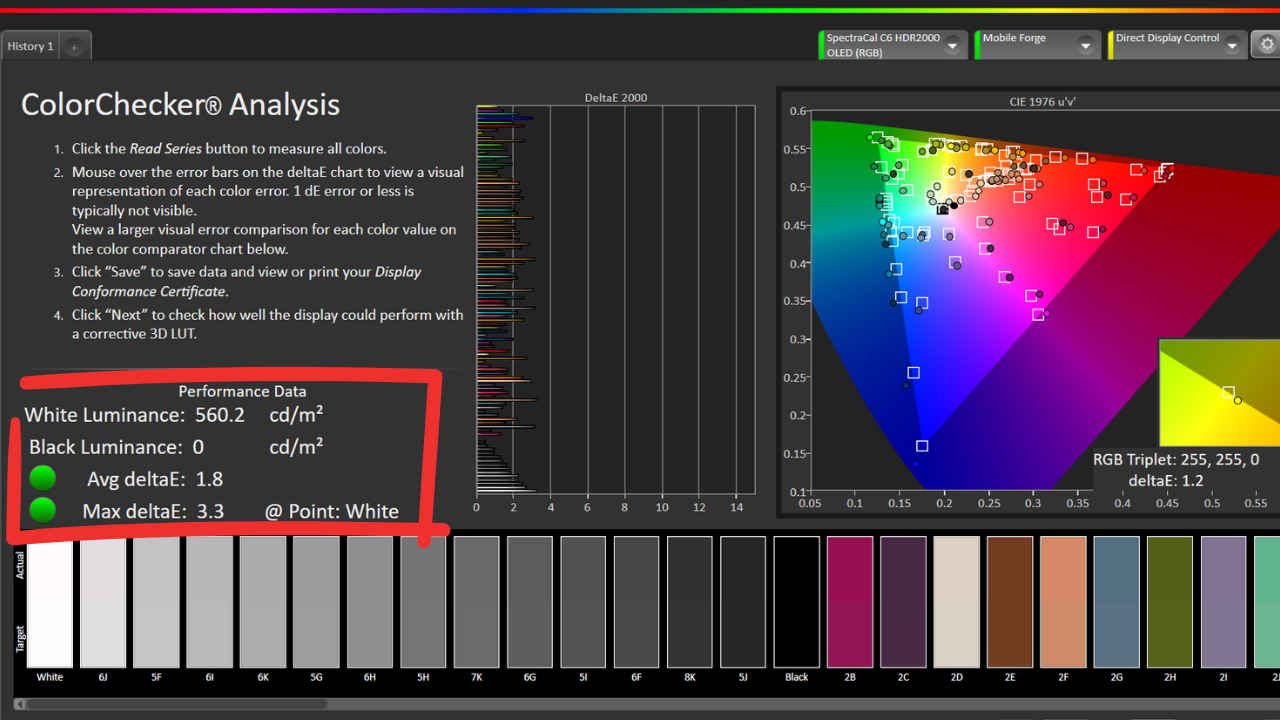
Next, this display delivers vibrant colours with solid contrast. The visuals lean slightly towards the natural side, and this was clearly visible during our testing as well. In Calman’s colourimeter test, the Poco F7 scored an average DeltaE of 1.8, which is actually pretty good, and indicates the display produces colours that are close to real-life tones.
Calman data
I feel that it also tries to get most details on point, because overall I loved watching content on it. And lastly, two things that add to the viewing experience on the Poco F7: Ultra-thin bezels and Dolby Vision support.
Poco F7 Review: Top-notch performance in the segment
As you all know, the Poco F7 is a performance-centric phone that comes with some impressive specifications: Snapdragon 8s Gen 4, up to 16GB of LPDDR5X RAM, and UFS 4.1 storage. But the real question is, does it actually deliver on those promises?
AnTuTu and Geekbench
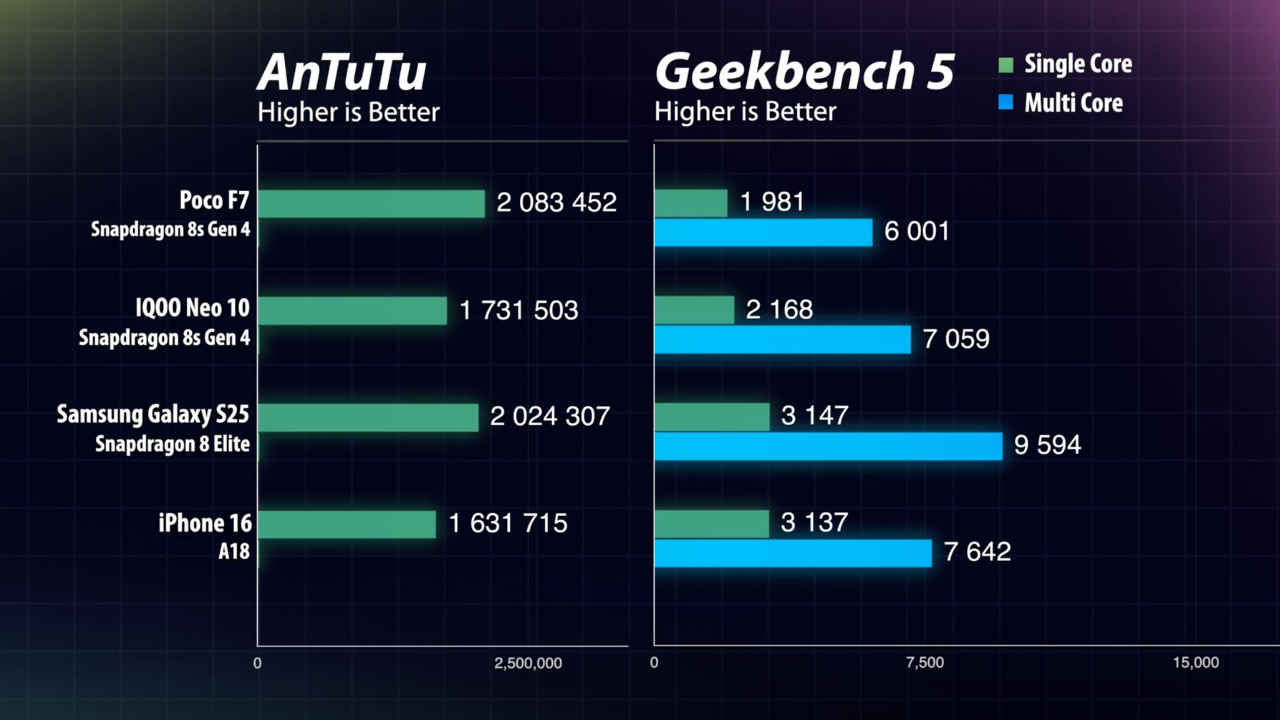
Well, according to our benchmark tests, the Poco F7 pulled off a seriously good score. I was already impressed with the iQOO Neo 10 when I reviewed it, and now Poco has managed to outshine that as well. Scoring over two million points on AnTuTu at a price of Rs 31,999 is a benchmark in itself. In our testing, flagship devices such as the Galaxy S25 and iPhone 16 have scored lower than the Poco F7 in AnTuTu. So yeah, this one definitely has the firepower of a genuine flagship killer.
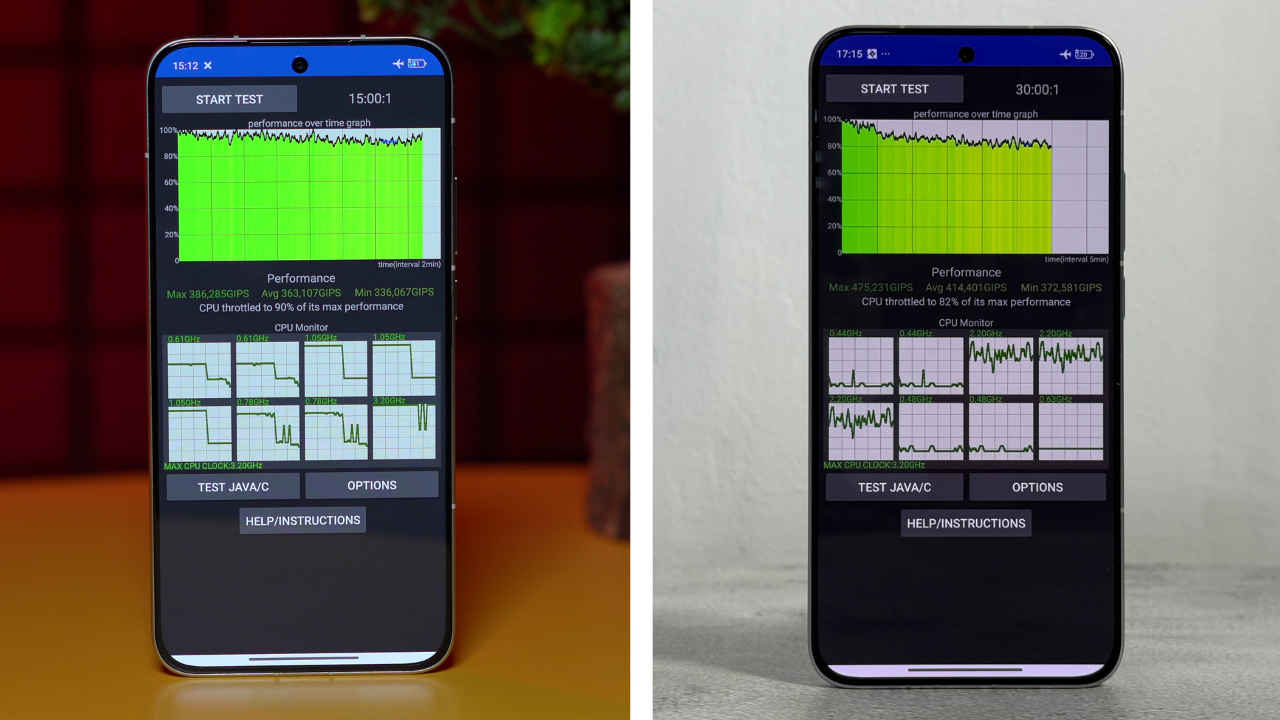
But raw power is one thing, but how consistent is that performance in daily use? To test that, I ran the CPU Throttling Test twice: a 15-minute session under moderate load, and another 30-minute session under heavy load.
CPU Throttling: 15 minutes VS 30 minutes
Turns out, the Poco F7 passed both tests like a piece of cake. In our 15-minute stress test, the CPU maintained 90% consistency, and thermals were impressively controlled. The 30-minute stress test did heat things up, but consistency stayed reasonably solid at 82%.
Now, all this was our lab-style testing to prove that this phone can take a left jab, a right jab, and even an uppercut when it comes to performance. But what about real-world usage? That’s where gaming steps in.
BGMI Gameplay
During a 30-minute BGMI session, we noticed that the Poco F7 currently supports only 90 FPS, but it is not capped there. We reached out to the Poco team, and they have confirmed an upcoming OTA update to enable 120 FPS support in BGMI. That said, even at 90 FPS, the experience was smooth like butter. In our session, the frame rate held steady with 99.4% stability and an average of 87.1 FPS. If it’s this good at 90 FPS, I am expecting a great ride at 120 FPS as well.
Cameras that don’t try too hard
Although the Poco F7 leaves some room for improvement on the camera front. But I won’t complain because let’s be honest, if I am buying this phone, it is to beat my friends in games, not to show off my photography skills. The phone carries a dual-camera setup with a 50-megapixel main sensor and an 8-megapixel ultrawide lens. On the front, you get a 20-megapixel selfie shooter as well.
While I was testing its camera, the weather was a little gloomy, which gave the shots a soft, diffused look. The Poco F7 manages to capture clean and natural-looking colours. It also tried to manage the dynamic range as much as it could, but it could be better. And most importantly, it retains most of the details without the pictures looking over-processed, meaning it clicks sharp photos.
I think the low-light performance is also pretty solid for the price. There are not too many light bleeds, and the exposure is also managed decently. Plus, we don’t get to see too much noise in the shots, but if your subject is in complete darkness, the detail takes an impact.
When it comes to portraits, the edge detection is decent, but textures like hair strands often get flattened, and if you look closely, the borders look a bit artificial. Also, the portrait mode tends to overly beautify the image, with colours popping more than they should.
I enjoyed using its 20-megapixel front camera. You can click sharp and well-exposed selfies with mostly accurate skin tones. Fortunately, this phone doesn’t aggressively smoothens the skin like we see on other phones.
That 7550mAh battery is the real MVP
The most powerful weapon in the Poco F7’s arsenal is its massive 7550mAh battery. I tried killing it in a day, but barely made a dent. All the performance testing I mentioned earlier only drained 17% of its juice.
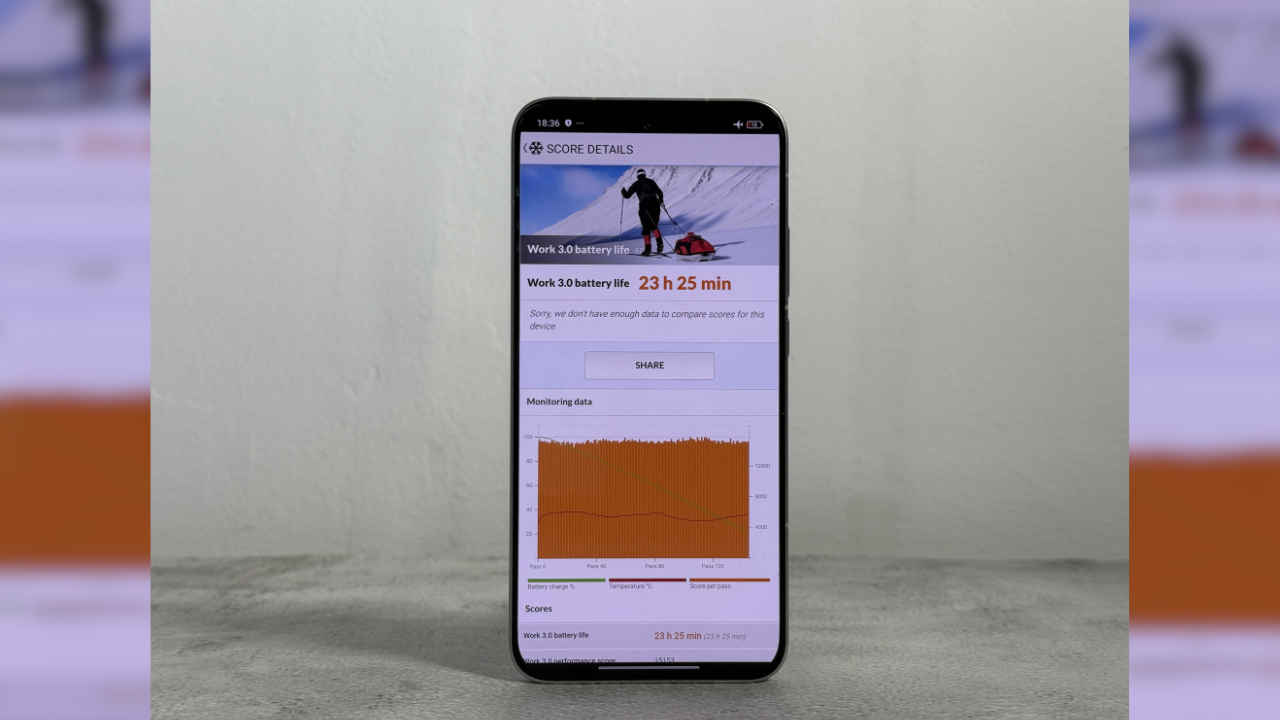
In our PC Mark Battery Life test, the Poco F7 clocked an impressive 23 hours and 25 minutes, our best score yet among mid-range phones. So yeah, you can easily expect two to three days of screen time on a single charge.
Speaking of charging, it supports 90-watt fast charging, which takes it from 0% to 100% in about 85 minutes. Now I know a lot of phones these days top up in under 50 minutes, but do they carry a battery this big? Nope!
So, what do we think about the Poco F7?
The Poco F7 feels like that overachiever kid in class who doesn’t flaunt it but consistently outperforms. For Rs 31,999, it gives you power enough to compete with flagships, unmatched battery life, and a design that’s rugged yet cool. Although the camera is not going to win awards, but it gets the job done (especially in low light). Add to that smooth 90 FPS gaming (with a promised 120 FPS update), you have got yourself a genuine“Flagship Killer” when it comes to performance. This phone is not trying to impress everyone, but it is made for the user who prioritises speed, stamina, and solid value.
Mustafa is a young tech journalist who tells it like it is, cutting through buzzwords to deliver straightforward smartphone reviews. He’s the office go-to for insider tips and quick demos, and his video content doesn’t waste anyone’s time. When he’s off the clock, he geeks out over cars, photography, and hunting down the best spot for Indian food.