I’ve been watching the sub‑Rs 10,000 headphone market get crowded lately. The popular ones already tick the basics: ANC, long battery life, app support, decent sound. So, standing out usually comes down to how well a brand does one or two things better than everyone else. The newly launched CMF Headphone Pro, priced at Rs 6,999 in the introductory period, tries that with a unique design and up to 100-hour battery life. It also packs interesting specs like Hi-Res LDAC support, hybrid ANC up to 40 dB, Bluetooth 5.4, etc. And in my testing, I wanted to see if CMF’s feature sheet translates into real value at this price and whether the design and other choices by the Nothing sub-brand make sense. Let’s dive in.
The CMF Headphone Pro immediately grabs attention with its cute and flashy look. Our review sample is teal coloured with a glossy finish on the metal rail and earcups. Whenever I put it on, in the office, in the metro, or at home, people around me would glance at it or even ask about it. It has a distinct and intentional appearance. But that can be subjective, and not everyone’s cup of tea. I would have preferred the light or dark grey variants instead.
There is a subtle ‘CMF by Nothing’ branding on the earcups. Both earcups also offer you a nice physical interface to easily control various settings and aspects:
While a physical interface allows more precise and intentional control mechanisms, it may demand some learning curve. Besides the buttons, the right earcup has a USB-C port, and the left earcup has a 3.5mm headphone jack. CMF packs a 3.5mm aux cable in the box.
Coming to comfort, the large and plush ear cushions offer good over-ear seal, and the cushioned headband also sits finely on the head. At 283 grams, with a plastic, metal, and synthetic leather material combination, the headphone is light and comfortable in daily use. The clamp force is negligible. You can easily twist and swap those ear cushions. The respective L and R markings inside them let you replace them and also put on the headphones properly.
You can rotate the earcups flat. This could aid in packing and carrying them on your neck. But, no folding hinge here. The given IPX2 water resistance is also weak, but at least you get some assurance from sweat and drizzle, which many headsets in the range don’t give.
Also Read: Nothing Headphone 1 Review: Visually daring, sonically reserved
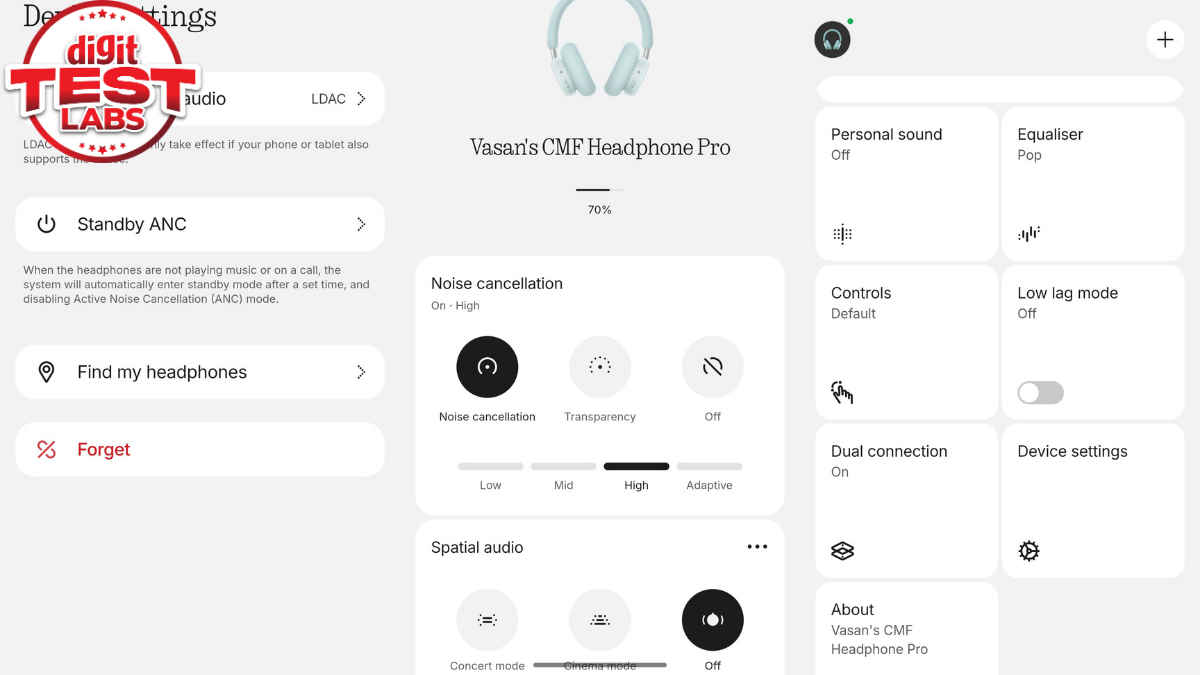
Pressing the pairing/power button on the left earcup for a few seconds begins pairing mode, and you’ll get a fast pairing notification on nearby Android phones. The headphones have Bluetooth 5.4, and the connection stays stable. It supports the Dual Connection feature, letting you connect to two devices and switch playback between them. You’ll have to pause one to start playing from the other. Not a flaw; just how it works. In any case, if you want it, you’ll have to enable it within the Nothing X app.
The Nothing X app also lets you choose a higher-resolution LDAC codec, switch ANC levels, toggle Spatial modes (Concert/Cinema), calibrate personal sound profile, Find Headphones, enable Low Lag mode with less than 120ms latency claim, Standby mode, and a simple EQ with some presets. This is a very simple EQ interface with some useful presets, but far from a full parametric EQ.
There’s no wear‑detection-based playback pause feature, which can be annoying if you remove the headphones from your ears and the music continues playing.
Battery life is arguably this headphone’s biggest bragging point. CMF claims ‘up to 100 hours’ of playback with ANC off and around 50 hours with ANC, AAC and at 50% volume. In my test, I got 37.5 hours with ANC, LDAC, and continuous playback at 80% volume. With ANC off and moderate use, you can eke out enough juice for a weekend outing.
Fast charging is practical too. I tested by draining the battery down, and it took close to 1 hour and 30 minutes to fully charge the device with a white LED indication. CMF says a 5-minute quick charging could fetch you 4 hours of playback. Good for morning commutes.
The headphone charges via USB‑C. There’s no wireless charging here. You can’t use the headphones wired or wirelessly while they’re charging. At least wired should work, I feel. But honestly, I barely had to charge it at all in normal use. The battery meter in the app is accurate, so I always knew how much juice was left.
There is no USB-C audio support, either. So, no, you can’t listen through the USB-C port. It is for charging only. What’s weird, though, is that you can listen via the 3.5mm cable only if the headphone is powered on.
Another qualm is that it doesn’t auto turn off when Bluetooth is connected to a device. So, hours later, when you pick it up, it will still be on. The auto standby mode mentioned before starts after 30 minutes only. It must not drain much battery, but the anxious me wished it had a quicker standby timer or an auto shut-down feature.
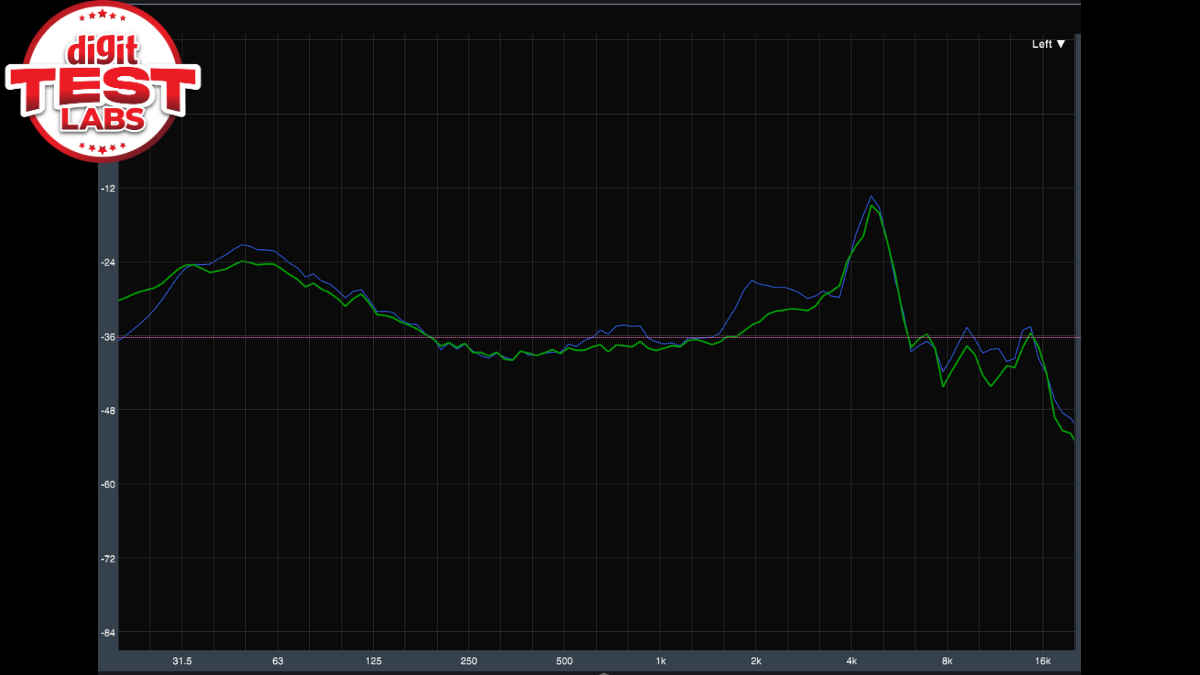
I tested the CMF Headphone Pro across a wide range of tracks, focusing on bass, mids, treble, presence, and stereo imaging. The performance is strong overall. Its limitations only become clear when compared directly with flagship headphones. So that tells you it’s quality.
In Dream Theater’s Pull Me Under, guitar riffs, bass lines, and drums remain mostly distinct, and James LaBrie’s vocals sound clear, but in the busy portions of the song, his sound feels slightly behind the guitar and other instrumental layers. This vocal performance is noticeable in Johnny Cash’s Hurt, too.
The bass drops on Billie Eilish’s Bad Guy are tight. Just a reminder, I was listening to the Pop EQ profile with the Bass slider at its lowest setting. But raising it does make the bass sound boomy, if that’s your preference. For instance, in Jeremy Soule’s Dragonborn (Skyrim game soundtrack), the war drums get a rumbling effect with the bass slider raised. The slider is handy for such quick toggles.
It offers a fairly wide stereo presentation with good detail in tracks like The Who’s Baba O’Riley. However, the staging in Dragonborn’s epic hall and orchestral passages does not feel as extended or spacious as on a flagship model like the WH-1000XM6. Spatial modes such as Concert and Cinema add width and are enjoyable to use, but the effect is subtle rather than transformative.
So, with the CMF headphones, you will get a fun, energetic tuning with decent clarity. It performs well for the asking price.
Active Noise Cancellation on the CMF Headphone Pro is quite effective for everyday use. I compared its ANC to our reference device, the Sony WH-1000XM6, and it was comparable in the indoor settings. Outdoors, some noise from heavy traffic or street noise seeps in. I used it mostly in the High ANC settings, but you can switch between Low, Medium and Adaptive levels.
As for Transparency mode, it is reasonably good but not as natural as Ambient mode on our higher-end reference device. My voice sounded a little distant or artificial to me in this mode.
For calls, the CMF did a decent job. Thanks to its 3 HD mics and Environmental Noise Cancellation (ENC), I was able to take calls comfortably using the headphone mic, and both people could hear each other properly.
After living with the CMF Headphone Pro for a few days, my takeaway is that it offers very strong value for the sub-Rs 8,000 mark. It looks intentionally playful and will appeal to people who like its cute charm or simply want something that doesn’t blend into a sea of serious-looking headphones. Even its physical control layout can feel unfamiliar at first, but once you get used to it, the buttons and roller feel deliberate and handy. Comfort is handled well, too, with a lightweight, cushioned chassis and a relaxed clamp that works for long listening sessions.
The sound, while not neutral or flagship-grade, is engaging and easy to like. LDAC support adds flexibility for higher-quality streaming, and ANC is effective enough to make that experience calmer and private. More importantly, battery life is strong enough that this experience can last long without much charging anxiety.
When so many things are done right, it’s natural to expect the same level of polish everywhere. But considering its price, there are some sensible but noticeable restrictions. You can’t use the headphones while they’re charging, either wired or wirelessly. The 3.5mm wired mode only works when the headphones are powered on. The hinge isn’t fully foldable. There’s no wear-detection, and the IPX2 rating offers only basic splash protection, which is lower than what some rivals manage.
Still, the core experience remains strong for the price. So, the CMF’s first headphones make the most sense for buyers who want something different from the usual serious-looking ANC headphones, and also value long battery life, comfort, and a fun, energetic sound. If that’s what you’re looking for, its compromises feel reasonable, and its strengths are easy to live with.
Also Read: Sennheiser HD 505 Copper review: Studio-style clarity under Rs 20,000