Microsoft has time and again focused on turning Windows 11 into a more AI driven platform. But the reaction that the company got isn’t what was anticipated. There has been a lot of backlash from long time users and developers about the new updates to Windows 11 and now, the company has admitted that there is a lot of work to be done. Microsoft says that the future of Windows is an “agentic” one, where the operating system becomes far more autonomous. At the same time, Windows chief Pavan Davuluri has tried to reassure people who worry that the OS is drifting away from the needs of technical users. His recent comments suggest that Microsoft is aware of the backlash, even if it has no intention of slowing down its AI roadmap.
Also read: New Android PCs could be powered by Snapdragon Elite processors, details here
Microsoft gets backlash from users over Windows 11
The trouble began on November 10, when Pavan Davuluri, President of Windows and Devices, posted on X about Windows’ next phase. His message described the OS as evolving into an “agentic” platform that connects devices, cloud services and AI in order to unlock smarter productivity and secure work from anywhere. The post was meant to set up Microsoft’s announcements at Ignite, but instead it triggered days of heated responses.
By the time the post went viral, it had crossed more than a million views, hundreds of replies and enough negative feedback that Pavan eventually locked the comments. Many users felt that their concerns about Windows’ reliability and UI inconsistencies were being ignored in favour of flashy AI additions.
Why users are upset
A number of long time Windows fans responded with frustration, saying the operating system no longer feels stable or developer friendly. One user, who claimed to have been on Microsoft products since the early eighties, said they had abandoned the ecosystem entirely. Others questioned why Microsoft was pushing AI deeper into Windows when the company still struggles to implement basic features like taskbar behaviour.
A particular pain point was the recent addition of “small taskbar icons”. Although the icons shrink, the taskbar remains full height, creating a mismatched look that users say feels unfinished. Several replies argued that Microsoft should focus on consistency, performance and bug fixes before introducing more AI features.
The backlash eventually reached prominent figures in the software engineering community. Gergely Orosz, author of a widely read technology newsletter, said Windows no longer seems like a platform for builders who want control over their tools. In his view, the AI first direction pushes developers toward macOS or Linux instead.
Microsoft’s response: We hear you
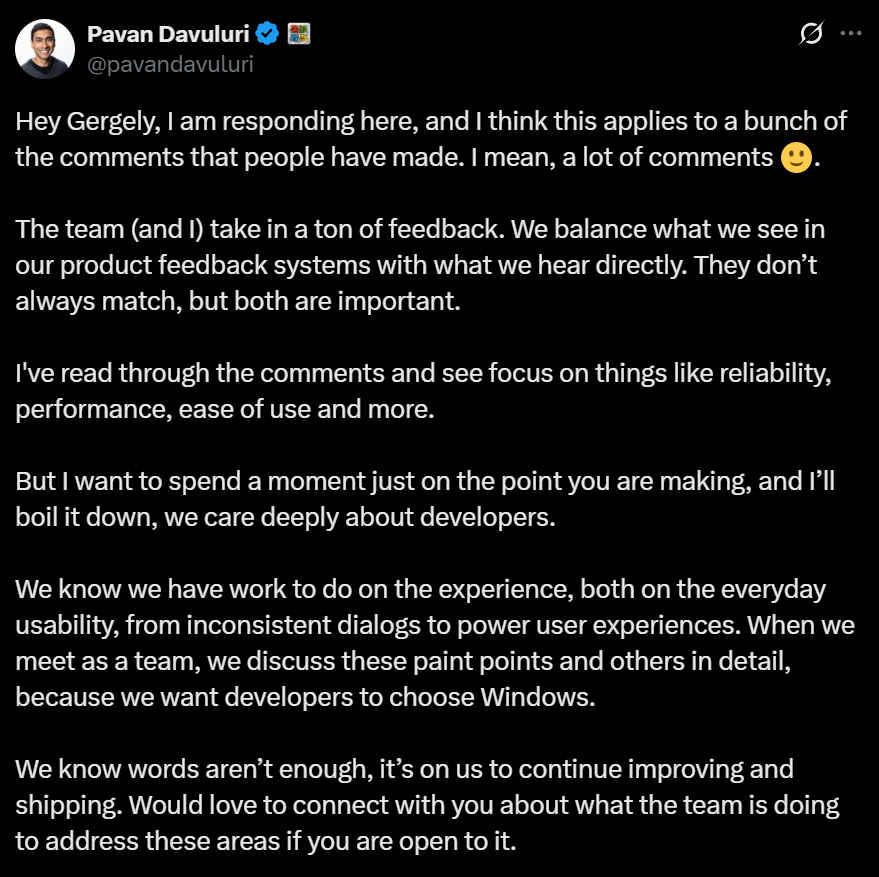
Pavan Davuluri responded directly to the backlash. He insisted that Microsoft still cares deeply about developers and power users. According to him, the Windows team collects feedback from multiple sources and the concerns about reliability, performance and inconsistent experiences are being actively discussed internally.
“Hey Gergely, I am responding here, and I think this applies to a bunch of the comments that people have made. I mean, a lot of comments. The team (and I) take in a ton of feedback. We balance what we see in our product feedback systems with what we hear directly. They don’t always match, but both are important,” the post read.
In a series of follow up posts, Pavan acknowledged that Windows has work to do, particularly in areas like everyday usability, system stability and power user features. He said the team regularly reviews pain points and that improving the developer experience remains a priority. He also admitted that simply saying these things is not enough and that Microsoft needs to show progress through updates.
What an “agentic OS” really means
So, what does agentic OS really mean? The phrase has caused confusion, but the idea is straightforward. The tech industry believes that autonomous agents will eventually perform routine tasks for users. Instead of manually opening apps or scripting workflows, an agent could handle actions across apps and services based on intent.
This could range from planning a trip to booking a restaurant or completing routine work tasks automatically. Until now, such agents have mostly lived inside browsers or web apps. Microsoft wants to move these capabilities directly into Windows so that the OS becomes the foundation for native AI agents.
In theory, Windows would become an environment where agents run apps and coordinate tasks on a user’s behalf. The challenge is that AI agents today are slow and often unreliable, which fuels scepticism about whether the OS should be built around them yet.
Also read: Best 5 thin and light laptops from Apple, Samsung and Asus