A long time ago, I remember having a red V-Guard stabiliser for our refrigerator at home. Back then, it felt essential. But for my TV, I never really thought about getting a stabiliser. Now, you may question: do we even need a stabiliser for TVs? Well, so I thought. Recently, when I moved to a new place in Gurgaon, I started noticing voltage fluctuations and abrupt power cuts. All this while, I was under the impression that modern TVs seemed smart enough to handle power issues on their own. But, seeing my 55-inch 4K TV switching off suddenly at times, I quickly realised there’s a major problem that needs fixing.
Fortunately, around the same time, I had also received the V-Guard Crystal TT 100 Plus stabiliser as a review unit. What timing, I thought. Since my TV was already acting up with the voltage fluctuation issues, here was a device that could fix exactly that. I will admit, I was a bit sceptical at first, but still, I hooked it up and started using it with my TV.
After living with the Crystall TT 100 Plus for a while, here is what I think about this small black box behind my TV. While I am at it, let me also tell you how the installation process went, what daily use felt like, and what you should know before deciding to buy a TV stabiliser.
Here is the uncomfortable truth. Modern TVs do not have a built-in stabiliser. What they have is a Switched-Mode Power Supply, or SMPS. It converts incoming AC power into stable DC power for internal components. But it does not stabilise voltage in the way people assume. If the voltage drops too low, the TV draws more current to compensate. That increases heat inside the power circuitry. Over time, that heat stresses capacitors and other internal components. You do not notice it immediately. The TV works fine until one day it does not.
As for the question of whether it will work for your TV, the Crystal TT 100 Plus is designed for TVs up to a 55-inch range. I tested it with a 55-inch panel and a 43-inch variant.
This model comes with a 3 Ampere load capacity. Multiply that by the standard voltage of about 230V, and the usable power headroom from this stabiliser will be roughly 700 to 800 Watts. That should be enough for a TV and perhaps even a set-top box, a gaming console or a soundbar. The Crystal TT 100 Plus should still leave some safety margin.
So, before buying this, check these five things:
Also Read: Your next TV upgrade may cost more than expected: Here’s why
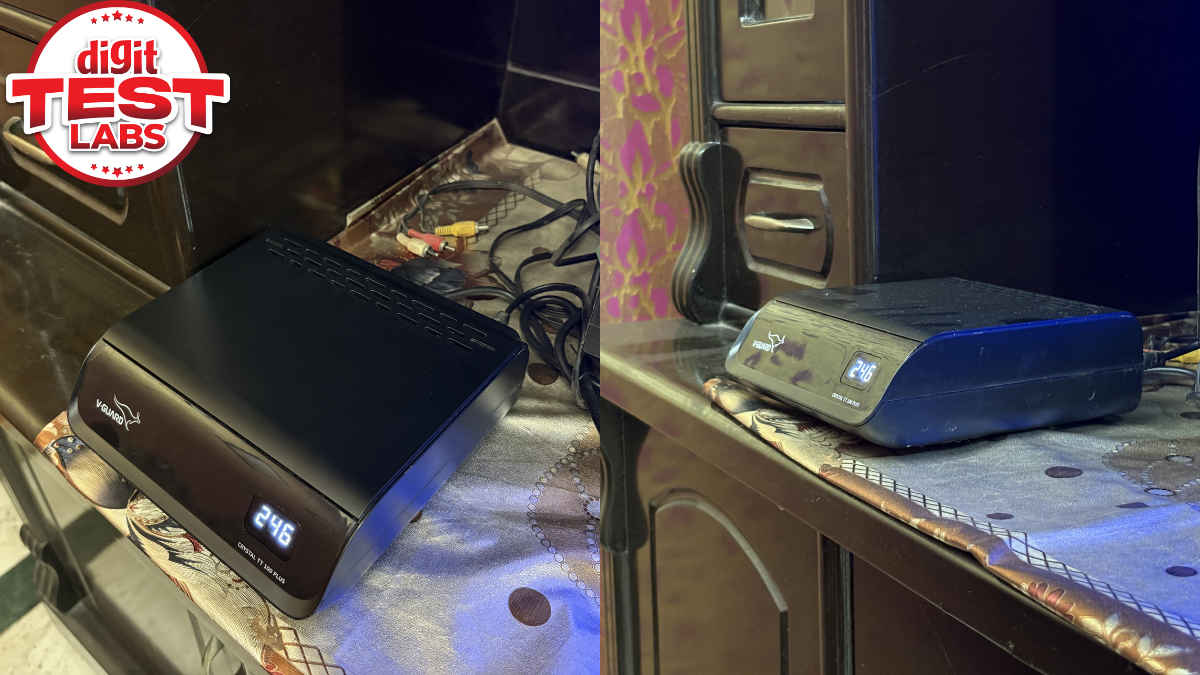
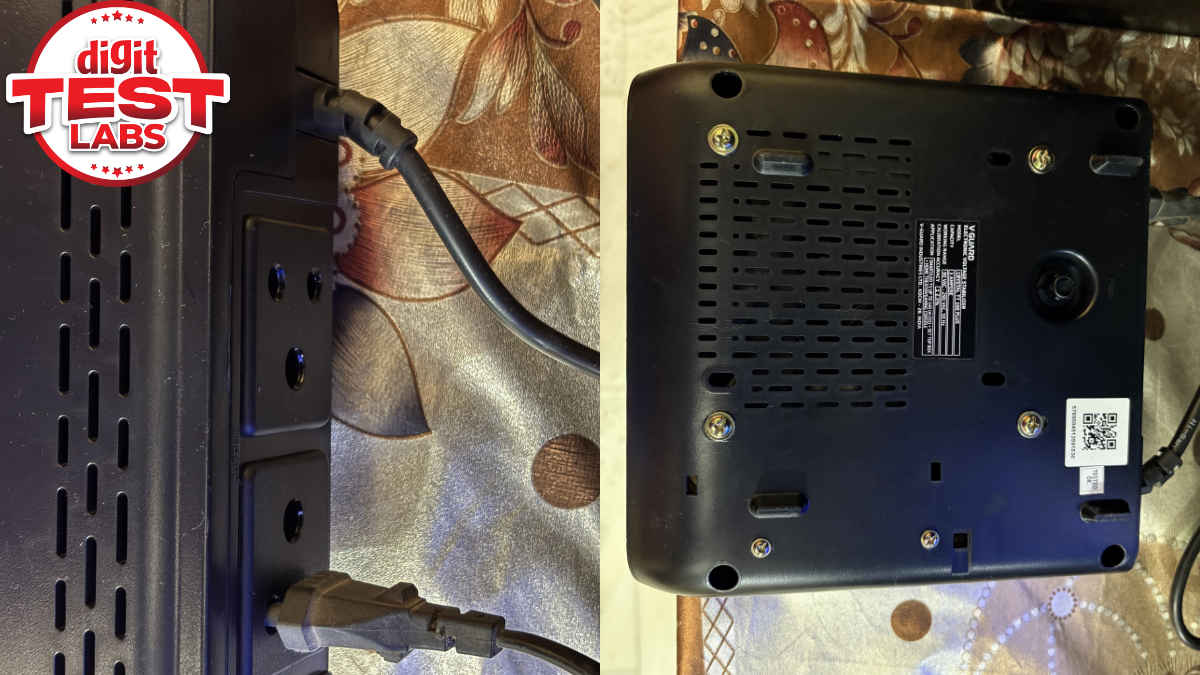
The Crystal TT 100 Plus uses a high-impact ABS plastic body. That is standard in electrical enclosures because it is heat-resistant and flame-retardant. It does not feel flimsy. In fact, when you lift it, you immediately notice the weight concentrated on one side. That is the internal transformer. In stabilisers, weight is usually a good sign. More copper generally means better load handling and thermal stability. Moreover, there are ventilation slots on the stabiliser’s sides to dissipate heat.
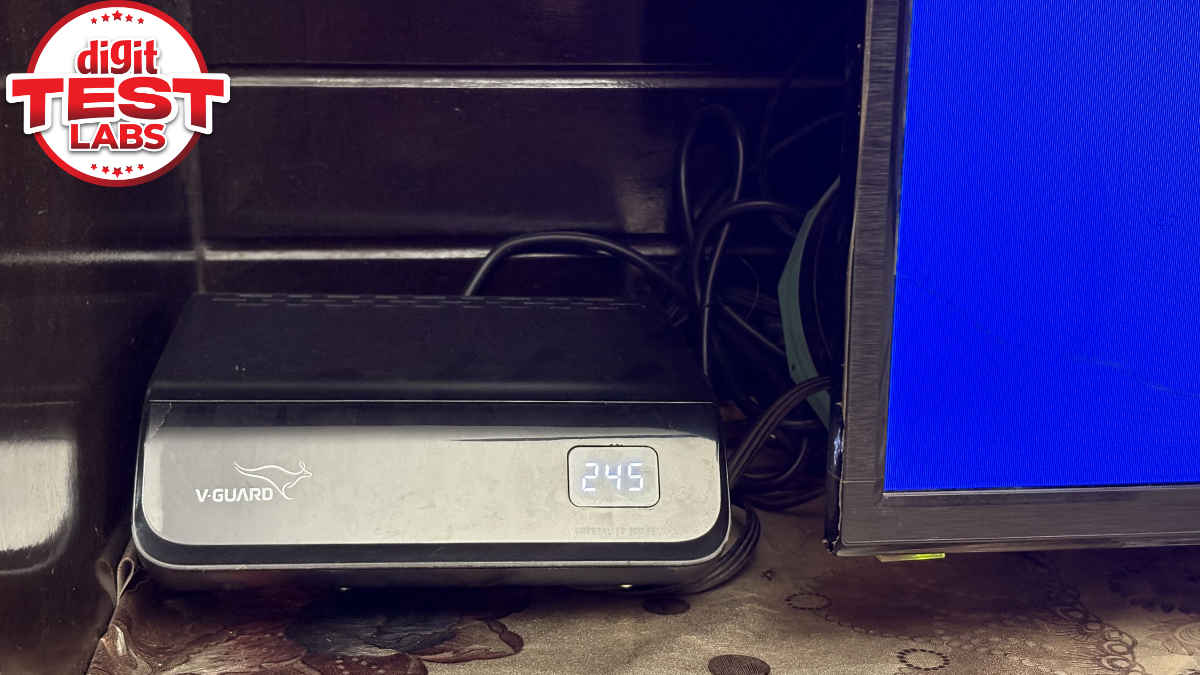
On the front, there is a digital LED display which alternates between showing input voltage and stabilised output voltage. I did not rely on it obsessively, but it was reassuring to see it correcting low incoming voltage to a safe output level.
The stabiliser is compact (8.7D x 20.6W x 24H cm) and sits comfortably within my home TV cabinet. I placed the unit next to the TV, and the black colour helps it stay discreet. The surface will attract dust over time, but you can simply wipe it off. The black 1.1m cable is also sturdy.
Coming to the setup, it is straightforward. The TV’s plug goes into the stabiliser, and the stabiliser’s plug goes into your wall socket. That’s all. No technical knowledge or expertise required. Once connected, switch it on, and the TV starts after a few seconds. We will talk about why this delay matters in a later section.
I did not simulate extreme voltage drops with lab equipment. What I observed instead was how it behaved during normal city fluctuations and occasional power cuts.
When power goes off and comes back on, the stabiliser does not immediately feed current to the TV. It is not an inverter or backup system. There is a brief delay before the TV turns on again. It is because the stabiliser is analysing incoming voltage after a power cut and ensuring it is stable before passing that voltage to your TV.
The stabiliser did not cause any random restarts or screen flicker. The TV booted up normally. albeit with that delay, every time after a power cut.
The unit also includes thermal overload protection. This means if someone accidentally plugs in a high-load appliance beyond its rating, it will cut off instead of overheating dangerously. You also get Metal Oxide Varistor Spike protection to ensure that extreme voltage surges are diverted away from your TV’s motherboard and other internal components.
Even after several hours of using the TV, the stabiliser felt warm but never hot to the touch. There was no continuous humming sound. Apart from occasional relay clicks, it stays silent. You will hear a small click when the stabiliser adjusts the voltage. It is easily ignorable, especially when the TV audio is on.
The V-Guard Crystal TT 100 Plus usually retails for around Rs 3,500 to Rs 4,000. If you are buying a mid to premium TV and live in an area with unstable power, spending a few thousand rupees on a dedicated TV stabiliser is preventive maintenance.
It is not a flashy device, but it simply stayed behind the TV and did its job. What it gave me was reassurance. A television today is not just another appliance. It is central to the living room, used daily by the entire family. I think reducing the risk of damage to such an expensive device makes practical sense. If you see your TV the same way, you can consider buying one.
Furthermore, V-Guard offers a 3-year warranty on this stabiliser against manufacturing defects and internal failures. It is primarily a carry-in service model, meaning you take the unit to an authorised service centre if required. Given the compact size and weight, it is manageable.
Keep reading Digit.in for similar stories.
Also Read: Home projectors can easily create 100-inch or even 300-inch screens: BenQ’s Rajeev Singh