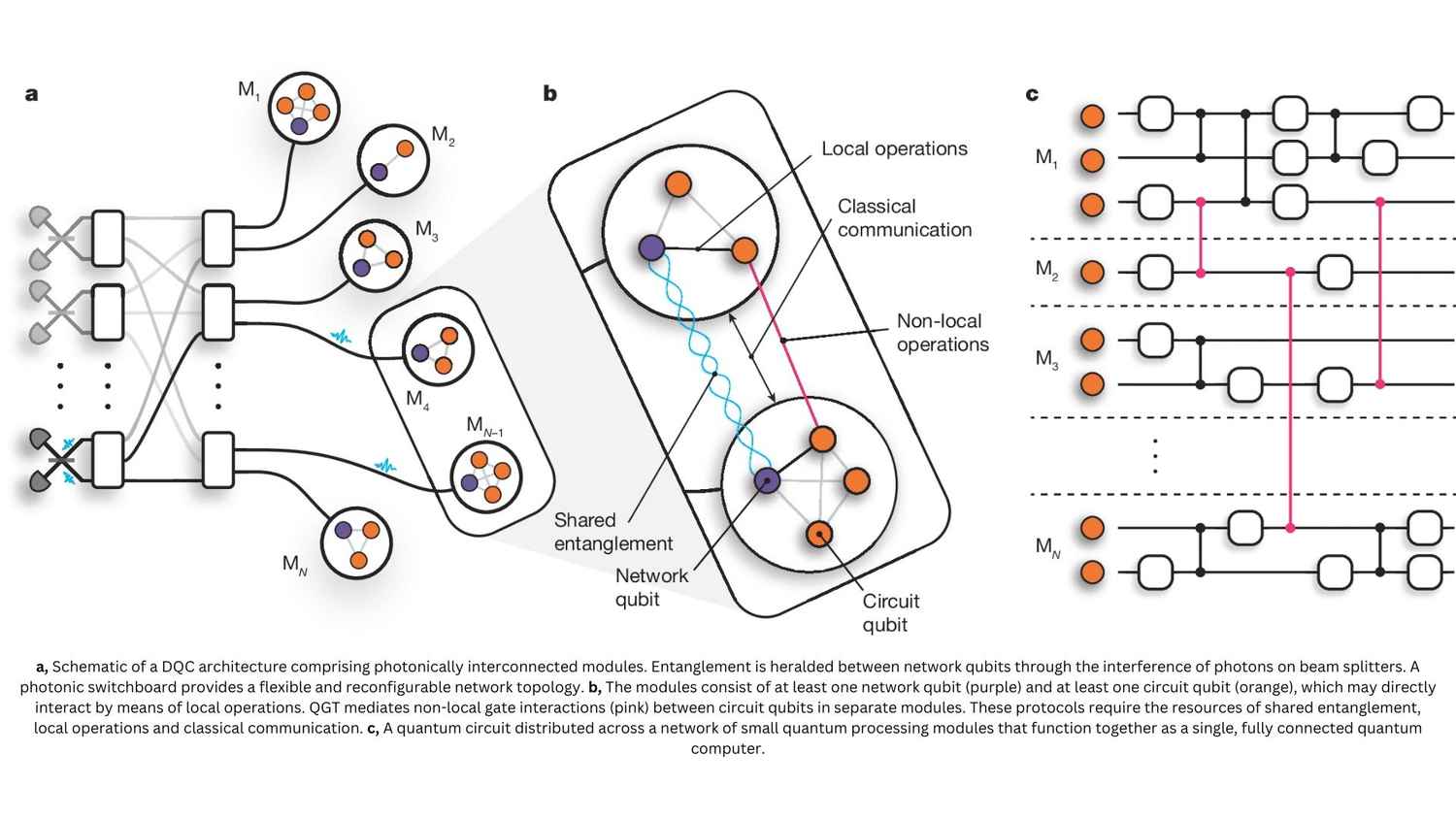
Quantum computing has long held the promise of solving problems far beyond the reach of classical computers, but a major bottleneck remains – scalability. Traditional quantum processors face limitations in hardware, qubit connectivity, and error rates, making it difficult to scale up quantum computations. However, a new study conducted by researchers at the University of Oxford has achieved a groundbreaking milestone. Titled Distributed Quantum Computing across an Optical Network Link and published in Nature, this research demonstrates the first fully deterministic quantum gate teleportation (QGT), a crucial step in enabling quantum operations across multiple interconnected modules with remarkable precision.
Quantum computing’s power comes from qubits, which can exist in superposition and entangle with each other, enabling exponentially faster calculations. But large-scale quantum computing isn’t just about adding more qubits; it’s about ensuring they work together efficiently. Traditional setups, where all qubits are housed within a single system, run into practical issues like noise, decoherence, and fabrication constraints.
DQC sidesteps these problems by spreading computational tasks across a network of quantum modules, each optimized for performance. This modular approach reduces hardware complexity, enhances fault tolerance, and enables scalable quantum computing. The key to making this work is the ability to teleport quantum gates between physically separate modules – a feat that has now been realized with unprecedented reliability.
For the first time, researchers have successfully implemented a deterministic Controlled-Z (CZ) gate between qubits in separate quantum modules. This was achieved using trapped-ion quantum processors connected by photonic links, essentially allowing qubits to interact as if they were next to each other, even though they were housed in different physical locations.
Unlike earlier attempts that relied on probabilistic methods, this breakthrough ensures that every teleportation attempt is successful, making quantum operations more predictable and scalable. The process starts with the creation of entanglement between network qubits in different modules. Once entangled, the quantum gate is teleported using local operations and classical communication, resulting in a high-fidelity (86%) non-local CZ gate.
Quantum computing has long been thought of as something confined to research labs and theoretical physics, but breakthroughs like this bring it closer to real-world applications. Here’s how distributed quantum computing could eventually impact consumer technology:
This isn’t just about teleporting a single quantum gate – researchers have also successfully implemented distributed versions of fundamental quantum algorithms. Grover’s search algorithm, which significantly speeds up database searching, was executed across two interconnected quantum modules with a success rate of 71%. This showcases how DQC can be used for practical quantum computing tasks.
Additionally, distributed implementations of iSWAP and SWAP gates, both essential for quantum computing architectures, were demonstrated using multiple instances of QGT. These results confirm that even complex quantum computations can be executed across modular networks without major loss in fidelity.
While this development is a significant leap forward, there are still hurdles to overcome. The fidelity of the teleported quantum gates, though high, needs further improvement to meet the stringent requirements of fault-tolerant quantum computing. Errors from photon loss, decoherence, and imperfect local operations need to be minimized.
Another challenge is scalability. While the experiment demonstrated two connected modules, a fully functional DQC system will require a large, scalable network of quantum nodes. This will demand advancements in quantum networking, including the integration of quantum repeaters and improved entanglement distribution techniques to ensure stable and reliable communication across long distances.
The potential of this research goes beyond a single experiment. By proving that quantum operations can be executed across separate modules without performance loss, this work lays the foundation for the next generation of scalable quantum computing.
In the future, DQC could lead to the creation of a global quantum internet, enabling real-time distributed quantum processing across vast distances. The flexibility of photonic interconnects means that different quantum hardware platforms – such as superconducting qubits, neutral atoms, and spin qubits – could be integrated into a single network. This hybrid approach would take advantage of each platform’s strengths, accelerating the practical deployment of quantum computing.
Moreover, the ability to perform high-fidelity non-local quantum operations has implications beyond computing. It could redefine fields like quantum cryptography, distributed quantum sensing, and even fundamental physics research. Ultra-secure networks, high-precision metrology, and collaborative quantum simulations between remote laboratories could all become a reality.
Quantum computing has taken a giant step forward with the demonstration of deterministic quantum gate teleportation. By enabling seamless connectivity between separate quantum processors, researchers have unlocked a path toward modular, scalable quantum computing.
This breakthrough is not just an academic achievement – it has tangible implications for the future of AI, cybersecurity, cloud computing, and materials science. As technology continues to evolve, distributed quantum computing may soon transition from theoretical promise to practical reality, changing the landscape of computation as we know it. The future of quantum innovation is not just about building bigger processors – it’s about connecting them in smarter, more efficient ways.