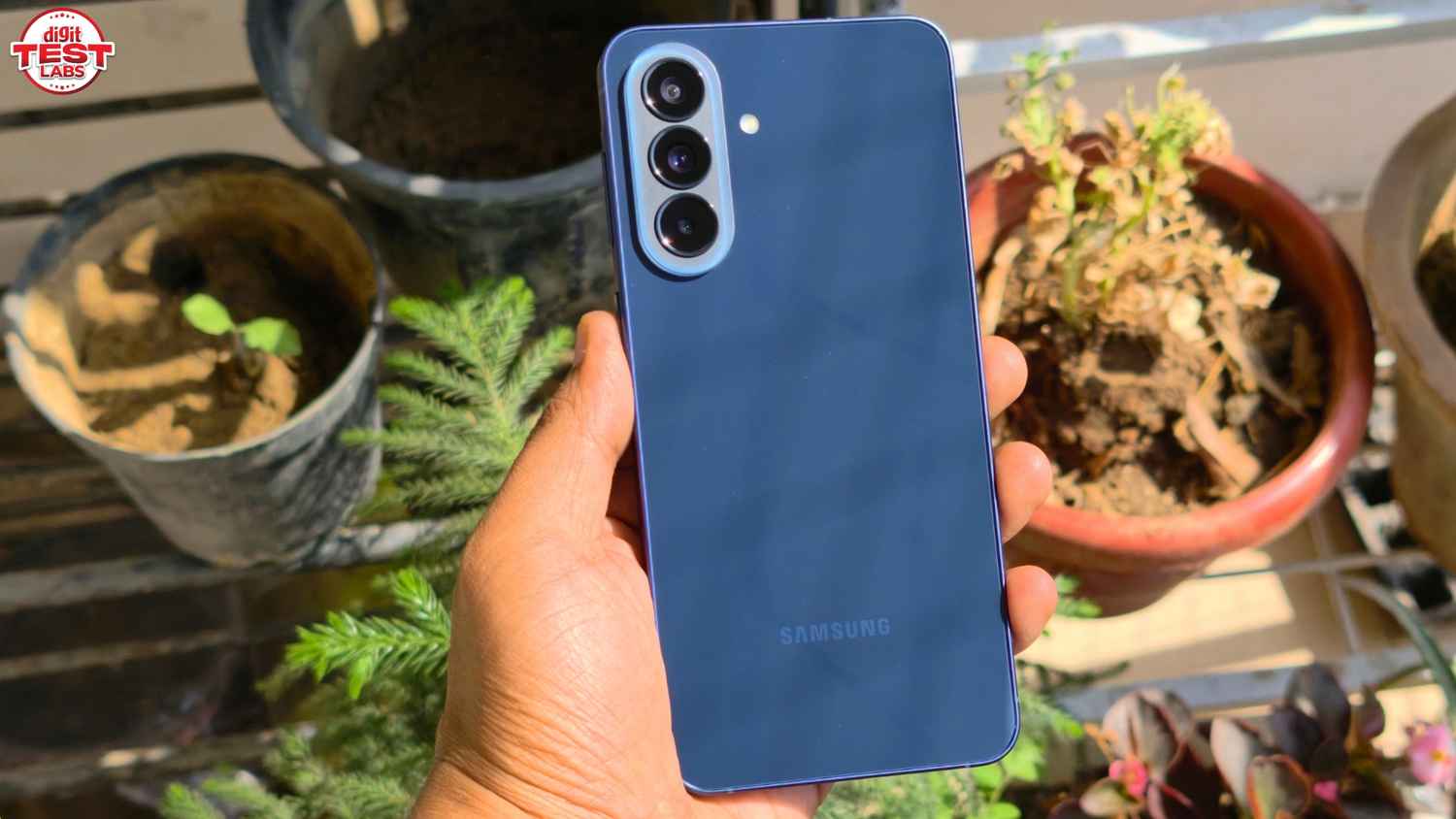
The Samsung Galaxy A-series is where the brand has historically defended its ground most fiercely. The Rs 25,000-40,000 price bracket is where the competition is rife with flagship features trickling down to mass market phones. The Galaxy A56 did a decent job last year and now Samsung has launched its successor, the Galaxy A57 in India.
The Galaxy A57 is priced starting at Rs 56,999 for the 8GB/256GB variant and Rs 62,499 for the 12GB/256GB variant, which places it in the upper-mid-range segment. The Galaxy A57 has just landed in Digit Test Labs, but before we put it through our test ringer, here’s a first look at what Samsung has improved on from the A56 and whether any of it matters to a buyer actually considering getting this phone.
Also Read: Samsung Galaxy Buds 4 Pro in Digit Test Labs: 24 hours later
| Category | Spec | Galaxy A56 | Galaxy A57 | Changed? |
|---|---|---|---|---|
| Build | Dimensions | 162.2 × 77.5 × 7.4 mm | 161.5 × 76.8 × 6.9 mm | ✅ |
| Weight | 198g | 179g | ✅ | |
| Water resistance | IP67 (1m / 30 min) | IP68 (1.5m / 30 min) | ✅ | |
| Glass protection | Gorilla Glass Victus+ | Gorilla Glass Victus+ | — | |
| Display | Panel type | Super AMOLED | Super AMOLED+ | ✅ |
| Size / Refresh rate | 6.7″ / 120Hz | 6.7″ / 120Hz | — | |
| Resolution | 1080 × 2340 | 1080 × 2340 | — | |
| Peak brightness | 1900 nits | 1900 nits | — | |
| Screen-to-body ratio | 87.7% | ~90% | ✅ | |
| Performance | Chipset | Exynos 1580 (4nm) | Exynos 1680 (4nm) | ✅ |
| GPU | Xclipse 540 | Xclipse 550 | ✅ | |
| Base RAM | 6GB | 8GB LPDDR5X | ✅ | |
| Max RAM | 12GB | 12GB | — | |
| Wi-Fi | Wi-Fi 6 | Wi-Fi 6E | ✅ | |
| Bluetooth | 5.3 | 6.0 | ✅ | |
| Camera | Main sensor | 50MP f/1.8, OIS, 1/1.56″ | 50MP f/1.8, OIS, 1/1.56″ | — |
| Ultrawide | 12MP f/2.2, 123° | 12MP f/2.2, 123° | — | |
| Macro | 5MP | 5MP | — | |
| Front camera | 12MP | 12MP | — | |
| Battery & Software | Capacity | 5000mAh | 5000mAh | — |
| Wired charging | 45W | 45W | — | |
| OS at launch | Android 15 / One UI 7 | Android 16 / One UI 8.5 | ✅ | |
| OS updates | 6 years | 6 years | — |
Right off the box, the Galaxy A57 is surprisingly lightweight, measuring 179 grams with 6.9mm thickness. Samsung claims that this is the slimmest A-series phone it has ever made. In comparison, the A56 weighs 198 grams and has a 7.4mm thickness and that’s nearly 20 grams lighter and half a millimetre slimmer, so the impact is substantial if you hold both phones in your hand.
The metal frame continues from the A56, but the IP rating gets bumped up from IP67 to IP68, meaning it can handle immersion up to 1.5 metres for 30 minutes. In addition, we get Gorilla Glass Victus+ on both front and back and that rounds up the durability aspect quite neatly. Colour options include Navy, Icyblue and Lilac, and we have the Navy variant with us.
The Galaxy A57 features a familiar-sized display that measures 6.7 inches with Full HD+ resolution, 120Hz refresh rate, HDR10+ certification and a claimed 1900 nits of peak brightness. Samsung has moved the A57 from the Super AMOLED panel on the A56 to a Super AMOLED+ display, and this upgrade is what physically enabled the phone to get thinner in the first place. The panel itself is slimmer, more power-efficient and delivers better light transmittance for more accurate colours and finer detail. Bezels are also noticeably trimmed by approximately 25-30% over the A56 which gives us larger screen estate.
The Galaxy A57 is powered by the Exynos 1680 which is built on a 4nm process and is a step-up from the Exynos 1580 on the A56. Samsung claims a 42 per cent NPU improvement and 17 per cent faster memory speeds. The base RAM is now 8GB with LPDDR5X across all variants and goes up to 12GB. The vapour chamber size is up by 13%, which Samsung claims offers better thermal management during gaming. We will be evaluating this in detail during our review for how it holds its ground during extended gaming sessions and everyday usage including app launches, processing speed, multitasking and more.
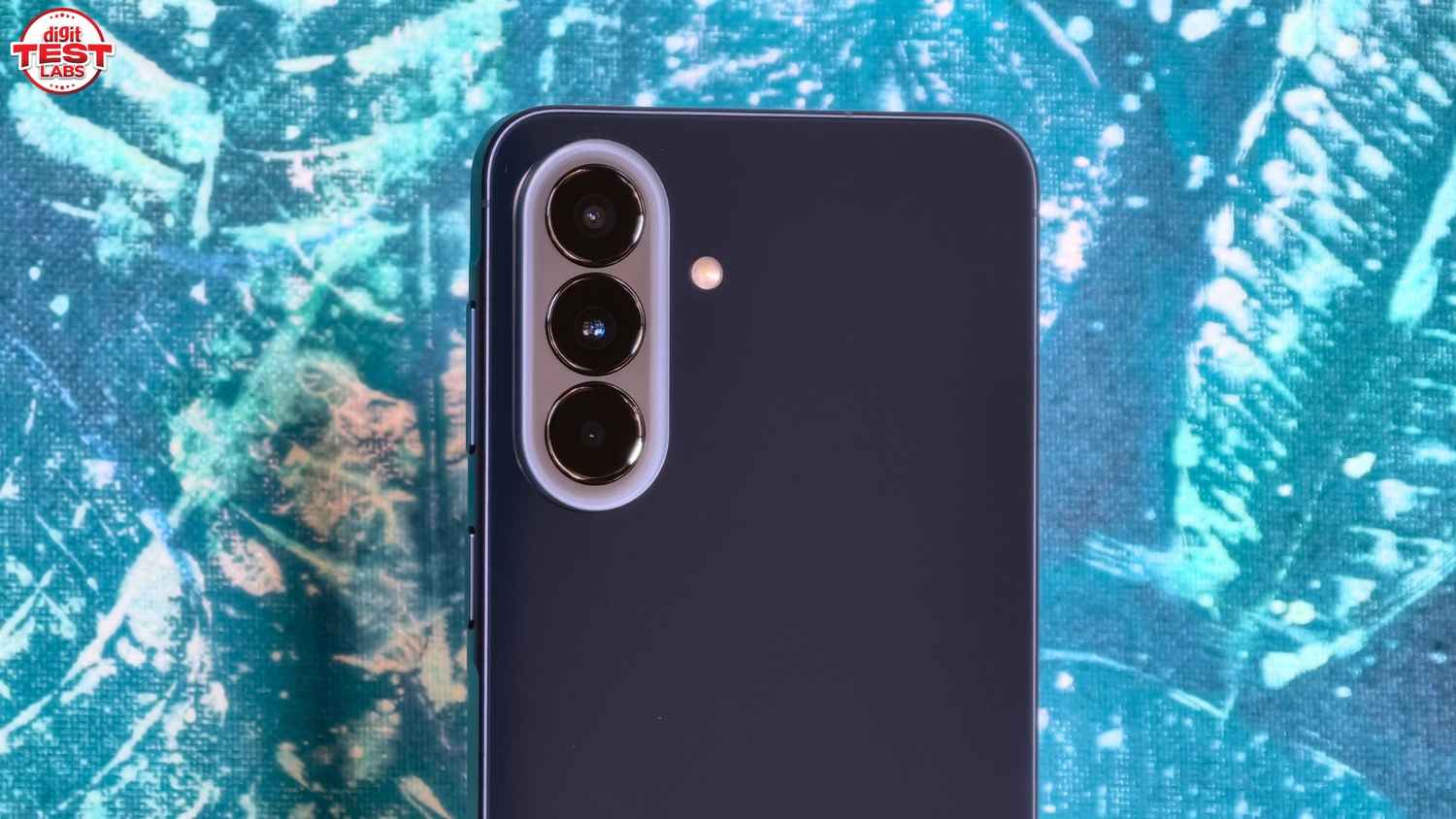
If you were expecting a camera hardware overhaul, the camera hardware on the A57 is identical to that of the A56. A 50MP f/1.8 main camera with OIS on a 1/1.56″ sensor, a 12MP ultrawide and a 5MP macro. The front camera remains a 12MP unit.
This year, Samsung is pushing hard on its AI portrait processing, now described as context-aware, analysing and optimising detail region by region rather than applying a blanket adjustment. Samsung says that shot-to-shot speed has reportedly come down to 4 milliseconds, meaning you won’t miss the moment while the phone is still processing the last frame. Best Face now works on regular photos (not just motion photos) and supports up to five people in the frame. Object eraser has also been made faster and more accurate.
The macro lens returning instead of a portrait or telephoto option could be a bummer for some. Although Samsung’s justification is that this decision is driven by user behaviour data around food photography, which happens to be a real use case for this demographic.
Having said that, we will reserve our judgment on the camera performance for the full review, which is still some days away.
The 5000mAh battery capacity is unchanged from the A56, but Samsung is now certifying a two-day battery life claim based on how many hours people spend on video, messaging, social media and camera.
The 45W charging brings the phone to 60% in 30 minutes, though some competitors are pushing 67W and 80W here. Samsung says that the combination of adaptive battery management, a deep sleep engine for background apps and variable refresh rate optimisation is all doing some work to extend the battery life.
One UI 8.5 on Android 16, with six major OS updates and six years of security patches. Samsung has been saying this for a couple of generations now, and they’ve been delivering on it. For a phone that a significant chunk of its buyers will use for three or more years, this is more important than any single spec upgrade.
In a market where Xiaomi just bumped its Note series to four OS updates, Samsung’s six-year commitment is the strongest software value proposition in the segment.
The Galaxy A57 does not reinvent the A-series, but it fixes some of the things that needed fixing on the previous generation. The A57 is now sleeker and lighter, the base RAM has been upgraded, the IP rating has been bumped up and there is a new display panel that brings notable improvement to the form factor.
Having said that, the camera hardware is largely the same and whether the AI processing improvements can deliver tangibly better output versus the competition is something we will test and report in our full review.
For now, the A57 looks like the most refined mid-range phone from Samsung, but whether it is enough to be the smart buy is something that we will only find out after putting it through the test bench.
Also Read: Samsung Galaxy A37 in Digit Test Labs: 48 hours later, is the Exynos 1480 actually enough?