I never saw Motorola launch a device specifically for gamers, but this time around, Motorola wants the Edge 70 Max to compete with other gaming-focused flagship smartphones. That’s a big claim, and instead of just believing it, I wanted to see how well it actually holds up in real life. Anyone can put a Snapdragon 8 Gen 5 chipset inside a phone and call it a gaming device. Still, the real test is whether that device can deliver consistent performance during long gaming sessions without slowing down or overheating. To find out, I spent hours playing BGMI, including Classic Ranked and TDM matches, while keeping temperature checks after every session of gameplay and running benchmarks. I also ran the phone through our complete benchmark tests at Digit Test Labs to compare the scores with my real-world gaming experience.
Here is what actually happens when you push the Motorola Edge 70 Max the way its own marketing says you should.
Under the hood, Motorola has gone with Qualcomm’s Snapdragon 8 Gen 5 chipset for the Edge 70 Max. Built on a 3nm process, it’s an octa-core processor with two prime cores clocked at up to 3.8GHz and six performance cores clocked at up to 3.3Ghz, paired with the Adreno 829 GPU that also supports real-time hardware-accelerated ray tracing. Our review unit came with 8GB of LPDDR5X RAM and 256GB of UFS 4.1 storage.
Now, beyond the spec sheet, the real test is opening BGMI and seeing how the Motorola Edge 70 Max actually performs during gameplay.
The Motorola Edge 70 Max supports Smooth + Ultra Extreme graphics in BGMI, which unlocks the gameplay up to 120fps. I started with a Ranked match, and throughout the gameplay, the frame rate peaked at 121fps and dropped to a minimum of 97fps, and averaged 119.2 FPS overall. Do note, I didn’t notice any of these ‘fps numbers’ while I was playing. Close-range fights with smoke grenades and in a 1 v 4 clutch situation stayed smooth, touch response felt instant, and using the controls felt intuitive, so aiming was easy and never frustrating.
Thermal management was the other thing that I took into account. The phone’s surface temperature measured around 40 Degrees Celsius after the match, but the back panel never got uncomfortable to hold, and the frame stayed relatively cool enough that I forgot I was even checking for the temperatures.
TDM is a different kind of match where the action keeps going because you respawn after dying. In this mode, the phone touched a max of 121fps, dropped to a low of 96fps, and averaged 118.7fps across the match.
Yes, 96fps is a dip from the peak, but once again, I did not feel it while playing. The match stayed fluid from start to end. If we talk about temperatures, then they actually came in lower than the Ranked match, settling around 38 Degrees Celsius. That also shows how Motorola has tuned this phone to handle continuous load even in intense situations.
Let’s evaluate how the Motorola Edge 70 Max feels in day-to-day life. General operation feels quick, apps open almost the moment I tap them, animations are smooth, and scrolling through long pages or on social media didn’t feel stuttery.
Multitasking held up the same way. I left 6-7 apps running in the background across a full day, and most of them resumed exactly where I left off when I came back. Switching between heavy apps, camera, a couple of browser tabs, and a game, I never felt like the phone was struggling to keep up.
Real-world testing tells you how a phone feels, although benchmarks tell you why.
The Antutu score lands exactly where a Snapdragon 8 Gen 5 phone would. Geekbench backs that up with strong numbers on both single and multi-core workloads, and the 3DMark Wildlife Extreme score of 5,076 confirms the Adreno 829 has enough GPU headroom for demanding titles, and not just BGMI at capped frame rates.
However, during the CPU Throttling Test, the Edge 70 Max struggled and showed an orange graph, with the chip settling at 65 per cent of its peak performance under sustained load. That’s a real drop on paper, but it matched what I actually felt through two back-to-back gaming sessions, with frame rates that stayed consistent instead of dropping during longer gameplay sessions.
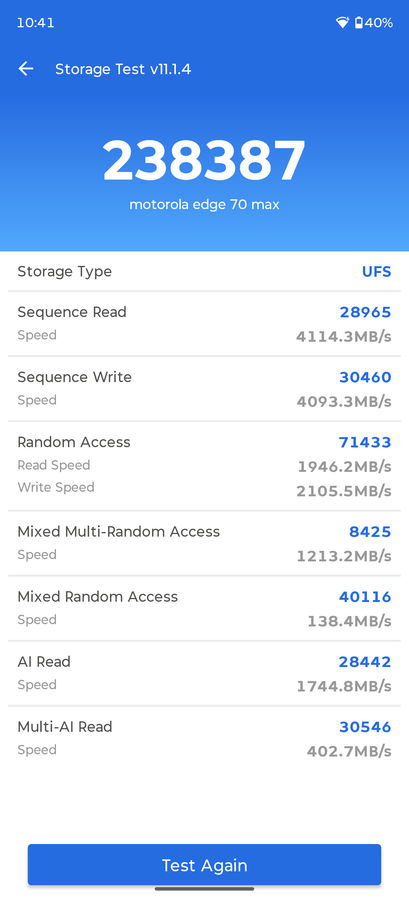
Motorola Edge 70 Max comes with UFS 4.1 storage, and it returned a sequential write speed of 4,093MB/s and a sequential read speed of 4,114MB/s in our tests, and these numbers show up in daily use too. I installed some games, and they installed faster than I’m used to; apps open with less delay, and moving files off the phone takes less time.
Putting a flagship chipset inside a phone is easy. Making it behave like one after several hours of gaming is not, and that’s where the Edge 70 Max earns the performance review. Frame rates held steady across both match types in BGMI, thermals never became an issue, multitasking did not choke, and storage speeds matched what the spec sheet promised.
If gaming is the reason you’re buying a phone, or you just want something that stays fast months after you’ve stopped paying attention to benchmarks, then, at Rs 54,999, the Motorola Edge 70 Max delivers exactly where it needs to.