There’s a version of PC progress where you get a bigger number on a spec sheet and not much else – Panther Lake or Intel Core Ultra series 3 doesn’t seem to be anything like that. It’s Intel’s attempt to make next year’s laptops and small desktops feel faster, quieter, and smarter in the moments you actually notice: 20 Chrome tabs, a Zoom call, Lightroom exporting in the background, fans barely audible.
The trick isn’t one monster core, according to Intel, but a platform that reshuffles the whole deck – CPU, GPU, AI, memory, even the camera pipeline – to scale performance without torching your battery.
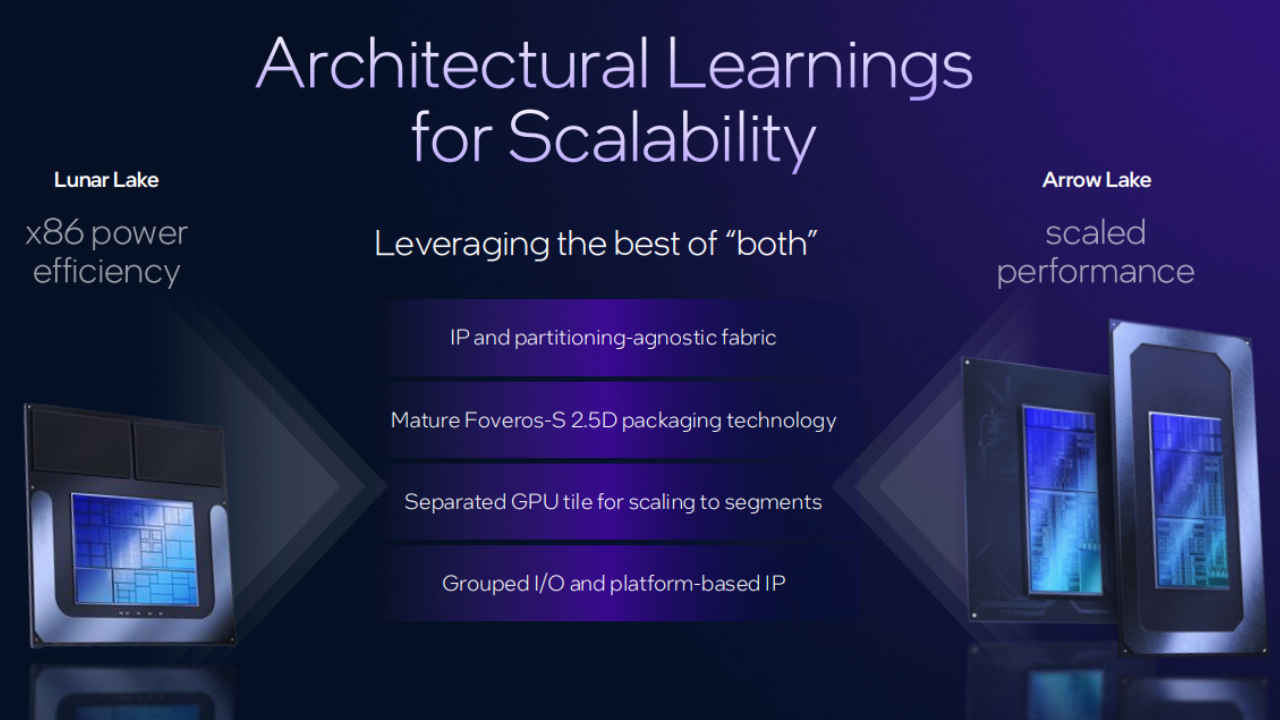
According to the company, the Panther Lake or Intel Core Ultra series 3 family of chips is said to deliver Lunar Lake-level power efficiency and Arrow Lake-class performance.
Panther Lake or Intel Core Ultra series 3 does that by utilizing a next-generation hybrid core architecture, with two distinct core types, both designed and optimized for the Intel 18A process node.
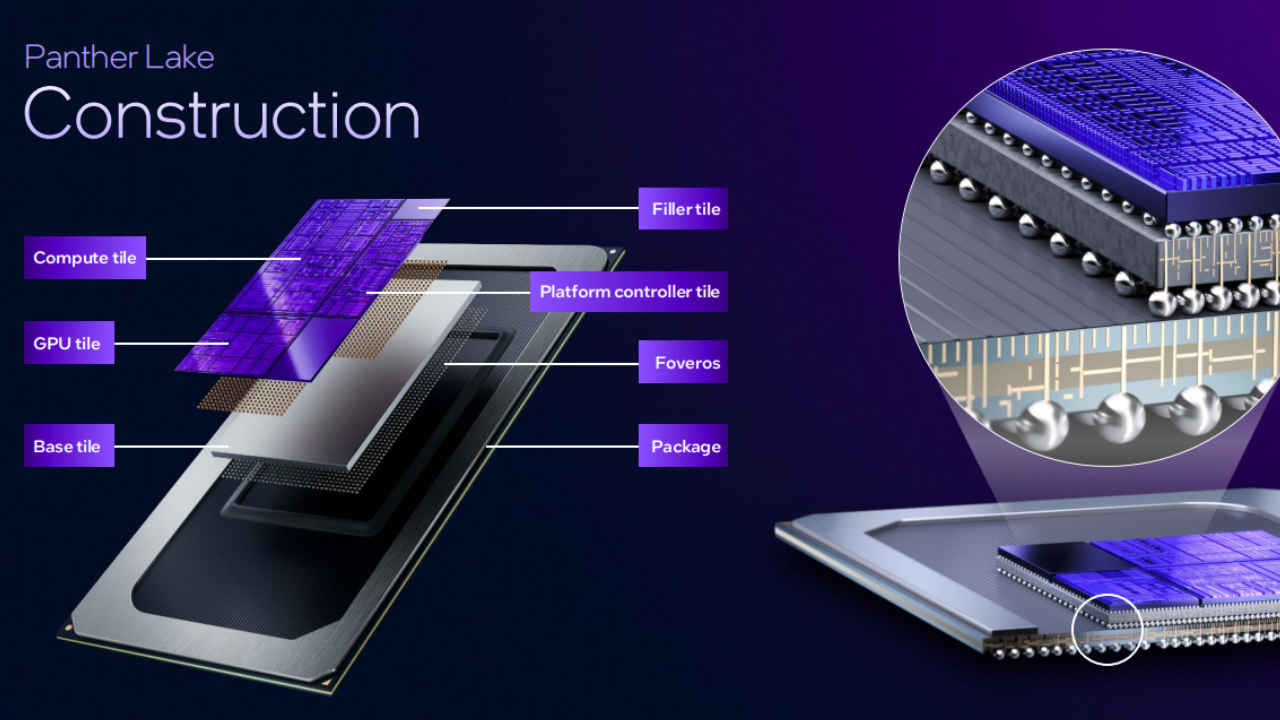
Disaggregated tiles (compute, GPU, and I/O) live on a common Foveros 2.5D package and talk over Intel’s Scalable Fabric Gen 2. What this means is that Intel can mix-and-match parts for thin-and-lights, creator rigs, or compact gaming boxes without breaking coherency or software – like Lego, but for silicon. It’s flexibility first, performance second, and power efficiency to the max – at least that’s what Intel claims for now.
Panther Lake brings fresh core IP – Cougar Cove (P-core) and Darkmont (E-core + LP E-core) – built for Intel 18A, with efficiency and IPC uplift as the headline goals. Two cluster styles match work to the right silicon: a Performance cluster that puts P- and E-cores behind a shared L3 for fast throughput, and an Efficiency cluster of E-cores with its own memory hooks for lean, scalable power draw.
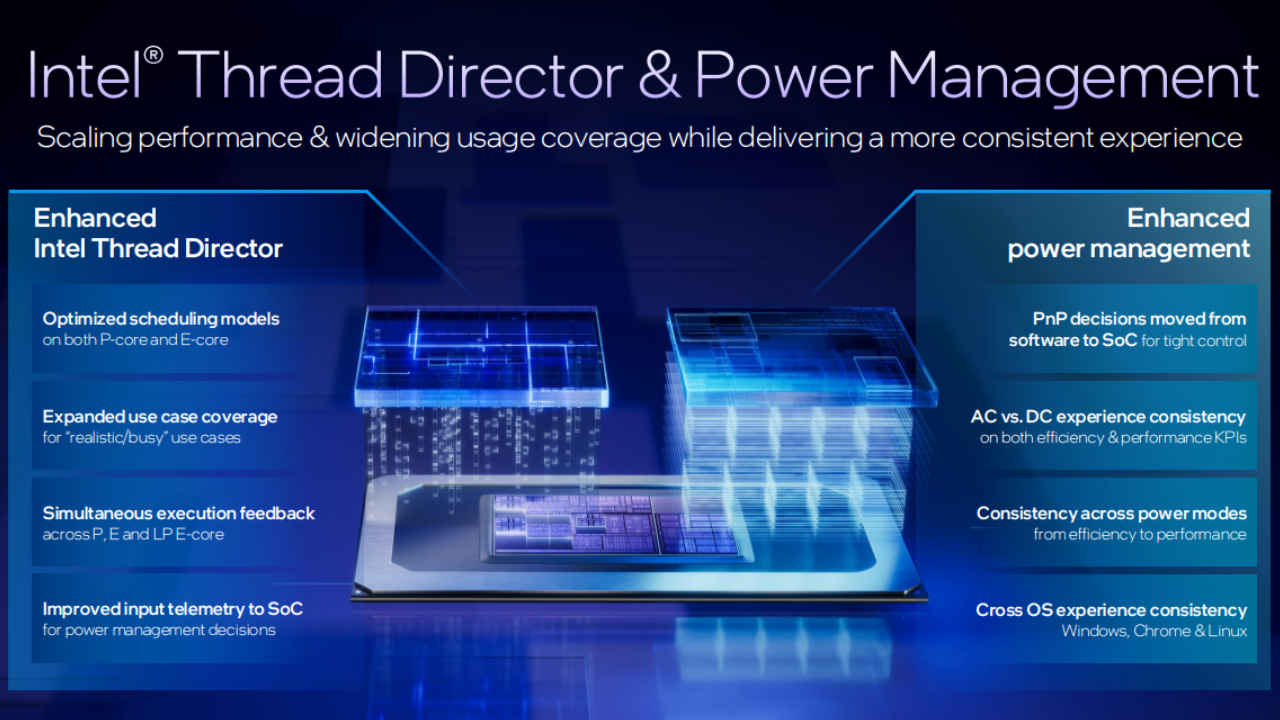
Darkmont’s E-core cluster gets 4 MB of shared L2, giving the scheduler (now with an enhanced Intel Thread Director) more room to keep “busy but realistic” multitasking on the efficient cores – so responsiveness stays high while the fans stay low.
Also read: Intel unveils Panther Lake: First AI PC chip built on 18A node
A dedicated 8 MB Memory-Side Cache sits at the SoC level, acting like a fast valet for frequently accessed data – from CPU bursts to I/O engines – cutting trips to DRAM, improving effective latency/bandwidth, and trimming power spikes. In human terms that translates to snappier app switches and fewer stuttered moments when everything piles on at once when you’re working on your laptop.
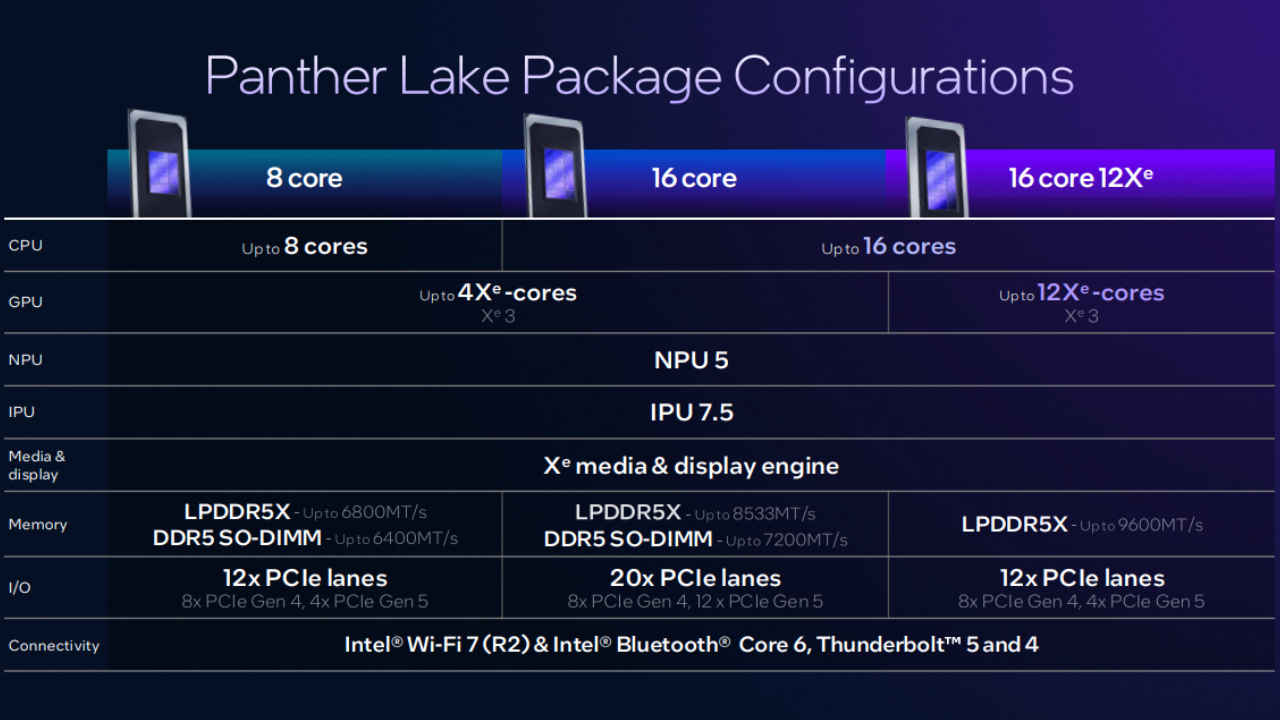
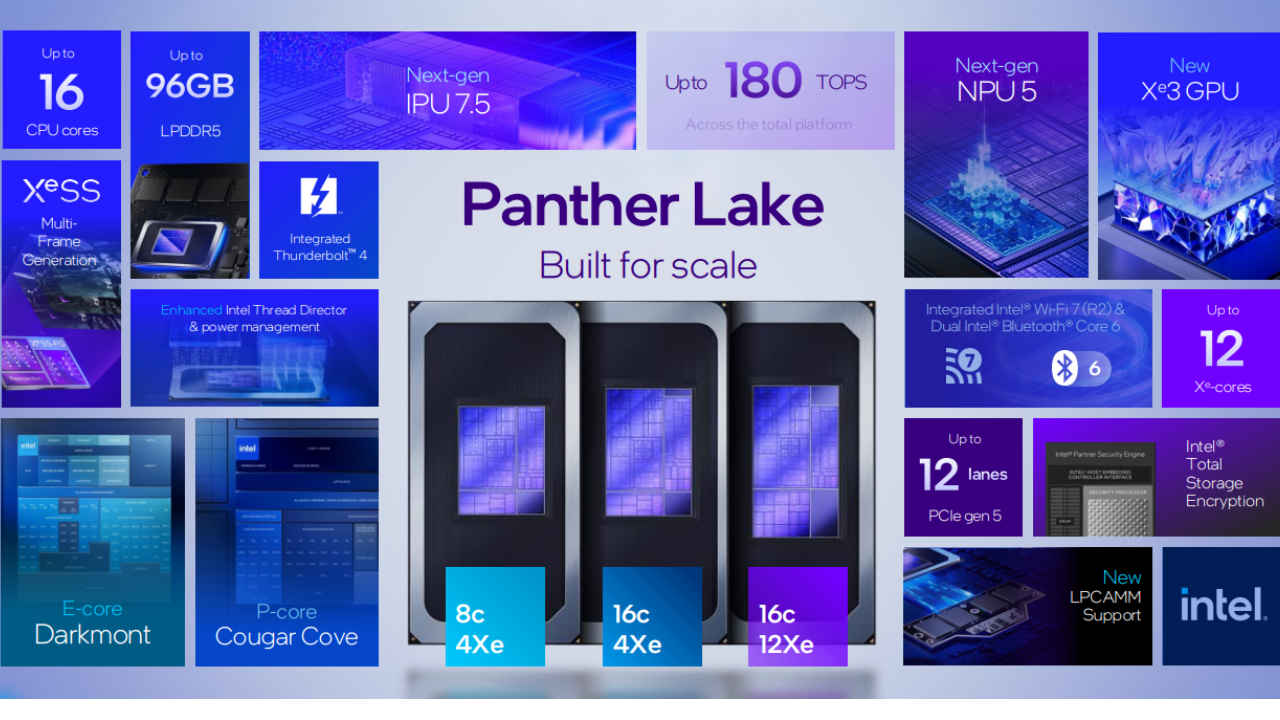
Intel’s own examples show how it scales the same package: an 8-core part for mainstream laptops, a 16-core for heavier multitaskers, and a 16-core paired with a larger GPU tile for creator/gaming machines. All share the same fabric and I/O tile, so features like PCIe Gen5 and Thunderbolt don’t go missing when you move down the stack.
Across the range, Intel claims you’ll see up to 12 lanes of PCIe Gen5, integrated Wi-Fi 7 (R2), dual Bluetooth 6.0, and as many as six integrated Thunderbolt 4 ports depending on model and OEM choices.
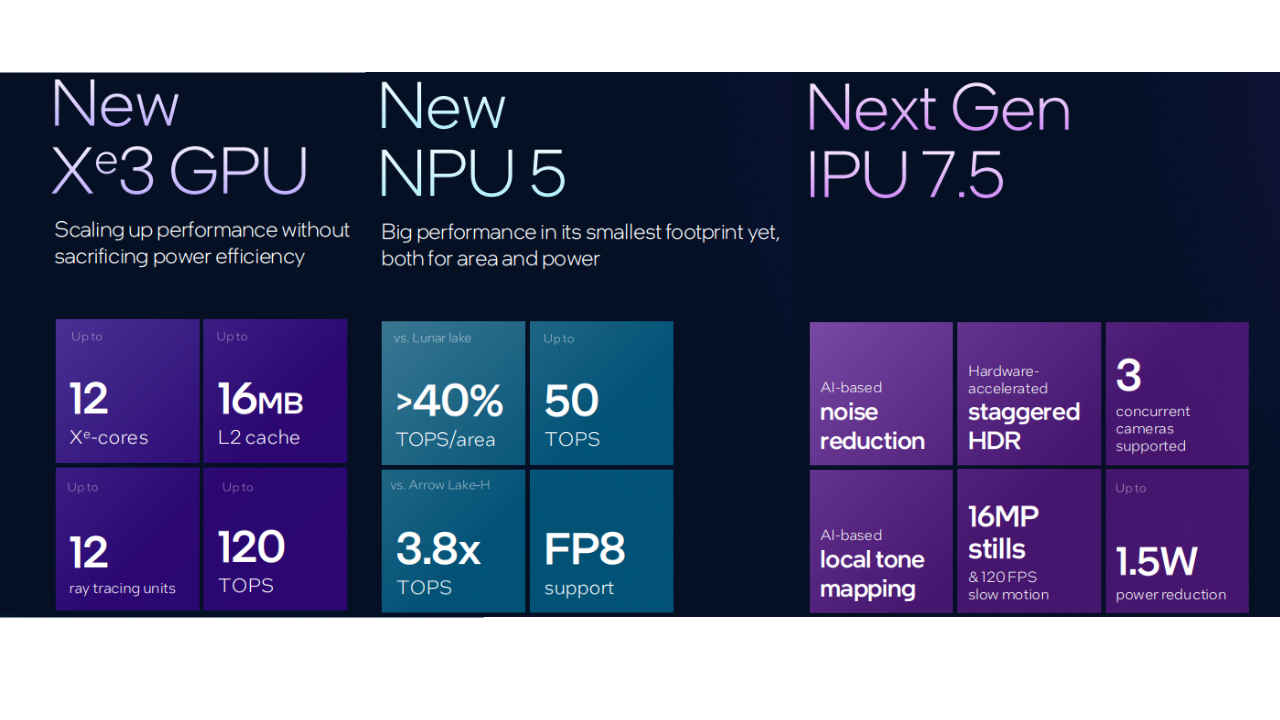
The GPU moves to its own tile and debuts the Xe3 architecture – up to 12 Xe-cores and 12 ray-tracing units with 16 MB L2 on the tile – so premium systems can scale graphics without roasting the CPU/NPU neighborhood. Intel also cites up to 120 TOPS worth of AI/graphics math on the GPU side, which matters for the growing wave of local AI effects (upscaling, denoising, background removal tasks).
On the neural side, NPU 5 targets up to 50 TOPS, with a >40% TOPS/area bump over Lunar Lake and ~3.8x more performance than Arrow Lake-H chips. It’s aimed squarely at on-device AI that doesn’t spin your fans like a ceiling vent. What this means is that in 2026, expect snappier copilots on your laptops, better live captions/translations, and smarter photo/video tools that don’t chew through your battery.
And because your webcam is now your office, Intel’s IPU 7.5 brings hardware-accelerated staggered HDR (Intel pegs ~1.5W lower power consumption than Lunar Lake), AI noise reduction, local tone mapping, support for up to three concurrent cameras, and capture up to 16MP still photos or 120fps slow-mo videos – quality-of-life upgrades you will actually notice on calls and creator workflows on laptops releasing in 2026.
Thread Director now spans P-, E-, and LP E-cores with tuned models per core type, while more power decisions move into the SoC hardware layer. The aim is simple but long overdue here, which is to provide a consistent behaviour across Windows, ChromeOS, and Linux, and across battery vs. plugged-in states – historically a sore spot for laptops.
With I/O centralized on a platform controller tile, OEMs can light up the ports you actually want – Thunderbolt 4 today (family support for TB5), PCIe Gen5 for GPU docks and scorching external storage, plus integrated Wi-Fi 7 (R2) and dual Bluetooth 6.0 – without respinning the CPU/GPU tiles.
In a nutshell, Panther Lake or upcoming Intel Core Ultra series 3’s efficiency gains vs. Lunar Lake & Arrow Lake chips of the past couple of years can be summed up as follows:
If Intel’s claims are true and they meet their timelines in shipping devices by early next year, the 2026 PC will feel different in the ways that matter – snappier, steadier, and strangely quiet while doing more. That’s what Panther Lake’s going for, according to Intel, to deliver AI-PC excellence at scale, without giving up on endurance.
Also read: Inside Intel’s reboot: Sachin Katti’s blueprint for an open, heterogeneous AI future