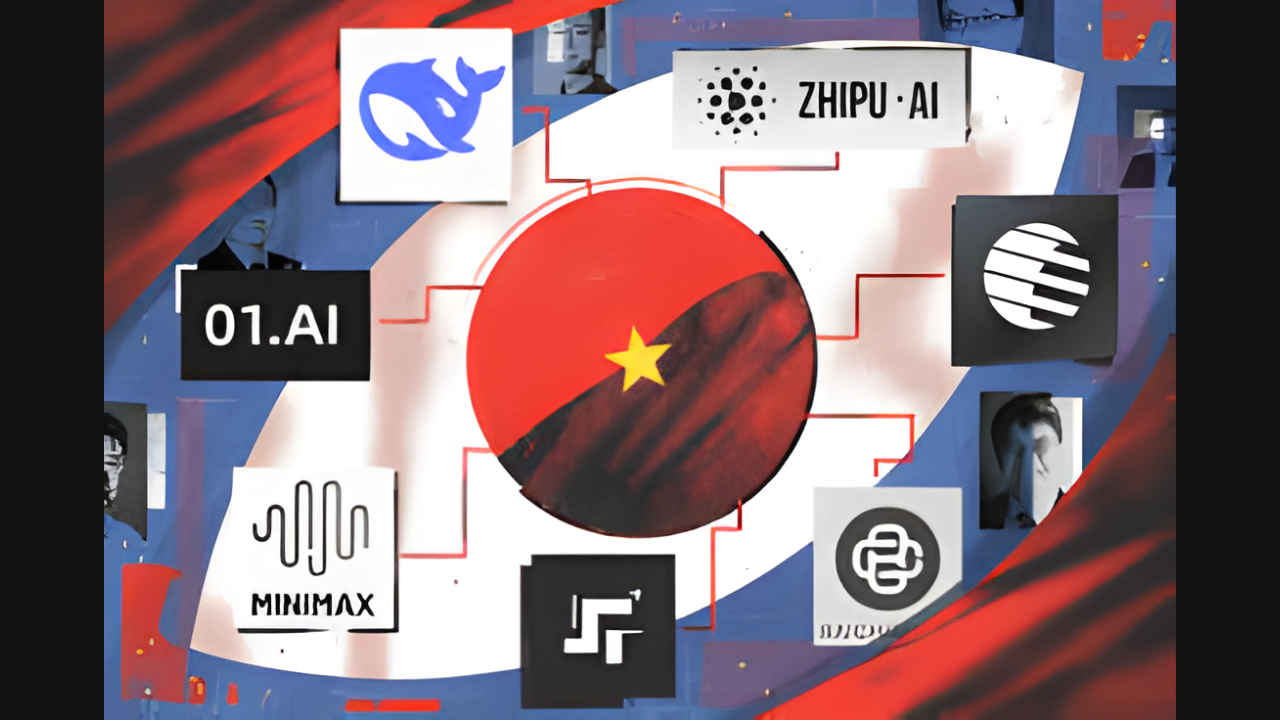
The narrative that American sanctions and hardware dominance have left China in the dust regarding Artificial Intelligence is beginning to fracture at the highest levels of the industry.
Speaking at the World Economic Forum in Davos this week, the debate over the “AI Gap” moved from theoretical policy discussions to a sharp disagreement between two of the world’s most prominent AI leaders. On one side, Google DeepMind CEO Demis Hassabis maintains the West holds a distinct, albeit narrowing, advantage. On the other, Mistral AI CEO Arthur Mensch has dismissed the idea of a Chinese lag entirely, calling it a “fairy tale” that the US tells itself.
The divergence in opinion highlights a critical shifting baseline in 2026: Is raw compute power still the only metric that matters, or has algorithmic efficiency leveled the playing field?
Also read: Google Gemini’s SAT practice tests in partnership with The Princeton Review: Here’s how it works
Arthur Mensch, whose Paris-based Mistral AI has rapidly become Europe’s answer to OpenAI, did not mince words during his Bloomberg interview. When asked about the perceived technological gap between the US and China, Mensch rejected the premise.
“China is not behind the West,” Mensch stated. He argued that the narrative of a crippled Chinese AI sector is a “fairy tale,” pointing specifically to the rapid advancements in China’s open-source ecosystem.
According to Mensch, the sheer velocity of model release coming out of Chinese labs is “probably stressing the CEOs in the US.” His comments come just as the industry is digesting the capabilities of recent Chinese open-source models (such as the DeepSeek-V3 and R1 architectures), which have demonstrated performance parity with top-tier Western proprietary models while running on significantly less ambitious hardware budgets.
For Mensch, the lesson is clear: Hardware constraints (like the US ban on NVIDIA H100 exports) have forced Chinese developers to become more efficient, innovating on architecture rather than simply scaling up parameter counts.
In contrast to Mensch’s bold assertion, Google DeepMind’s Demis Hassabis offered a more traditional, though cautious, assessment.
Also read: TeraWave by Blue Origin: 6 Tbps internet speed from space, Starlink in danger?
Also speaking at Davos, Hassabis estimated that China remains approximately “six months behind” the United States in the development of frontier models. While a six-month lead might sound negligible in traditional industries like automotive or construction, in the hyper-accelerated timeline of AI development – where a “generation” of models lasts barely a year – six months is significant. It represents one full iteration cycle of training and safety testing.
However, Hassabis’s estimate is arguably a downgrade from previous years, where US policymakers often cited a gap of 18 to 24 months. By narrowing that window to half a year, even the “optimistic” American view acknowledges that export controls have not stopped China’s momentum; they have merely slowed it.
The friction between these two viewpoints underscores the disruptive power of open source.
Western giants like Google, OpenAI, and Anthropic have largely pursued closed, proprietary systems. This protects their IP but also isolates their development. China, partly out of necessity and partly by strategy, has embraced an open ecosystem. When a lab in Hangzhou releases a highly efficient model like DeepSeek, it is immediately dissected, optimized, and improved upon by the global developer community – including engineers in the West.
Mensch’s Mistral AI, which sits in the middle – offering both open-weights and proprietary models – seems to view the Chinese approach as a valid threat to the closed-garden model of Silicon Valley.
Mensch’s comments were underpinned by Mistral’s own aggressive roadmap. In the same series of interviews, he confirmed that the French startup is projecting over €1 billion in revenue for 2026 and plans to spend roughly the same amount on compute infrastructure this year.
By declaring the US lead a “fairy tale,” Mensch isn’t just analyzing geopolitics; he is signaling that the era of uncontested American hegemony in AI is over. If a European startup and Chinese labs can rival Silicon Valley’s output with a fraction of the capital and hardware access, the “gap” may indeed be more of a narrative than a technical reality.
Also read: Jensen Huang: AI will create wealth for plumbers, builders, factory workers, here’s how