The RTX 5050 packs 2,560 CUDA cores, 8 GB of VRAM and a 2.5 GHz boost clock, delivering about 11 percent faster OpenCL performance than the RTX 4050.
Its power envelope ranges from 50 W to 100 W (115 W with Dynamic Boost), so real-world speeds vary with each laptop’s cooling capability
A wider 128-bit memory bus and doubled VRAM ease bandwidth bottlenecks, boosting ray-tracing and frame-generation performance.
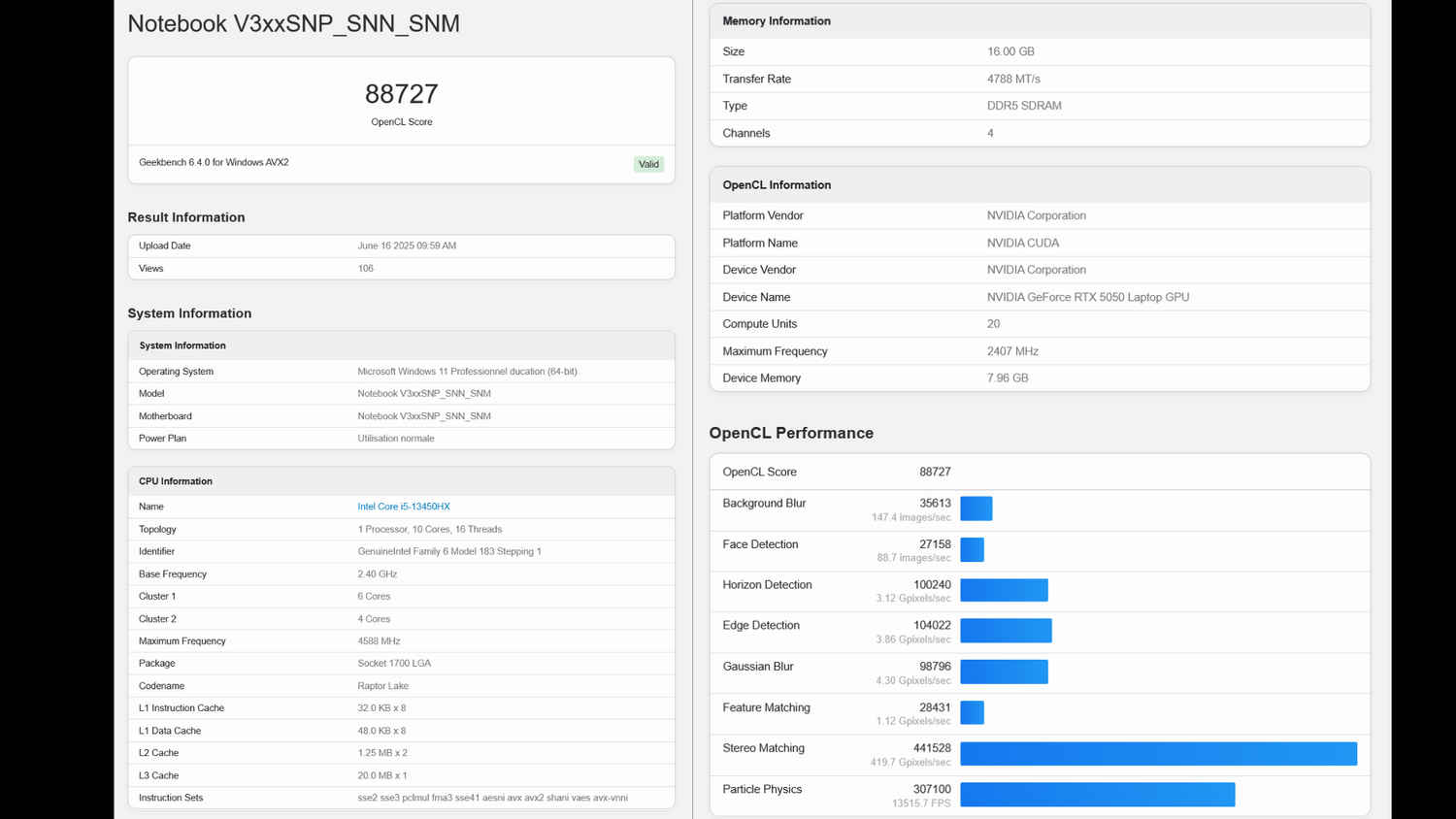
NVIDIA’s GeForce RTX 5050 Laptop GPU has finally stepped out of the rumour mill and into a public benchmark database, giving us our first solid look at what the new 50-class mobile part can do. A fresh Geekbench OpenCL run lists 2,560 CUDA cores, an 8 GB frame buffer, and a 2.5 GHz boost clock, good for a score roughly 11% ahead of the current RTX 4050 Laptop GPU.
 Survey
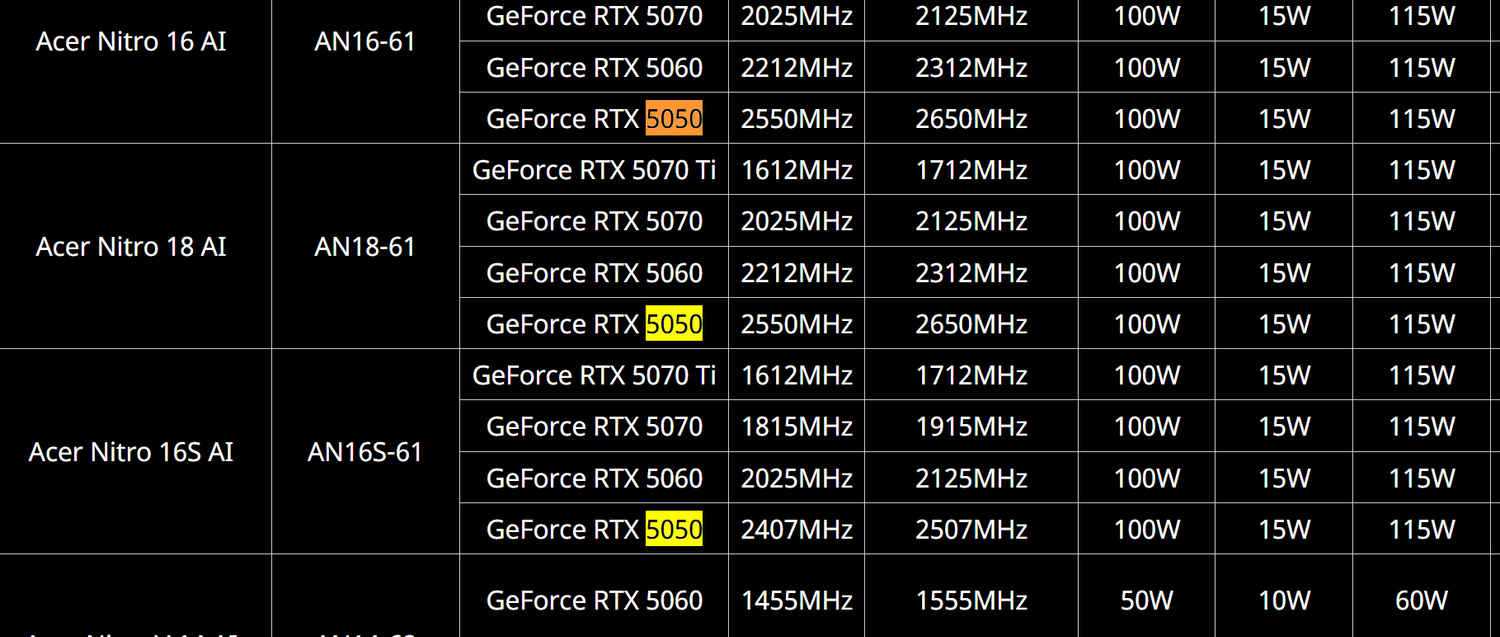
Power figures leaked by Acer (later on removed) show the chip scaling from 50 W in thin-and-light designs right up to 100 W (115 W with Dynamic Boost) in full-size gaming rigs, so real-world performance will vary widely. Still, thanks to a wider 128-bit bus, double the memory capacity, and NVIDIA’s latest Blackwell architecture, the RTX 5050 looks set to fix many of the bottlenecks that held its predecessor back, especially in newer games that lean on ray tracing and frame-generation tech.


What did Geekbench reveal?
A listing published on 16 June shows the RTX 5050 running at 2.50 GHz and scoring 88,727 points in Geekbench’s OpenCL test, around 11% higher than the average RTX 4050 result of 79,601 points on the same benchmark. The benchmark confirms 20 Streaming Multiprocessors, translating to 2,560 CUDA cores, and it also flags 8 GB of dedicated VRAM, the first time a 50-class mobile part has moved beyond 6 GB.
Architecture and core specification
Multiple leaks tie the new chip to NVIDIA’s GB207 die, part of the Blackwell family that underpins every other RTX 50-series laptop GPU so far. That means fourth-generation RT cores, updated tensor cores for DLSS 4 frame generation, and the latest power-management features inherited from the higher-end RTX 5070 Ti and RTX 5090 mobile parts.
Also read: What is DLSS? What is the Difference between DLSS 3 and DLSS 4?
Interestingly, the CUDA-core count is unchanged versus the RTX 4050, but doubling the memory and widening the bus from 96-bit to 128-bit should boost bandwidth-limited scenarios, particularly in open-world titles and creator workloads.
Memory: GDDR6 today, possible GDDR7 tomorrow
The Geekbench entry lists standard GDDR6, but at least two retailers and OEMs slips, including Lenovo’s LOQ and Legion listings, explicitly mention an 8 GB configuration and leave the door open for faster GDDR7 on pricier models.
TechRadar’s analysis echoes that split, noting that engineering samples have been spotted with both memory types as NVIDIA and its partners tune costs and thermal envelopes ahead of launch.
Power envelopes and clock speeds
Acer’s “Predator & Nitro GPU Power Specifications” page (from which they removed the 5050 machines later) details five RTX 5050 variants:
- 50 W TGP (60 W max) @ 1,500 MHz
- 60 W TGP (75 W max) @ 1,905 MHz
- 70 W TGP (85 W max) @ 2,212 MHz
- 80 W TGP (95 W max) @ 2,212 MHz
- 100 W TGP (115 W max) @ 2,550 MHz (2,650 MHz with Acer’s “OC” profile)
Also read: Intel vs AMD: Which Laptop CPU Should Gamers Pick in 2025?
These broad ranges explain why early synthetic results beat an RTX 4050 by only double-digit margins: the Geekbench entry almost certainly used one of the mid-power configurations. In a 100 W chassis, the gap should widen, edging closer to a stock 80 W RTX 4060 Laptop GPU.
On paper, the RTX 5050 offers roughly 45% more peak FP32 throughput than its predecessor when both are compared at their respective maximum clocks and power limits. More importantly for games, the extra two gigabytes of VRAM and wider bus ease the memory pressure that often forced the RTX 4050 down to medium textures at 1080p. NVIDIA’s latest frame-generation pipeline stands to benefit as well, because tensor-core operations no longer have to fight for bandwidth with the frame buffer.
Which laptops are getting it?
Acer’s Nitro 16 AI, 16S AI, 17 AI, and 18 AI lines, plus the thinner Nitro V series, all list RTX 5050 options spanning 50 W to 100 W TGPs. Lenovo’s leak shows the GPU in forthcoming LOQ and Legion 5 refreshes, again with 8 GB of memory as standard. HP’s Victus 15 and LG’s Gram Pro 16 have also appeared with the part in early certification documents and FCC filings, pointing to a wider target audience than just budget gaming rigs.
When will NVIDIA make it official?
Although NVIDIA skipped a formal reveal at Computex, several insiders tip a summer announcement, with TechPowerUp citing partner briefings that point to a July desktop-card launch and laptop availability.
The RTX 5050’s raw compute uplift may look modest on a spec sheet, but doubling the memory, widening the bus, and adopting Blackwell’s efficiency tweaks transform NVIDIA’s entry-level offering into a far more balanced package. In well-cooled 80–100 W laptops, it should deliver 4060-class frame rates at 1080p while preserving battery life in lower-power notebooks. The real winners are gamers and creators who have been stuck choosing between inadequate 6 GB models or paying a premium for a 4060 – a compromise the RTX 5050 finally removes.
 Follow Us
Sagar Sharma
A software engineer who happens to love testing computers and sometimes they crash. While reviving his crashed system, you can find him reading literature, manga, or watering plants. View Full Profile


