Snowflake unveils enterprise AI agents that act as digital coworkers
New developer tools turn data workflows into governed, AI-native systems
SAP partnership and data sovereignty shape Snowflake’s intelligent enterprise vision

Snowflake’s annual BUILD 2025 wasn’t just another product showcase. The cloud data expert now wants to make AI feel practical, tangible, and yes, accountable.
 Survey
And it wants to unlock the potential for AI at work through something called as the Snowflake Intelligence – the company’s self-described “trusted enterprise agent.” Think of it less as a chatbot and more as a sentient analyst that can parse, reason, and respond to complex business questions in plain English, all within the safety of Snowflake’s AI Data Cloud.


“Our latest enhancements to the Snowflake platform make this possible, democratizing the power of AI so every employee can make smarter and faster decisions, fundamentally changing how our customers will innovate for years to come,” says Christian Kleinerman, EVP of Product at Snowflake.
Over 1,000 customers have already deployed 15,000 AI agents in the past quarter alone, says Snowflake. Toyota Motor Europe and Cisco, among others, report major cuts in development time, according to Snowflake. One Toyota data head said Snowflake Intelligence let them “shift focus from writing code to building rich business context” – a subtle but profound change that reframes AI as more like a colleague, not just an inanimate codebase.
What makes Snowflake Intelligence distinctive is its blend of speed and self-regulation. Powered by large models from Anthropic and assessed with an “Agent GPA” (Goal, Plan, Action) framework, the platform claims to detect up to 95% of reasoning errors. That kind of self-checking loop nudges AI closer to what Kleinerman calls “near-human” decision accuracy.
Also read: Snowflake’s new AI agents aim to democratize data analytics: Here’s how
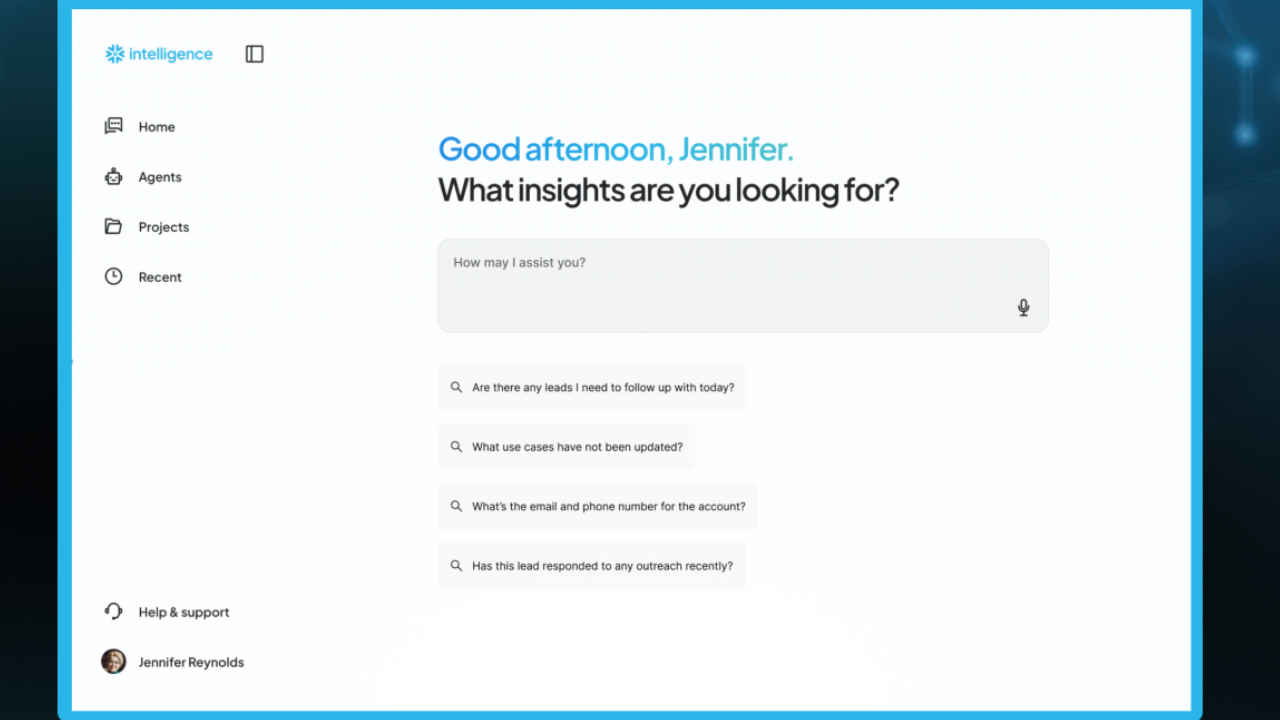
Kleinerman sees this shift – from static tools to autonomous collaborators – as a new computing era. “By 2026, one interesting way AI will be deployed in the enterprise is AI agents becoming integral members of the workforce… Organizations will onboard AI agents much like new employees – giving them access to contextual documents, letting them observe workflows, assigning tasks, and providing feedback to help them learn and improve.”
He even envisions “manager agents” supervising others – a self-improving AI workforce nested inside corporate ecosystems. It’s an audacious reimagining of enterprise software, one that stretches Snowflake’s identity from a data warehouse into a digital organism that learns.
Snowflake wants to build the factory floor of AI
That ambition requires serious developer muscle. Enter Cortex Code, a conversational assistant that lives inside the Snowflake UI, letting developers debug, query, and optimize through natural language. With Cortex AISQL and Dynamic Tables, teams can spin up inference pipelines with a few lines of SQL, while AI Redact ensures sensitive data never leaks into training sets.
Developers can now code and version-control directly inside Snowflake Workspaces – Git and VS Code included – while staying within the guardrails of enterprise governance. Kleinerman calls it “reducing overhead and total cost of ownership – all within a single governed platform.”
Also read: NVIDIA’s Kari Briski believes open models will define the next era of AI
There’s also a quiet but deliberate push toward open standards. Apache Iceberg, Polaris Catalog, and cross-cloud interoperability. In the AI arms race, flexibility is Snowflake’s idea of security.
Speaking on security, Kleinerman acknowledges a tectonic shift in how nations and corporations view control. “Sovereign AI clouds are a natural evolution of digital sovereignty – where organizations want more control over where their data resides, how it’s protected, and how AI models are trained and deployed.”
He points out that Snowflake’s early investments in regional infrastructure and partnerships now let customers meet “evolving standards around sovereign AI clouds, without compromising on performance, scale, or security.” His mantra is simple. “Planning for change, rather than reacting to it, is the only way to be equipped to navigate disruption.”
SAP + Snowflake: Where context meets compute
One of BUILD’s headline reveals was Snowflake’s deepened alliance with SAP. The new SAP Snowflake solution extension ties Snowflake’s AI Data Cloud directly into SAP’s Business Data Cloud, marrying SAP’s semantically rich data with Snowflake’s compute and AI muscle.
“By tightly integrating SAP and Snowflake, we’re making it simple for enterprises to connect their critical business data… with the power of seamless AI app and data agent development at scale in Snowflake,” Kleinerman said.
The result? Zero-copy data sharing, unified governance, and a powerful bridge between business context and AI execution – a missing piece in the puzzle of enterprise-scale intelligence.
If BUILD 2025 was about enabling, 2026 will be about embedding – AI agents that coexist with human teams, governed by sovereignty, powered by openness, and learning from everything they touch. Kleinerman’s final words captured both pragmatism and inevitability, “Sovereign demands will always shift, and in today’s fast-changing AI landscape, flexibility is the new security.”
Also read: Snowflake’s Baris Gultekin believes AI agents are critical for future of work
 Follow Us
Jayesh Shinde
Executive Editor at Digit. Technology journalist since Jan 2008, with stints at Indiatimes.com and PCWorld.in. Enthusiastic dad, reluctant traveler, weekend gamer, LOTR nerd, pseudo bon vivant. View Full Profile


