Arattai leverages Zoho’s enterprise communication experience to deliver a consumer-friendly, privacy-centric messaging app.
The app will roll out end-to-end encryption and features like large group management, payments, and multi-language support.
Zoho maintains a no-ads, non-data-monetization model, prioritizing trust, scalability, and user experience over short-term revenue.
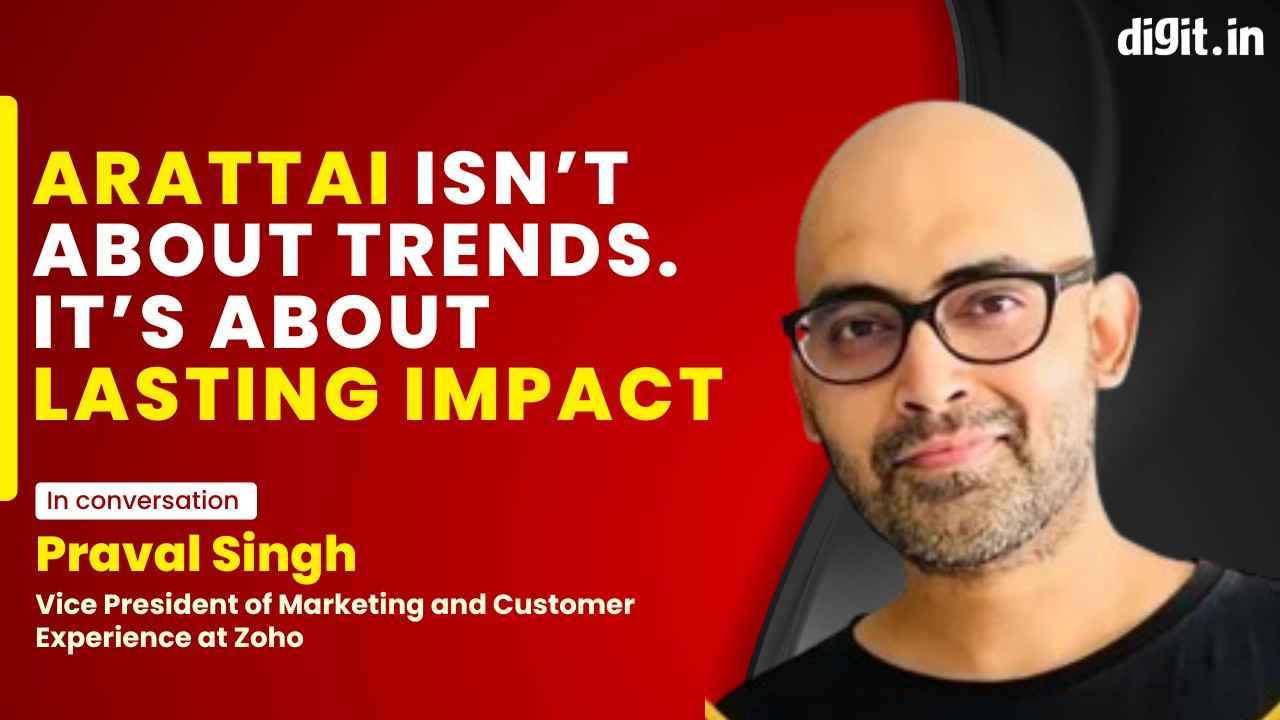
We are in the middle of India’s fast-evolving messaging app landscape, and Zoho’s Arattai has found itself at the centre of attention. What began as a quietly developed side project over four years ago within one of India’s most respected software companies has now crossed 10 million downloads on the Google Play Store, sparking debate about whether a homegrown platform can realistically challenge the dominance of WhatsApp, Google and others.
 Survey
However, Praval Singh, VP of Marketing and Customer Experience at Zoho, believes that the conversation is not about chasing trends or riding short-term hype. ‘We are not a start-up that came out two weeks ago,’ he says. ‘We’ve been around for nearly three decades. Whatever we build today has a strong foundation: our technology infrastructure, data centres and a global user base of 130 million.’


From B2B expertise to consumer-grade communication
Talking about the app, Singh said Arattai did not emerge out of thin air. He stated that the app draws on Zoho’s long-standing experience in building communication tools for businesses, such as Zoho Cliq, a full-fledged messaging, voice and video platform that has powered enterprise communication for almost years.
‘Arattai was an attempt to build a consumer app using the same infrastructure, but with different features, capabilities and user experience. The underlying platform, technology and R&D already exist,’ he added.
The sudden surge in downloads, he adds, has prompted Zoho to expand capacity and scale its servers, but the company’s approach remains measured. ‘We’re not trying to replace an existing app because these are habit-forming products. We believe if we stay true to our core values: privacy, value and simplicity, people will stay,’ Singh stated.
Privacy as a principle, not a checkbox
When asked about end-to-end encryption and balancing user privacy with government compliance, Singh is clear. ‘Encryption is already present in transit and at rest. End-to-end encryption was always planned, and we’ll be implementing it soon,’ he said.
However, for him, privacy is more than just encryption protocols; it is an integral part of Zoho’s DNA. ‘Privacy is more than just a checkmark on a feature list. It is about the company’s ethos. Zoho generates no revenue from advertising. We do not monetise or sell user data. As a result, hundreds of thousands of businesses around the world trust us.’
When it comes to cooperating with laws in different regions, Singh says, ‘We play by the law of the land, whether it’s India, the United States or Europe. Some regions require that data not leave the country, which is why we have invested in 18 data centres worldwide. But our stance on user privacy remains unchanged.’
Onboarding users in a crowded space
Arattai’s biggest challenge is obvious: breaking user habits in a market dominated by Meta and Google. Singh acknowledges this, saying, ‘Consumer apps are based on habits. For Arattai to become a daily driver, it must provide value.’
That value, he says, will come from features tailored to Indian users, such as expanded group management for communities, societies or large families, as well as future integrations like payments. ‘We already support nine Indian languages and are considering dialect diversity. We want to create something that will stick,’ Singh said.
‘The plan is long-term. We need to be patient. Every day, our engineers work tirelessly to improve the experience. And, as with UPI, adoption will grow organically as people realise the convenience and value,’ he added.
Competing with global giants
Can an Indian app outperform the Metas and Googles of the world? Singh replied thoughtfully: ‘As a fellow Indian, I would like to see that happen. However, it will require more Zohos, companies with similar mindsets. It’s easy to talk. Building requires time. Look at UPI; India has achieved something that even advanced economies admire. It became a habit not overnight, but with consistent value.’
He adds that India’s moment to build for the world has arrived, with talent, technology and infrastructure all in sync. ‘We’ve been doing this for thirty years. However, more entrepreneurs should adopt this mindset. When that happens, the shift will be notable,’ he said.
No ads, no shortcuts
When it comes to monetisation, Singh is clear: ‘We are not looking at advertising as a revenue model. Our goal is to keep Arattai free and privacy-friendly.’ Instead, Zoho plans to introduce premium features, business integrations, AI tools and payment capabilities in the future as a revenue stream.
‘People will pay for additional value,’ he says. ‘But monetisation is not our priority right now. Our focus is on scalability, stability and user experience. We’re profitable as a company, and our existing B2B revenue powers this experimentation,’ he said.
He doesn’t rule out more consumer products either. ‘We enjoy the freedom to experiment. If we build something that adds value, we’ll launch it. You shouldn’t be surprised to see more from us.’
Also read: WhatsApp alternative Arattai is number 1 on App Store: What is it and how it works
Building trust, line by line
For Singh, trust isn’t something that can be declared; it’s earned. ‘Trust doesn’t get built on face value. It gets built over time, by knowing a company’s roots and actions. Zoho has been consistent for decades. Even our free products have no ads. People say we’re leaving money on the table, and we are, but we’re still profitable,’ he said.
He says Zoho’s vertically integrated infrastructure, from data centres to application layers, gives it a rare level of control and security. ‘We’re not just an application company. We run the whole stack. That’s how we deliver the experience and privacy our users expect,’ he added.
As the conversation ends, Singh circles back to Zoho’s philosophy: ‘We’re not chasing overnight success. We’re building for the long run. Whether it’s Arattai, Ula (a privacy-focused web browser), or something else tomorrow, our principles won’t change. The story is sticking, and more people are beginning to see that,’ he stated.
 Follow Us
Ashish Singh
Ashish Singh is the Chief Copy Editor at Digit. He's been wrangling tech jargon since 2020 (Times Internet, Jagran English '22). When not policing commas, he's likely fueling his gadget habit with coffee, strategising his next virtual race, or plotting a road trip to test the latest in-car tech. He speaks fluent Geek. View Full Profile


